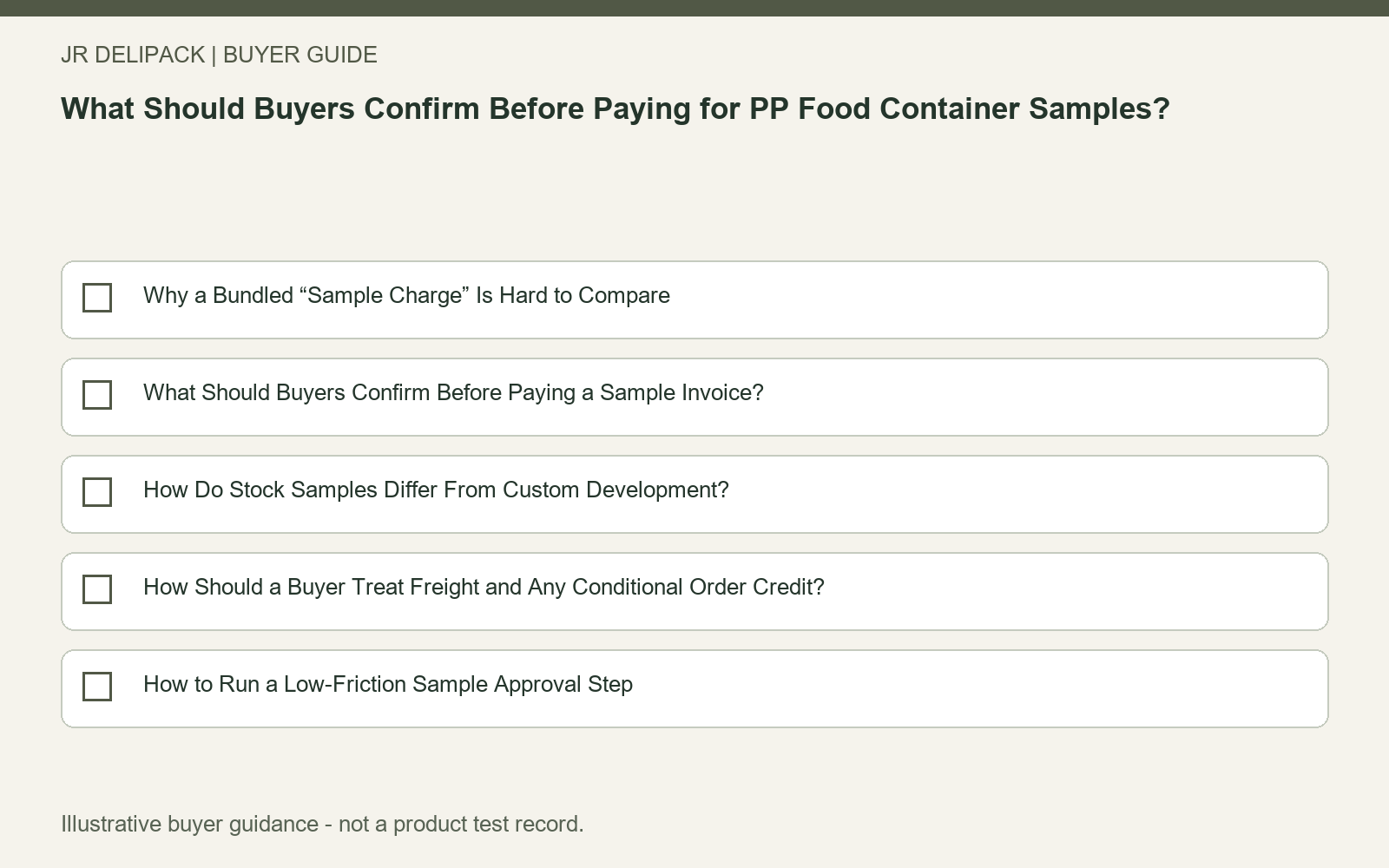
Before paying for PP food container samples, separate the quotation into four written lines: the physical sample cost, any custom development or tooling charge, the freight arrangement, and whether either charge is later credited against an order. Ask the supplier to state each item, amount and condition on the quotation, so the commercial basis is visible rather than assumed.
Why a Bundled “Sample Charge” Is Hard to Compare
A single line reading only “sample charge” can combine picking, packing, trial-run effort, courier arrangement and administration. That bundling matters because a buyer can accept the total yet still be surprised by what happens to the fee if the order does not proceed, or by what the written amount actually covers.
Separating the components does not require complicated paperwork. It requires the supplier to name the item, state the amount in the quoted currency, and show the condition attached to it. The U.S. International Trade Administration notes that a pro forma quotation can identify goods, quantities, specifications and price before shipment. Applied here, that is a simple prompt: put the agreed sample scope in writing and keep it with your working file. This citation is U.S. exporter guidance, not Chinese law; check shipment-specific requirements with your importer or freight forwarder.
What Should Buyers Confirm Before Paying a Sample Invoice?
Work through the quotation in four blocks. First, identify whether the requested item is selected from an existing mould range or depends on new development; the two are funded and scheduled differently. Second, locate the freight line: who chooses the courier, who is the consignee, and what happens if a destination charge appears after the invoice is paid. Third, read every condition attached to the credit, especially the trigger event and the time window. Fourth, confirm the sample ownership and reuse position in writing — the practical question for a distributor or brand owner.
Sample quotation comparison: what to look for
| Line item | Ask the supplier | What a workable answer looks like |
|---|---|---|
| Physical sample cost | Does the fee cover the item only, or also handling? | The quotation identifies what the fee covers. |
| Development charge | Does it depend on an existing mould or new tooling? | The trigger and scope of the development work are stated on the quotation. |
| Freight | Is freight prepaid, collect or estimated? | The paying party and the service level are named in writing. |
| Order credit | What order value or date activates the credit? | The condition appears on the quotation, not agreed verbally only. |
| Validity | How long does the quotation hold? | An explicit expiry date appears on the document. |
How Do Stock Samples Differ From Custom Development?
A stock sample is drawn from moulds a supplier already holds. JR DELIPACK’s public product pages show a broad PP food container range, including square and rectangular containers, round bowls, soup cups and hinged sauce cups, and the brand facts list “Existing mould selection” as a capability — which makes a stock sample mainly a picking, packing and shipping exercise.
Custom development is different in kind. Choosing a non-standard capacity, changing a wall profile, adding print, matching a lid set, or configuring an outer carton each introduces a step that is not simply inventory retrieval. When a supplier groups both under one “sample charge,” you lose the ability to compare quotations or to decide which one you are actually funding. A useful habit is to ask for the sample description to state the code or family reference and to say whether the item exists as a mould or requires development. If the answer is development, ask what the charge covers before you approve it.
This is also where pricing conversations often go off track. A buyer may assume the PP food container sample charges sit against an eventual production order, while the supplier treats the fee as a project cost. Neither reading is wrong on its own; the problem is that the assumption was never written down.
How Should a Buyer Treat Freight and Any Conditional Order Credit?
Freight is the line most easily left ambiguous. A product may be supplied without charge while freight remains payable, and a buyer who reads “free sample” as “delivered free” will be surprised at delivery. Ask three questions before approving: which courier and service are used, how the shipment is billed, and what the supplier needs from you as receiver. If your own courier account is used, confirm that the supplier will pack to the dimension and weight that account expects.
Conditional order credit needs the same precision. Useful wording names the trigger, the amount, the time limit and the exclusion. For example, a quotation might state that the sample cost is credited against an order above a stated value placed before a stated date, with a note about whether the credit applies to the product line or only to the same model. Ask the supplier to confirm the credit in writing if it was only discussed verbally. A dated quotation condition is workable; a verbal promise with no date is not.
Quick pre-payment checklist
- Sample code, nominal capacity and material stated in writing.
- Development or tooling charge shown as its own line, with scope.
- Freight line names the payer and the service level.
- Order credit trigger and time window stated on the quotation.
- Quotation validity date present.
- Currency and payment channel confirmed before transfer.
How to Run a Low-Friction Sample Approval Step
A short written approval before payment prevents most misunderstandings. Send one message that lists the sample reference, the total amount, what the amount includes, and the date by which you expect the shipment to be arranged. Keep the supplier’s reply with the quotation so the record shows what both sides accepted.
If you are working with a specific supplier, look at how it describes its own quality and specification process before committing money. JR DELIPACK publishes pages covering PP food containers and related product families and a factory and quality overview, which are the right places to check a supplier’s own stated approach. When you are ready, a short enquiry through the contact page listing your sample reference, intended market and expected order timing is usually enough to get a written quotation back.
FAQ
Can a free sample still involve a freight charge?
Yes. A product may be offered without charge while the shipping cost remains payable by the buyer. Ask for the freight arrangement to be stated before you approve, rather than assuming a zero product price means zero delivered cost.
Should I pay a development charge before seeing a sample?
Development charges usually relate to setup work that happens before a finished sample exists, so they are commonly handled at the start of a project. Before paying, ask the supplier to describe in writing what the charge covers and what you will receive at the end of that step.
What makes a sample credit condition workable in practice?
Precision. The quotation should state the trigger, the amount, the deadline and any exclusion. A credit condition with a date and an order threshold is much easier to apply later than a general promise that the sample cost will be “taken into account.”
Does a sample quotation need an expiry date?
It should. A validity date tells both parties how long the quoted figures hold, which is useful when your own approval process takes time. If no date appears, ask for one before payment.
Sources
- U.S. International Trade Administration, Common Export Documents — describes the pro forma quotation as identifying goods, quantities, specifications and price before shipment; this is U.S. exporter guidance, not Chinese law: trade.gov/common-export-documents
- JR DELIPACK product and capability information: https://jrdelipack.com/products/
- JR DELIPACK factory and quality overview: https://jrdelipack.com/factory-quality/
If you would like a sample quotation checked against this checklist, send the reference, quantity and destination to JR DELIPACK through the contact page and ask for the four cost lines to be separated.