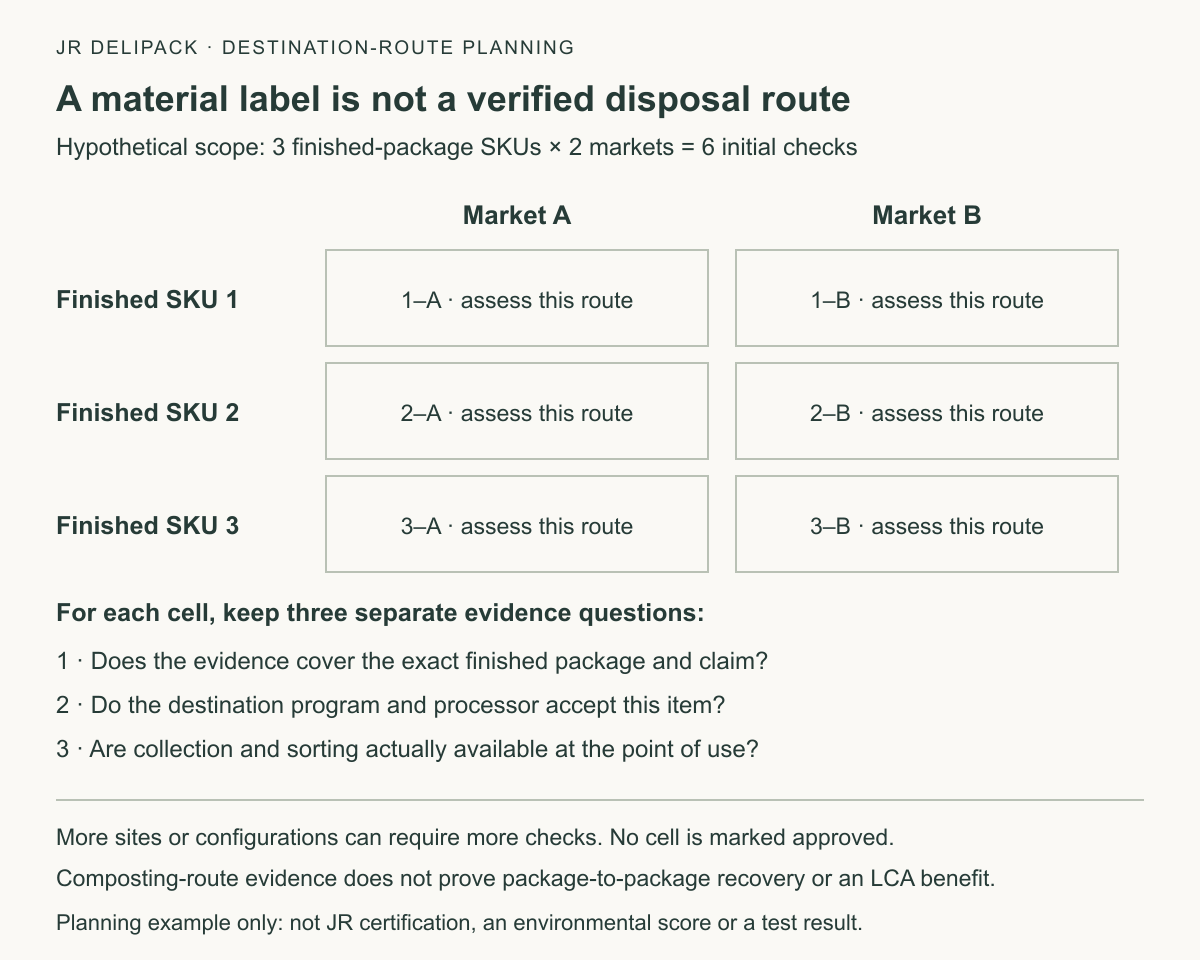
Before buying compostable food containers, verify each finished package and destination route separately: in an explicitly hypothetical purchase of 3 SKUs for 2 markets, that means 6 initial product–market checks (3 × 2), not one brand-wide approval. This is a planning calculation, not a required sample size or environmental result. Different sites, processors or configurations can require additional checks.
The practical question is not simply “Is this container compostable?” It is: “Can this exact finished package be collected in the intended food-service setting, accepted by the receiving program, and processed under conditions supported by the evidence?” Those are separate checks. A material name, a resin or fiber label, or a certificate viewed without its scope cannot answer all three.
JR DELIPACK is operated by Dongguan JR Delipack Packaging Co., Ltd. The company currently supplies PP, PLA, and paper-based foodservice packaging. Availability, material, structure, dimensions, and documentation must be confirmed for the specific product being quoted. A general statement about a material family is not a representation that every JR DELIPACK product is compostable, recyclable, certified, or accepted in a particular destination.
Why does a compostable label not establish a closed loop?
This guide evaluates a composting route, not a demonstrated package-to-package recycling loop. Confirming collection and composting does not show that a discarded container becomes another container, or establish a measured environmental benefit. Keep those broader claims separate from the narrower purchasing decision: whether the exact finished item has suitable evidence and an available, accepted destination route.
Composting is a managed biological process. The U.S. Environmental Protection Agency explains that moisture, oxygen, temperature and feedstock matter; accepted inputs differ between facilities. Its composting overview is process context, not evidence that a particular JR product is accepted. 1: EPA composting overview (reference details).
That variability matters to a restaurant, caterer, distributor, or packaging buyer. A package may be designed and tested for an industrial composting process, but the customer’s local organics collection may not accept it. A hauler may exclude foodservice ware even where food scraps are collected. A facility may accept certain certified items but reject look-alike conventional plastic. The name of the material alone cannot establish the operating route.
Evaluate the handoffs rather than adopting “closed loop” as a broad sustainability adjective. If product scope, user sorting, collection or processor acceptance is missing, identify that gap. Even when all are documented, describe the verified route rather than promising a package-to-package loop or a quantified environmental improvement.
What are the 3 checks to complete before approving a claim?
1. Verify the exact finished package, not only its base material
Start with the saleable item as used: container, lid, label, coating, ink, adhesive, and any other component that remains attached during disposal. Ask the supplier to identify the exact SKU and the exact configuration covered by its report or certification. If the lid is separate, the buyer should verify whether it is part of the assessed system or needs its own evidence.
For U.S. marketing, the FTC Green Guides address scientific support for an item’s safe, timely conversion into usable compost and qualifications concerning home composting and limited facility availability. Review the actual claim and its audience against the relevant provisions; a product label alone does not establish compliance. 2: 16 CFR 260.7, compostable claims (reference details).
Use the source as a checklist, not as a shortcut to a legal conclusion. Record the exact product name, model, configuration, intended process, applicable test method, report date, issuer, and any conditions or exclusions. Confirm that the supporting document refers to the product being purchased—not simply to a resin, raw material, factory, or another product with a similar name.
Ask whether the certificate or test report covers the complete package or only a component. Check the validity period and scope against the exact item. If the document is not public, ask the supplier to confirm the applicable scope in writing and provide the relevant document through an appropriate private business channel. Do not publish confidential factory records, customer-specific documents, or a certificate image stripped of its scope.
Do not convert a limited test statement into broader claims such as “home compostable,” “biodegrades anywhere,” “leaves no residue,” or “accepted nationwide.” Each adds conditions that need its own substantiation. The FTC specifically states that third-party certification does not remove the marketer’s substantiation responsibility. 3: 16 CFR 260.6(c), certification scope (reference details).
2. Confirm the destination program and processor accept the item
Identify where the package will be used and discarded: the specific facility or service area, not just the country. Ask the local authority, hauler, or processor whether it accepts the exact type of foodservice ware, including the relevant material and form. “Organics collected here” is not the same as “this container is accepted here.”
EPA’s backyard-composting guidance lists compostable foodservice ware and bags among materials to avoid in a home pile. It directs readers to confirm commercial-facility acceptance. This general guidance does not verify the performance of a particular package. 4: EPA composting at home, materials to avoid (reference details).
EPA’s foodservice-ware purchasing guidance recommends commercially compostable products only with a locally available program accepting those product types and arranged hauling. It also addresses clear sorting instructions. This federal-purchasing guidance is useful context, not a universal obligation imposed on every private buyer. 5: EPA foodservice-ware procurement, second-choice conditions (reference details).
For each destination, document the answer, who supplied it, and when it was checked. Useful evidence may include an accepted-material list from the processor, written confirmation from the hauler, service-area instructions, or a contract specification. A general municipal composting page is weaker evidence if it does not identify whether foodservice packaging is accepted.
Ask about contamination rules and exceptions. Does the program require a particular certification mark? Are lids, labels, or coated paper excluded? Must food residue be removed? Are compostable plastics accepted only at a named facility? Can the collector identify and route the material correctly? If the answer is “not sure,” do not present acceptance as confirmed.
3. Make collection and sorting workable at the point of use
Even an accepted package cannot follow the intended route if staff or customers cannot distinguish it from other items or if the site has no collection service. Map the last-use point: dining room, takeaway counter, event, institutional kitchen, or customer home. Then identify who supplies the bin, who empties it, where the material goes, and how the collector avoids mixing incompatible streams.
Before launch, write a one-page operating instruction covering the accepted items, prohibited look-alikes, food-scrap handling, lid treatment, bin labels, collection frequency, and escalation contact. Have the processor or hauler review the language when possible. Use product names or clear descriptions rather than a vague green leaf symbol that can be mistaken for universal environmental approval.
Run a small operational check before making a broad public claim. For example, a site can review a week of collection records as an internal pilot, but the one-week duration is a buyer-selected example—not an EPA or FTC threshold. Count the packages delivered to each stream, record contamination or rejected loads, and ask the hauler whether the material reached the intended facility. Do not turn a pilot at one location into a claim about every site or customer.
Define what would trigger a pause: the facility changes its acceptance list, the hauler stops collecting the material, the package configuration changes, or the processor reports repeated contamination. Assign an owner and a review date. A purchasing decision should be revisited when the SKU, destination, collection contract, or processing route changes.
How can a buyer build a document trail that can be audited?
The purpose of a verification file is to let another person reproduce the decision. Keep one row per product configuration and destination route, rather than combining every material and market in a single “sustainable packaging” folder.
| Record field | What to capture |
|---|---|
| Buyer and site | Operating location and the person responsible for waste service |
| Product | Supplier, exact SKU, container and lid configuration, and revision |
| Claim | The precise wording proposed for packaging, website, or sales material |
| Product evidence | Test or certification issuer, identifier, date, scope, and exclusions |
| Collection | Hauler or program, accepted-material confirmation, and date checked |
| Processing | Receiving facility, accepted item description, and route confirmation |
| Operations | Bin label, staff instruction, contamination response, and collection frequency |
| Review | Owner, next review date, and events that require an earlier recheck |
Keep source records beside the row they support. A certificate for one container should not be copied into a general folder and then treated as covering every lid, coating, or brand configuration. If a document is confidential, store it in the buyer’s controlled procurement system and retain only a non-sensitive reference in any public article.
For a multi-site buyer, distinguish the corporate standard from site readiness. A company may choose one preferred material family, but individual sites can have different haulers and processors. An evidence file should show which sites have a verified route and which remain pending. Do not state that an entire chain has a composting route when only selected locations have been checked.
Use a staged evidence review
An efficient review can be completed in four passes. Pass one is identity: match supplier, SKU, component list, and revision across the quotation, product drawing, sample label, and evidence document. Pass two is claim scope: write down exactly what the document supports and what it does not mention. Pass three is local route: obtain acceptance information from the actual program and processor. Pass four is implementation: confirm bins, signs, staff instructions, hauling, and a date to recheck. A buyer may complete all four in one meeting, but the four questions should not be merged into one unchecked “green” field.
For each record, use a status with a defined meaning. “Verified” means the cited document or responsible party answers the exact question. “Pending” means a request has been sent but no sufficient answer has arrived. “Not accepted” means the responsible program has declined the item. “Out of scope” means that a document or check refers to a different product, site, or market. Avoid a single yes/no value when several independent facts are being reviewed; that format hides which part of the route is incomplete.
Preserve the original evidence version and the date reviewed. If a supplier later changes a lid, coating, adhesive, or manufacturing specification, compare the new configuration with the scope of the old record rather than assuming the old certificate still applies. The same applies when the customer switches haulers or the composting facility updates its accepted-material rules. Record the revision that triggered the review and whether the buyer needs a new supplier statement, test, or facility confirmation.
Separate marketing copy from disposal instructions
Marketing language and staff instructions solve different problems. A short front-of-pack claim may need a qualification explaining the process or limited availability. A back-of-house instruction must tell staff which bin to use, what to do with lids, and what items are rejected by the local service. A website FAQ can link to a local program, but it should not imply that every reader’s municipality offers the same collection.
Read the qualification beside the claim, not in isolation on a separate policy page. The FTC’s general principles address understandable, prominent qualifications, precise product-versus-package scope and substantiated comparisons. Apply that review to the complete presentation, including imagery. 6: 16 CFR 260.3, general principles (reference details).
An appropriate qualified statement should match the evidence and destination. A buyer can draft a provisional sentence such as “Designed for commercial composting where accepted; check local program requirements,” but should use it only if the product evidence supports the design statement and the qualification is clear in context. If a product is not accepted in the target service area, the wording should not suggest that local composting is available. Have legal counsel review claims where the consequences or applicable law require it.
Record evidence strength without turning it into a fake score
Do not assign a product a numerical “circularity score” merely because the buyer has collected several documents. Instead, record the status of each link separately: product identity matched, test scope matched, claim wording reviewed, local acceptance confirmed, collection available, and sorting instructions in place. A count of completed fields can help a team see remaining tasks, but it is not a measurement of environmental benefit.
For example, a buyer could have 5 of 6 administrative fields filled while the most important unresolved field—facility acceptance—is still blank. Reporting “83% verified” would make that incomplete route look more conclusive than it is. The arithmetic is correct only for the form fields, not for compostability, environmental performance, or the share of material actually recovered. Use plain status labels for the important evidence questions and explain the remaining uncertainty.
Where a company wants to report results, define the numerator and denominator first. “Packages collected” differs from “packages accepted by a processor”; both differ from “usable compost produced.” A site pilot can record package counts or rejected loads, but those operational records do not by themselves establish a life-cycle comparison or prove net environmental benefit. For a public outcome claim, use a method appropriate to the claim and link the supporting study or official data directly beside the statement.
Which common mistakes break the evidence chain?
Treating a material name as an end-of-life instruction
“PLA,” “plant-based,” or “paper-based” describes only part of the product story. The term does not answer whether the whole package is certified for the intended process, whether a facility accepts it, or whether collection is available. State only the scope supported by the relevant document and local program.
Saying “compostable” without a qualifying context
Review home-composting and facility-availability qualifications under the actual U.S. claim provisions. Have qualified counsel review market-specific advertising where legal interpretation is needed; this guide is a purchasing framework, not a product certification or legal opinion. 2: 16 CFR 260.7(c)–(d)
Assuming food scraps collection includes packaging
An organics program may collect food but reject packaging. EPA’s purchasing guidance expressly notes that some commercial facilities exclude compostable products. Confirm the exact item with the intended receiver before adding it to a collection stream. 5: EPA foodservice-ware procurement
Confusing a pilot result with a general performance claim
A clean result at one restaurant does not establish performance at another site with different staff, service provider, contamination rules, or package mix. Describe the pilot population and period. Do not extrapolate a one-location observation into a nationwide acceptance or diversion percentage.
A practical go / conditional / stop decision
Use “go” only when the exact finished product’s evidence is in scope, the destination program confirms acceptance, and collection and sorting instructions are operational. Keep a record of who confirmed each link and on what date.
Use “conditional” when product evidence exists but local collection or processor acceptance is not yet confirmed. The next action is to identify the missing party and request a written answer. Until then, any public description should state the limitation plainly; do not imply that a complete recovery route already exists.
Use “stop” when the documentation refers to a different SKU, the destination facility rejects the item, or the site cannot keep it out of incompatible streams. Choose another package or waste route, or revisit the decision after the conditions change. This is a purchasing control, not a claim that one material is always better than another.
The decision is intentionally specific. A package can have a credible technical test and still lack an available route. Conversely, a local collection program cannot make an unsupported product claim true. Both the product evidence and the actual destination pathway matter.
What this means when requesting a packaging quotation
When asking a supplier about a material or environmental claim, include the intended destination, use conditions, exact product format, separate-lid or attached-lid preference, approximate quantity, and the documentation you need to review. Ask which documents apply to the quoted configuration and which details must be confirmed for a particular market. Avoid requesting a broad “eco certificate” without naming the question the document must answer.
JR DELIPACK’s product range includes PP, PLA, and paper-based foodservice packaging. Product-level claims and available documents should be confirmed against the selected SKU and destination. Buyers can review the product range, the quality information, the focused material-scope disclosure guide, and contact JR DELIPACK with the model, quantity, destination, and requested evidence. The broader disposal-reality guide covers the local route comparison. These links provide product and enquiry context; they do not replace local acceptance confirmation or a product-specific certificate.
Frequently asked questions
Does a compostability certificate mean my local hauler will collect the container?
No. A certificate or test addresses product evidence within its scope. Ask the hauler and receiving facility whether they accept the exact item in the intended service area, and record the response.
Can I put commercially compostable foodservice ware in a backyard compost pile?
Do not assume so. EPA lists those items among materials to avoid in backyard composting and advises checking commercial-facility acceptance. Follow product-specific directions and the actual destination program. 4: EPA composting at home
Is a PLA container automatically accepted in a food-scrap program?
No. Confirm the exact finished package and the local program’s accepted-material list. Material identity alone does not establish processor compatibility or collection availability.
What should a distributor request from a supplier?
Request the exact SKU and configuration, the evidence document’s scope and date, known exclusions, and written clarification for the destination market. Keep confidential documents in a controlled business channel rather than reproducing them publicly.
What if the local facility’s answer is unclear?
Mark the route as unverified. Ask the hauler or facility for written clarification, including whether lids and foodservice ware are accepted. Until confirmed, avoid statements that the item is locally compostable or part of a closed loop.
Does this guide certify any JR DELIPACK product as compostable?
No. This is a buyer verification framework. Product claims, certification scope, and destination acceptance must be checked for the particular SKU and market. JR DELIPACK supplies multiple packaging material families, and one statement should not be generalized to every product.
Conclusion
A credible compostability decision joins three records: evidence for the complete package, acceptance by the destination processor, and an operating collection-and-sorting route. If a buyer is comparing 3 SKUs in 2 markets, the illustrative minimum is 6 separate product–market checks; real programs may require additional site or configuration checks. That count is a planning aid, not a performance result.
Use precise, qualified language, preserve the source documents, and repeat the check when the product or destination changes. A product claim should tell a buyer what has been demonstrated—and where the remaining uncertainty lies—rather than promise an end-of-life outcome that has not been verified.
References
- U.S. EPA, Composting: process and accepted feedstocks. Page updated 18 May 2026; reviewed 6 October 2026. Back to citation.
- FTC Green Guides, 16 CFR 260.7: compostable claims. Section publication date not provided in this view; title-level currency displayed as 5 October 2026, not this section’s amendment date. Reviewed 8 October 2026. Back to citation.
- FTC Green Guides, 16 CFR 260.6: certifications and seals. Section publication date not provided in this view; title-level currency displayed as 5 October 2026, not this section’s amendment date. Reviewed 8 October 2026. Back to citation.
- U.S. EPA, Composting at Home: materials to avoid. Page updated 8 December 2025; reviewed 6 October 2026. Back to citation.
- U.S. EPA, Identifying Sustainable Food Service and Food Service Ware. Page updated 5 October 2026; reviewed 8 October 2026. Back to citation.
- FTC Green Guides, 16 CFR 260.3: qualifications, scope and comparisons. Section publication date not provided in this view; title-level currency displayed as 2 October 2026, not this section’s amendment date. Reviewed 8 October 2026. Back to citation.
KEEP READING
“Compostable Food Containers Are Not a Closed-Loop Solution Without Proper Disposal Infrastructure”的3个回复