
Check a supplier’s food-contact evidence against 3 elements: the substance’s identity, its specifications and the limits of its permitted use, rather than accepting an “FDA certificate” label alone. FDA identifies these three elements when explaining how to review an authorization. The review concerns the actual packaging you intend to buy, not an unrestricted approval of a supplier’s catalogue. 1: FDA component review guidance (reference details).
For a distributor comparing China packaging suppliers, the useful question is which evidence supports the exact base, lid and proposed food-contact application. A polished document may answer part of that question. It may also describe another configuration. Begin with a precise purchasing brief so that the supplier, laboratory and responsible technical reviewer are all assessing the same request.
This guide concerns U.S. food-contact evidence. If the goods will be marketed in the Philippines or another destination, confirm that market’s requirements separately with the responsible importer and qualified adviser. A U.S. reference is not a complete destination-market approval. The workflow below is a suggested purchasing method, not a prescribed regulatory test or a certification service.
What question should replace a request for an FDA certificate?
Ask the supplier to identify the applicable basis for the intended use and explain how the delivered product maps to it. FDA’s component guidance describes several possible bases, including relevant regulations, GRAS status, prior sanctions, threshold exemptions and effective food-contact notifications. Different bases have different conditions; do not insist that every legitimate material must have the same type of document. 1: FDA component review guidance
Frame the request around a product reference and revision. State whether the order includes only a base, a complete base-and-lid set, printing, labels or other components. Ask which claimed uses are supported and which remain to be assessed. An answer that lists a regulation without connecting it to the proposed configuration needs clarification before it becomes purchasing evidence.
Keep the commercial discussion separate from the technical decision. A supplier can quote a price while an application remains under review. Equally, a well-documented product may not suit the order quantity, packing or delivery requirement. Recording these as separate decisions prevents a good price from being mistaken for a satisfactory compliance assessment.
Match the packaging configuration before comparing documents
Create a short specification record covering the selected model, dimensions, base and lid materials, colour, decoration and intended application. Use identifiable supplier references rather than a photograph caption such as large lunch box. Record the revision of drawings or specifications so that later changes can be distinguished from the item initially reviewed.
Ask which components are covered by each supporting file. A document about a base should not silently become a statement about an optional lid, ink or adhesive. Where the supplier proposes alternatives, keep them as separate configurations until the reviewer has mapped the evidence. Avoid making a single folder called approved packaging do the work of a product-specific decision. If the proposed programme includes a compostability claim, request finished-package material-scope disclosure in addition to the food-contact review.
Describe the actual handling sequence in the enquiry: filling, storage, transport and any intended heating. FDA’s notification reference tables distinguish food types and conditions of use, including storage without thermal treatment and foods reheated in their containers. Those categories help explain why an application must be specified; they are not instructions to conduct a kitchen safety test. 2: FDA food types and use conditions (reference details).
For the narrower reheating question, use the microwave-use verification guide. Keep that assessment separate from the document-authenticity check here. Knowing that a report is genuine does not identify every use the finished package can support.
Distinguish the regulatory routes instead of treating them alike
When a supplier cites a provision in the Code of Federal Regulations, follow the specific provision and review its scope. FDA’s inventory identifies substances and relevant regulations, but also includes prohibited substances. A search result in the inventory therefore needs interpretation; presence in a database is not a positive decision for every application. 3: FDA inventory and scope notes (reference details).
A Food Contact Substance Notification, or FCN, requires particular attention to the identified manufacturer or supplier. FDA explains that buyers can rely on an effective notification for material obtained from the identified source, within the notified use and limitations. Do not assume that an unrelated source is covered merely because its substance sounds identical. 4: FDA effective notification inventory (reference details).
Do not extend that source restriction indiscriminately to every other route. FDA separately explains that a Threshold of Regulation exemption can be used by any manufacturer or supplier for its specified use and conditions. The reviewer must identify the actual basis before deciding which source and scope checks apply. 5: FDA authorization pathways (reference details).
Record the answer in plain language alongside the citation. Identify the proposed material, the relied-on reference, the supported application and any unresolved correspondence. Send uncertain interpretations to a competent regulatory reviewer. A purchasing team should not convert a keyword match into a legal conclusion or invent a missing authorization number.
What can a manufacturer letter of guaranty establish?
FDA describes a manufacturer-supplied letter of guaranty and links the relevant legal basis and suggested forms. That is different from treating a supplier’s letter as an FDA-issued certificate. Review who makes the statement and which product and use it addresses; obtain qualified advice on its legal effect when needed. 6: FDA letter of guaranty guidance (reference details).
For the purchasing file, ask for a dated statement that clearly identifies the supplied article or specification and the intended application. Keep the statement connected to the supporting material rather than copying its conclusion into a general sales presentation. If its product reference differs from the quotation, resolve that mismatch before relying on it for the order.
Agree how changes will be communicated. A later switch of material, component or manufacturing source may require a fresh review rather than reuse of the original letter. Preserve earlier versions so that a future inquiry can be answered against the product actually supplied at the time, not only the latest document in the folder.
How should a buyer check an SGS report?
Use the issuer’s own verification route. SGS offers a service for checking SGS-branded documents and asks users to submit the document for verification. Choose a process that you are authorised to use with the document owner; do not publish confidential reports or source-factory records as part of a marketing article. 7: SGS document verification service (reference details).
SGS’s detailed guidance distinguishes reports from management-system or process certificates. For report verification it calls for a complete document, not just a report number. It also explains that some inconclusive automated results need manual verification. An incomplete lookup is not, by itself, proof of forgery. 8: SGS report and certificate verification guidance (reference details).
After authenticity is addressed, examine applicability as a separate question. Compare the sample description, referenced specification, tested conditions and reported conclusions with the selected packaging. Record precisely which claim the document supports. Do not turn an authentic file into a catalogue-wide statement, and do not replace the actual findings with a logo or a cropped result.
If full disclosure is commercially sensitive, agree an appropriate confidential review between the authorised parties. The practical requirement is a traceable basis for the decision, not unrestricted public access to every upstream record. Where adequate verification cannot be arranged, keep the relevant claim unresolved and consider another supported option.
Reconcile supplier roles without demanding identical company names
Identify the entity issuing the quotation, the party supplying the goods and the manufacturer relevant to the evidence. Different names should prompt a written explanation of the relationship, not an automatic accusation. Conversely, similar names or matching logos do not establish that a document covers the proposed source and specification.
Keep a private relationship record linked to the order. Where an FCN is the relied-on basis, connect the relevant material supply to the identified source. For other evidence, ask the reviewer what relationship must be established. Do not substitute a factory tour, company profile or manufacturing-history statement for the product evidence itself.
Use the minimum necessary information for public communication. Customer-facing summaries can state the verified product scope and document availability without exposing protected source-factory identities, addresses, certificates or partner imagery. Give confidential reviewers sufficient context through the agreed channel, while keeping the public website focused on supported purchasing information.
A worked example of document reconciliation
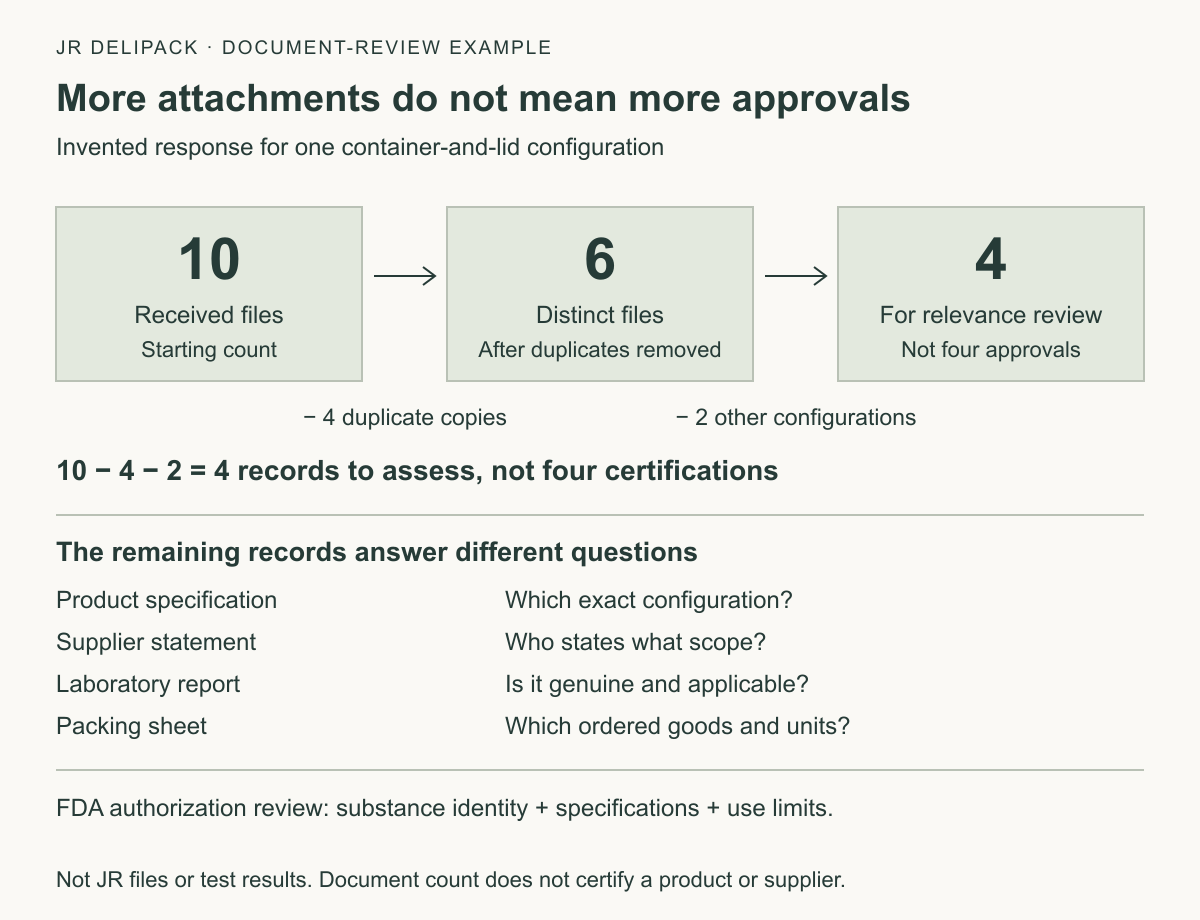
Consider a hypothetical supplier response containing ten attachments for one proposed container-and-lid configuration. Four are duplicate copies, leaving six distinct files. Two of those six describe a different configuration, leaving four files for further relevance review. The calculation is 10 minus 4 minus 2 equals 4; it measures file sorting, not four approvals or four successful product tests.
Suppose the four remaining files comprise a product specification, a supplier statement, a laboratory report and a packing sheet. They answer different questions. The packing sheet may help receiving staff identify the ordered goods, while the laboratory report requires a separate scope assessment. Counting them equally as certificates would conceal rather than clarify the evidence.
Now suppose a revised lid is offered after the quotation. Do not simply add its photograph as an eleventh attachment and retain the earlier conclusion. Identify which of the four relevant records need remapping, which still apply unchanged and which questions are newly open. The useful output is a controlled decision for the revised configuration, not a larger file count.
This approach also makes supplier comparisons clearer. Compare the same required answers across offers, distinguishing confirmed, awaiting clarification and not applicable. A supplier with fewer well-matched records can be easier to evaluate than one with many duplicates. Neither document volume nor response speed establishes product conformity; preserve the reasoning behind each assessment.
Use a document register that another reviewer can follow
Maintain one register for the selected configuration, with an entry for each relevant record. Separate the issuer’s document reference from your internal filename. A renamed PDF should not appear to be a new technical revision. Keep the original received file and record where subsequent clarifications are stored.
| Field | Purchasing record |
|---|---|
| Product | Exact base, lid and specification revision |
| Intended use | Food application and documented handling conditions |
| Evidence | Issuer, record reference, date and version |
| Authenticity | Verification route and actual response |
| Applicability | Matching scope, exclusions and open questions |
| Decision | Responsible reviewer, limited conclusion and date |
| Change control | Events requiring another review |
Write unresolved questions so that the recipient can answer them. Replace “certificate unclear” with a specific mismatch, such as a different lid reference or an application absent from the supplied statement. Link the question to the document version reviewed. This reduces circular exchanges in which the supplier repeatedly sends the same irrelevant file.
Do not invent expiry dates for records that state none. Record the date actually shown, any stated validity, and the reason the file remains relevant to the current specification. Ask about material or process changes since issuance. A document’s age and its applicability are related review questions, not interchangeable labels.
Connect the decision to samples and the purchase order
Request samples against the same identifiable specification used for the quotation and document review. Agree what any operational evaluation is intended to demonstrate, how observations will be recorded and who interprets them. A sample that looks satisfactory does not close an unrelated gap in the supporting regulatory evidence.
Keep physical performance questions distinct. Fit, closure consistency and observed leakage belong in a defined evaluation with stated conditions; they are not substitutes for a food-contact assessment. The lid-fit purchasing checklist can support that separate work. Do not present a restaurant demonstration as an independent laboratory clearance.
In the purchase order, reference the selected specification, component pairing, agreed documents and change-notification responsibilities. Confirm packing and delivery terms in their own fields. The sample quotation checklist and quotation-scope guide address those commercial details without deciding whether a technical report is applicable.
At receiving, reconcile delivered references and agreed lot information with the order. Escalate discrepancies before distributing stock across multiple customers or locations. Retain the purchasing decision and its limits so that downstream descriptions do not become broader than the evidence reviewed. A reorder should refer back to the supported configuration, not only its old unit price.
When should purchasing proceed or stay pending?
Proceed with the relevant purchasing approval only when the responsible reviewer has resolved the product, source and application questions needed for that decision. State the approved configuration and any restrictions in the handover. Avoid an unrestricted approved-supplier label that could be interpreted as covering later products without review.
Keep a configuration pending when an issuer response, source mapping or use limitation remains unresolved. Name the missing answer and the person responsible for obtaining it. Other independently supported configurations can continue through their own review. This allows procurement to make progress without disguising a gap in the item still under consideration.
Seek an alternative when the required support cannot be established or the proposed use falls outside it. Record a factual reason rather than an allegation about the supplier’s nationality or motives. The purpose is a defensible buying decision, not a public judgment based on an unsuccessful search or an unexplained document mismatch.
Prepare a focused enquiry for JR DELIPACK
JR DELIPACK supplies PP, PLA and paper-based foodservice packaging with supply and manufacturing support. Review the product range and factory and quality information as the starting point for a product-specific enquiry. These pages do not establish that every document applies to every model or destination.
Contact JR DELIPACK with the selected format, base and lid requirements, proposed food application, quantity and destination. Identify the evidence question you need answered and any relevant specification. Applicable records and availability must be confirmed for the proposed order. Place this step within the B2B container sourcing guide rather than treating it as a replacement for the full purchasing process.
Frequently asked questions
Does an FDA reference approve the supplier’s whole range?
No such conclusion follows from a reference alone. Identify the actual regulatory basis and connect it to the selected product and intended use. A limited statement should not be extended to every lid, colour, decoration or future specification offered by the supplier.
Can another manufacturer rely on an existing FCN?
Check the identified manufacturer or supplier and the material’s actual source. FDA explains when purchasers can rely on the effective notification and its limitations. Do not assume that an unrelated source is covered merely because it uses the same substance name. 4: FDA effective notification inventory
Does a genuine SGS report settle product suitability?
Authenticity is only one part of the review. Compare the report’s sample and conditions with the packaging and application being proposed. Keep the limited result separate from a wider claim, and have unresolved applicability questions assessed by an appropriately qualified reviewer.
Must the seller and manufacturer always have identical names?
Treat different names as a relationship to reconcile, not automatic proof of a problem. Obtain a clear explanation and the evidence needed for the particular authorization or document relied upon. Keep sensitive upstream information within the authorised private review process.
Do ten attachments provide more assurance than four?
Not by file count alone. Remove duplicates, separate unmatched configurations and identify what each remaining record actually answers. In the hypothetical example above, four files remain for review; that does not mean four certifications, four passing tests or a complete approval.
Does this U.S. evidence replace Philippine import requirements?
Do not treat it as a complete destination-market decision. Identify where the packaging will be marketed and obtain the applicable assessment from the responsible importer and qualified adviser. Keep that determination separate from checking the authenticity and scope of a U.S.-oriented document.
References
- FDA, component regulatory-status guidance. Three-part authorization review and possible regulatory bases. Publication date not displayed in the reviewed page. Reviewed 6 October 2026. Back to citation.
- FDA, food-type and use-condition reference tables. Notification reference categories, not a finished-product approval. Publication date not displayed. Reviewed 6 October 2026. Back to citation.
- FDA, 21 CFR food-contact inventory. Inventory scope and prohibited-substance warning. Publication date not displayed. Reviewed 6 October 2026. Back to citation.
- FDA, effective food-contact notification inventory. Identified source and use limitations. The page also carries a 21 March 2024 rule notice; that is not the publication date of an individual notification. Reviewed 6 October 2026. Back to citation.
- FDA, food-contact authorization pathways. Threshold-exemption scope. Publication date not displayed. Reviewed 6 October 2026. Back to citation.
- FDA, manufacturer letter of guaranty. Page dated December 2007. Reviewed 6 October 2026. Back to citation.
- SGS, official document verification service. Service description and submission route, not verification of any particular JR document. Publication date not displayed. Reviewed 6 October 2026. Back to citation.
- SGS TIC Mall, report and certificate verification FAQ, 11 March 2026. Report completeness, certificate lookup and manual-review distinctions. Reviewed 6 October 2026. Back to citation.
KEEP READING
“The FDA Certificate Trap: Verify China Food Packaging Compliance”的一个回复