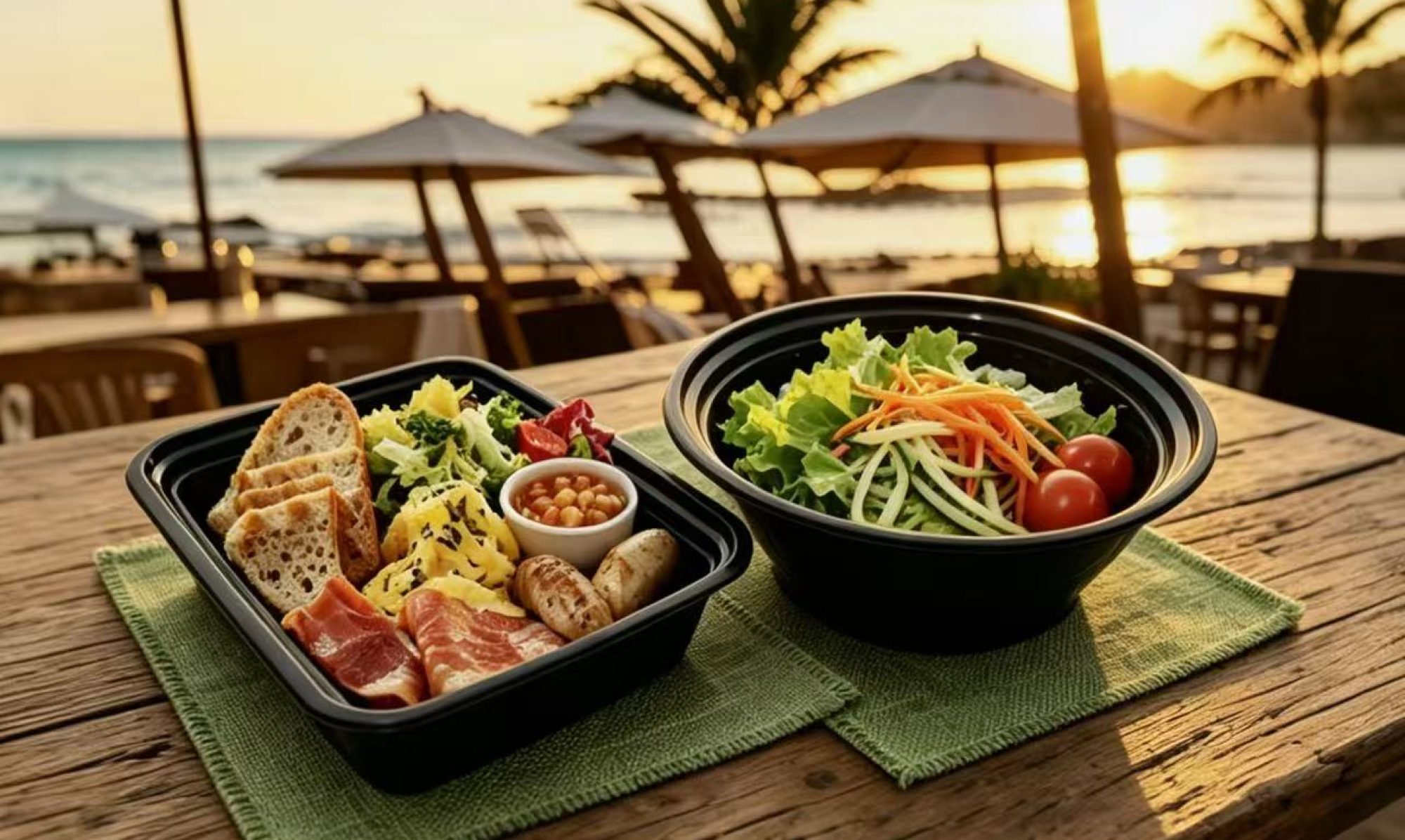
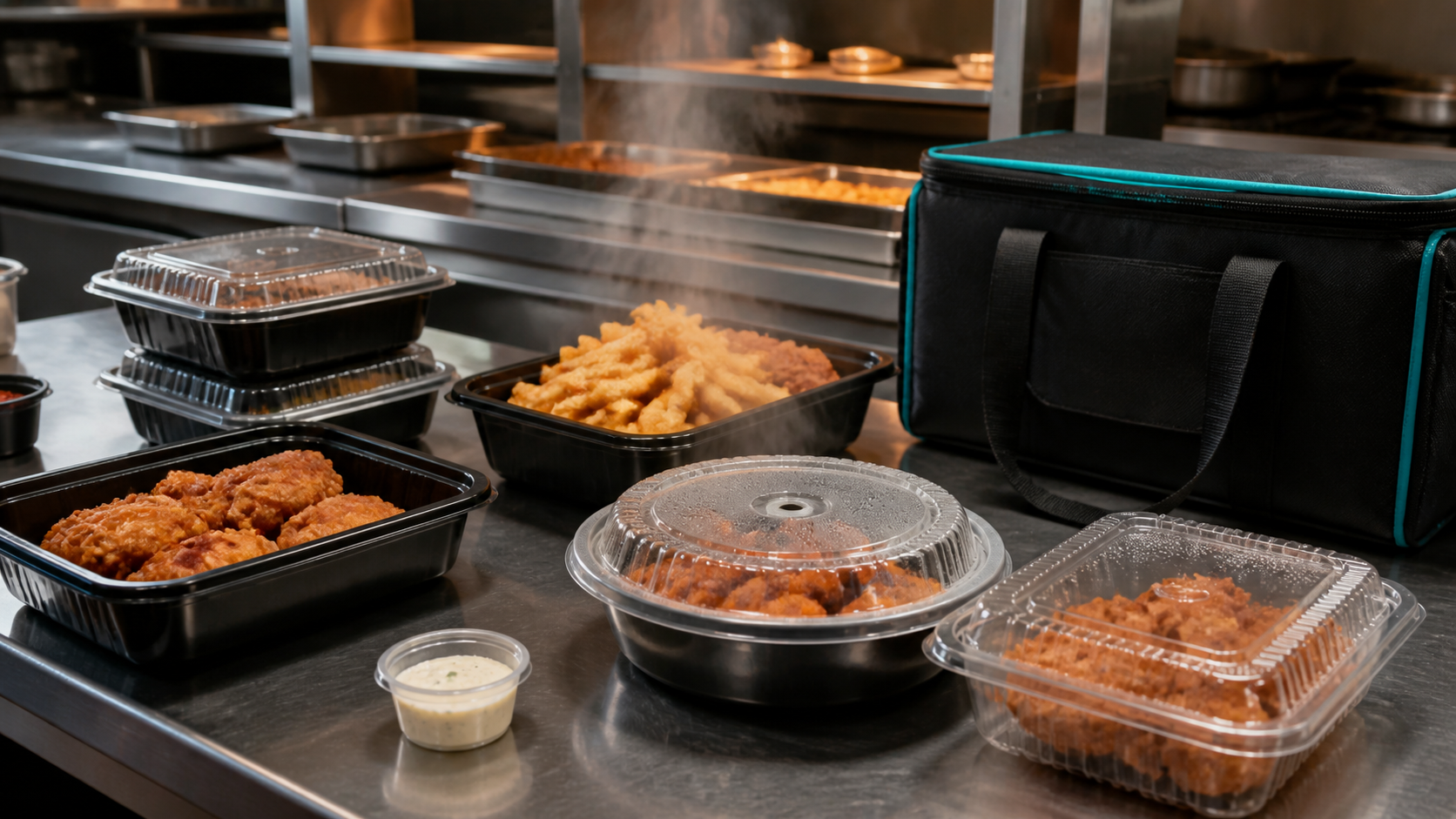
Investigate moisture, meal assembly and packing conditions when hot takeaway food becomes soggy: a hypothetical comparison of 2 packaging configurations at 4 opening times, with 3 separately packed samples per combination, requires 24 samples. This gives a buyer a structured way to observe where quality changes, rather than blaming the container material alone. The numbers describe a planning example, not completed JR DELIPACK tests or a required sampling standard.
The sixty-minute timetable below is illustrative. It is neither a promise that food will remain crisp nor permission to hold food outside an approved food-safety procedure. Choose conditions that represent your operation, and keep the purchasing comparison separate from regulatory suitability and food-safety decisions.
What should buyers investigate when a packed meal becomes soggy?
Start by separating the observations. Water droplets on the lid, a wet underside, softened coating and sauce soaking into bread are different findings. Record where the change occurs and what touched that surface. A photograph of droplets alone does not establish the cause of a texture complaint or prove that replacing the box will resolve it.
Condensation is the change from water vapor to liquid water; warm, moist air meeting a cooler surface provides a familiar example. The USGS explanation supports that physical mechanism, not a restaurant holding time or a container performance rating. In your comparison, inspect the lid and walls for visible droplets rather than assuming every damp surface has the same cause. 1: USGS explanation of condensation · reference details
Also inspect the meal before closing the package. Record whether a coating is already soft, whether sauce contacts it, whether portions overlap and whether food touches the lid. If candidates receive different meals at the start, their later appearance cannot fairly answer which packaging arrangement worked better. Preserve a description of the starting condition alongside each later observation.
Treat a proposed remedy as a question. Will separating the sauce help this meal? Does the supplied vented configuration behave differently when bagged and stacked? Does the actual delivery arrangement change the result? Do not turn these questions into product claims until the exact comparison has been completed and reviewed.
Define the food, package and journey before choosing a test
Write a single purchasing question that the trial can answer. For example, compare the same fried menu item in two documented package configurations over your defined dispatch-to-opening journey. Avoid combining this with a search for the cheapest supplier, a recycling claim or a microwave approval. Those are different decisions with different evidence needs.
Identify the recipe, portion, sauce placement, filling process, base code, lid code, vent configuration, bag and stacking arrangement. Define when the clock starts and what ends the journey. A timer beginning at vehicle departure omits waiting at the collection counter; if that waiting is part of the purchasing question, record it separately and include it in the planned comparison.
The National Restaurant Association’s sourcing guidance recommends evaluating samples with the actual food and considering holding conditions, opening, closing and other required functions. It cautions against assuming one package suits every food. This supports application-specific evaluation, not a universal winner or a fixed number of samples. 2: National Restaurant Association sourcing guidance · reference details
Use the existing menu-to-container selection guide to narrow the application first. A broth dish, a dry sandwich and a fried coating need different observation criteria. This article addresses the subsequent timed comparison, not a material recommendation for every item on the menu.
How many samples does the illustrative timetable require?
Assume, solely for planning, two configurations: A and B. Assign each to opening at fifteen, thirty, forty-five and sixty minutes, with three separately packed samples at each endpoint. The calculation is 2 × 4 × 3 = 24 packed samples. Each assigned sample is opened at its own endpoint, rather than repeatedly opened and reclosed at every checkpoint.
If you also want three immediate-opening reference samples for each configuration, allow 2 × 3 = 6 additional samples, giving 24 + 6 = 30 samples in total. These reference samples document the starting presentation. They do not replace the later samples or turn the example into a statistically justified acceptance plan.
Three samples per combination is an invented resource assumption, not a minimum validated by the sources. Decide the actual number with the people responsible for the purchasing decision and its risk. A small exploratory comparison may identify a problem, but it cannot establish a population defect rate or prove reliability across all future deliveries.
| Opening endpoint in this example | Configuration A | Configuration B | Purpose |
|---|---|---|---|
| Immediate reference, if included | 3 separate samples | 3 separate samples | Record starting condition |
| 15 minutes | 3 separate samples | 3 separate samples | Observe the assigned early endpoint |
| 30 minutes | 3 separate samples | 3 separate samples | Observe the assigned middle endpoint |
| 45 minutes | 3 separate samples | 3 separate samples | Observe the assigned later endpoint |
| 60 minutes | 3 separate samples | 3 separate samples | Observe the final planned endpoint |
Label containers before filling so that staff do not have to guess their destination. Include configuration, preparation batch, assigned endpoint and sample identifier. Keep spare packaging distinct from allocated samples. If a sample is dropped, mislabeled or stopped for a safety concern, record that event; do not silently substitute a better-looking result.
How can a restaurant make the comparison fair?
Choose one principal difference for the first comparison, such as two supplied lid configurations on a compatible base. Keep the recipe, portion, bag and planned handling the same. If several features differ, describe the result as a comparison of complete systems; do not attribute the difference specifically to venting, thickness or material.
Preparation batch and operator can complicate a comparison. NIST explains blocking as a way to compare treatments within groups where important nuisance factors are held consistent, with randomization addressing remaining variation. Its handbook example is industrial experimental design, not a restaurant sampling protocol. The following kitchen arrangement is a practical adaptation, not a NIST-mandated method. 3: NIST randomized block designs · reference details
For an exploratory kitchen comparison, distribute portions from each preparation batch across both configurations rather than assigning one batch entirely to A and the next entirely to B. Record the operator and packing order, and vary that order within the agreed plan. If the arrangement changes during service, preserve the deviation rather than pretending conditions stayed identical.
Separately packed samples from one cooking batch still share that batch’s conditions. Repeating observations across different service periods can reveal whether the first comparison transfers, but no specific number of periods is prescribed here. Distinguish individual packages, preparation batches and separate trial runs when describing the evidence to a purchasing manager.
Keep the quality trial inside established food-safety controls
Have the responsible food-safety lead review the plan before food is prepared. Specify handling, temperature measurement, stopping conditions and disposal under the establishment’s applicable procedures. Do not improvise a countertop waiting period to let steam escape, and do not extend the trial merely to reach the final row of the example timetable.
FDA describes its Food Code as a model used by jurisdictions to develop or update their own rules. The current FDA page identifies the 2026 edition, but publication does not establish which edition or provisions apply at your premises. Confirm applicable local requirements; this packaging guide does not substitute a general time limit for that review. 4: FDA Food Code and model status · reference details
Temperature belongs in a measured record with units, method, location and instrument identification, not in a subjective one-to-five score. Appearance, aroma and crispness cannot establish food safety. If an applicable control is not met, follow the approved stop and disposal procedure; do not taste a questionable sample to complete a texture assessment.
Only use configurations within their documented intended application. Do not cut makeshift vents, partly disengage a lid or create an unsupported reheating instruction to improve the comparison. Questions about reheating belong in the separate microwave-use verification guide, with evidence for the selected base and lid.
Record what happens without hiding failures inside a score
Prepare a worksheet before the trial. Give each criterion a plain description so observers know what to record. For condensation, distinguish scattered droplets, larger pools and observed contact with food. For texture, describe the menu-specific feature being judged. Keep these as separate observations rather than assuming one measurement explains the other.
A simple ordinal scale may help organize texture observations if its categories are agreed in advance. A score of four is not twice as crisp as a score of two, and changing from three to four does not demonstrate a thirty-three-percent improvement in crispness. Report the category descriptions and individual observations instead of manufacturing a percentage from the scale.
Record closure engagement, visible escapes, deformation, meal movement and opening difficulty separately. A pleasant texture score must not cancel a detached lid or a stopped sample. Detailed base-and-lid inspection belongs in the lid-fit and leak checklist; retain the relevant result in this meal comparison without rewriting the entire fit procedure.
Photograph the assigned sample at opening, showing the identifier and relevant surfaces without exposing customer information. Use consistent lighting and framing where practical. Do not select only the best photograph for a configuration; keep the complete sample record, including unexpectedly wet, damaged or unevaluable examples and the reason for any exclusion.
How should buyers interpret incomplete or mixed results?
Compare like endpoints and report their sample counts. Combining early and late observations into a single attractive average can conceal the point at which the meal became unacceptable. If the actual customer journey is longer than an observed acceptable endpoint, the available record does not support a longer delivery promise.
Consider another invented accounting example. Of the twenty-four scheduled endpoint samples, suppose two have unreadable labels and one is stopped under the food-safety procedure. Then 24 − 2 − 1 = 21 endpoint samples remain potentially available for quality evaluation. That does not mean twenty-one passes; each still needs its actual result, and the missing assignments must stay visible.
List the affected configuration and endpoint rather than simply reporting an overall completion percentage. Missing samples may prevent the intended comparison, especially if they occur together in one condition. Any replacement run should receive new identifiers and its own preparation record, while the original missing or stopped records remain retained.
If one configuration presents the meal better but creates another unacceptable result, document the trade-off and revise the purchasing requirement. Possible next questions include separate sauce packing, a different documented configuration or a more limited delivery offering. Change one defined aspect, explain why, and repeat the relevant comparison instead of declaring a universal packaging winner.
Turn the comparison into a usable supplier brief
Send the supplier the actual application and unresolved questions, not just a request for the best hot-food box. Include base and lid references, intended food contact, dimensions, usable portion requirements, packing arrangement and service conditions. Ask which supporting documents apply to that exact configuration and destination before treating the operational trial as an ordering decision.
Retain a reference sample and the comparison version alongside the commercial specification. Identify which changes would require review, such as a different lid, vent design, portion, recipe or delivery bag. A favorable observation for one arrangement should not automatically approve an entire product family or a later substitute with the same nominal capacity.
The final purchasing record should state the decision, scope and remaining uncertainty in ordinary language. It might allow a limited operational evaluation, require another comparison or reject the candidate for the stated use. Avoid an unqualified approved stamp that hides whether the review concerned presentation, compatibility, documentation or food safety.
Keep a short trial record that another shift can reproduce
Use a front sheet for the plan and a separate row for every allocated sample. On the front sheet, identify the purchasing question, people responsible, planned conditions and criteria for a useful comparison. Save a dated version before starting. This helps a later reviewer distinguish an intended design from an explanation written after an unexpected result.
For each sample, record the actual filling and opening times, not just the target interval. Include the preparation batch, package references, bag position and any departure from the plan. If a sample assigned to thirty minutes is opened late, retain both times. Do not relabel it as an on-time observation simply because the team was busy.
Before the review meeting, reconcile allocated samples against completed, missing and stopped records. Check that photographs and temperature records refer to the same identifiers as the written observations. Ask a person who did not conduct the trial to trace one sample from preparation to decision. Missing links should remain questions, not be filled with remembered estimates presented as measurements.
Finally, separate the immediate buying decision from the next learning step. A promising comparison may justify requesting a documented sample variant without justifying a full order. An unresolved handling problem may require another observation under the existing approved procedure. Record who will answer each question and which evidence is needed, so that a purchasing deadline does not quietly convert an exploratory result into a performance guarantee.
Frequently asked questions
Does the sixty-minute example prove a safe holding period?
No. It is an illustrative schedule for organizing observations. Actual handling, temperature controls and stop rules must follow the applicable food-safety procedure. Reaching an endpoint, retaining heat or looking appetizing does not establish that a meal is safe to serve or taste.
Are vented containers always better for fried food?
That conclusion needs an application-specific comparison. Define the exact supplied configuration, meal, bag and stacking arrangement, then record the relevant quality and handling observations. Do not infer a guaranteed crispness result from the presence of vents or improvise holes in an unsupported package.
Can I reopen the same box at every checkpoint?
That would answer a different question from observing a previously unopened delivery. For the example here, each package has one assigned opening endpoint. If repeated opening is part of the real intended use, document it as a separate condition rather than mixing those records with unopened samples.
Are three samples enough to approve a supplier?
The number three is only an assumption used to explain the sample calculation. It is not a validated acceptance quantity or evidence of statistical confidence. Determine the necessary scope and follow-up with the people responsible for the purchasing risk and keep supplier qualification separate from this exploratory meal comparison.
Will a thicker container prevent sogginess?
Thickness alone does not answer the purchasing question. Compare the specified meal and complete packing arrangement, recording starting condition, droplets, texture, closure and handling separately. A single acceptable meal or a thicker-looking sample does not establish a general condensation or food-quality guarantee.
What if neither configuration meets the requirement?
Keep the unsuccessful observations and identify the specific unmet requirement. Review the menu assembly, documented packaging alternatives and delivery offering without weakening safety controls. A revised plan can then test a defined change; an unsuccessful comparison is useful evidence, not a reason to invent a successful outcome.
Discuss the exact application with JR DELIPACK
JR DELIPACK supplies PP, PLA and paper-based foodservice packaging with supply and manufacturing support. Review the product range and factory and quality information as starting points for an enquiry. Product suitability and available evidence must be confirmed for the selected configuration and destination.
Contact JR DELIPACK with your menu, portion, packing arrangement, intended service conditions, quantity and destination. Include the specific quality or handling question you need to resolve so that sample discussions remain tied to a defined application.
References
- USGS, Condensation and the Water Cycle. Published 8 June 2019; read 7 October 2026. Supports the physical definition and familiar cooler-surface examples, not food performance or a holding limit. Back to the relevant paragraph.
2. National Restaurant Association, Don’t get boxed in: Do’s and don’ts in package sourcing. Published 6 April 2022; read 7 October 2026. Practical sourcing guidance on actual-food evaluation and required functions; survey percentages are not used here. Back to the relevant paragraph.
3. NIST/SEMATECH e-Handbook, Randomized block designs. Read 7 October 2026. General experimental-design principles; the meal arrangement and sample counts in this article are our illustrative adaptation, not a prescribed NIST food test. Back to the relevant paragraph.
4. FDA, Food Code. Read 7 October 2026. Explains model-code status and identifies the current federal edition; local applicability must be checked separately. Back to the relevant paragraph.
KEEP READING