Choose hinged or separate-lid sauce cups by comparing the complete filling workflow, usable stock and performance with your sauce: an assumed saving of 1 second per accepted portion equals 1,000 seconds, or about 16.7 minutes, across 1,000 portions. That arithmetic can explain why handling deserves attention, but it does not prove that either format is faster or cheaper in your operation.
The numerical examples below use invented planning inputs, not JR DELIPACK prices, trials or customer results. Replace them with documented observations before making a purchasing decision. A cup that is convenient to fill must also suit the food, hold the intended portion and remain correctly closed through the defined service journey.
What actually changes when the lid is attached?
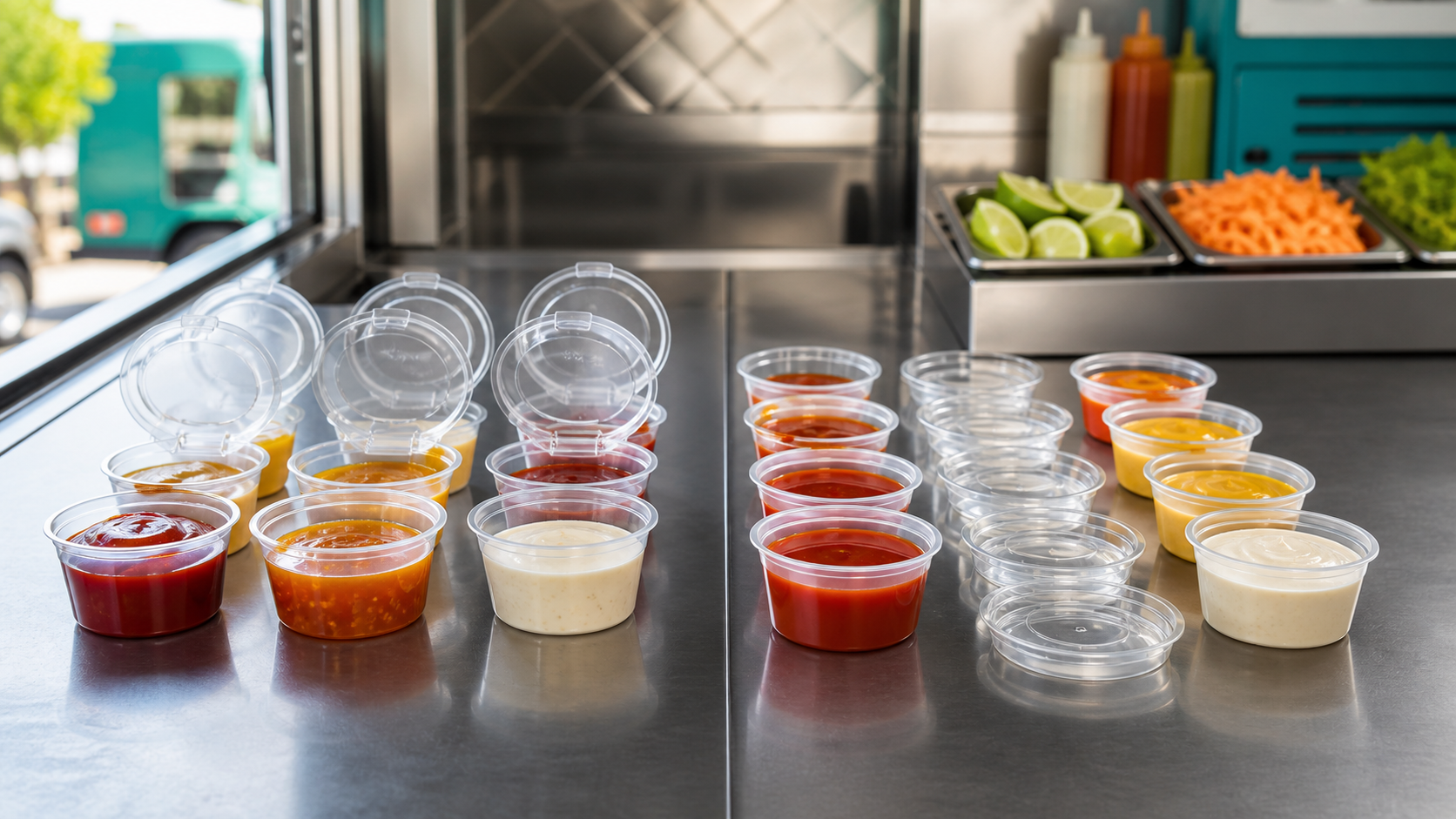
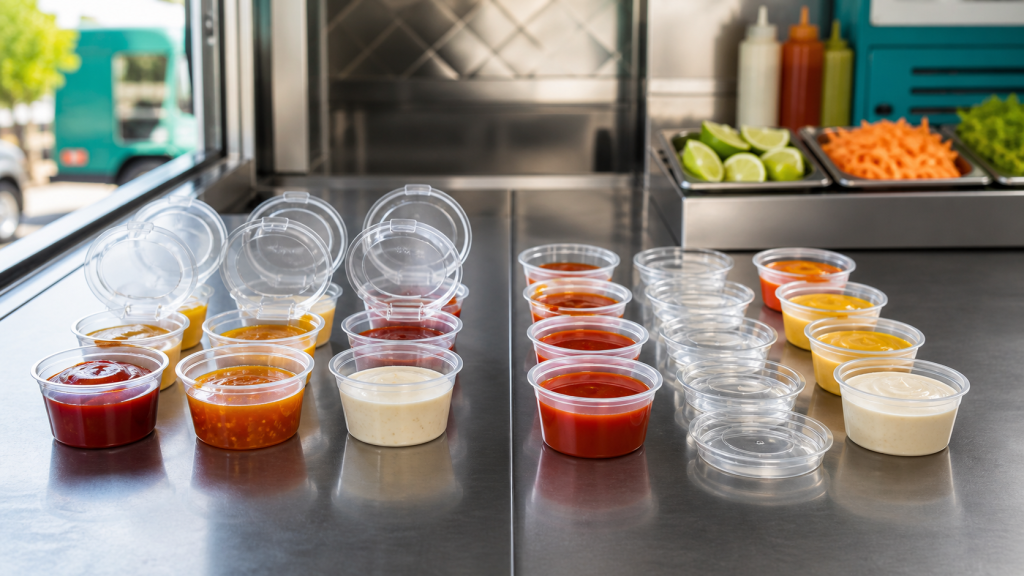
A hinged design joins the lid and cup in one supplied item. The packing station does not need a separately stocked lid for that item. Staff still need to separate nested pieces, hold the lid clear while filling, close it correctly and check the result. Fewer separate components do not automatically establish fewer errors or a faster complete cycle.
A separate-lid arrangement requires the correct cup and compatible lid to be available together. It allows the lid to be staged independently and removed completely during use. Those characteristics can be useful in a particular layout, but they also create matching and replenishment tasks. Evaluate the actual station rather than treating the number of components as the whole decision.
Do not describe hinged stock as immune to shortage. A damaged hinge, contaminated interior or rejected closure may make the whole item unavailable. With separate components, a sound cup may remain usable when its intended lid is missing, but not as a complete lidded portion. Define what counts as usable for the service being purchased.
Keep the comparison at model level. The hinge geometry, rim, lid engagement, nesting and supplied packaging can differ between products with the same nominal capacity. Confirm a shared lid arrangement in the supplier’s product information and review each proposed pairing; a matching volume label alone is not evidence that two rims fit.
Specify the sauce and service before comparing formats
Describe the actual food, portion, filling conditions and intended storage or delivery. Include whether the cup will hold a thin dressing, an oily sauce or a thicker condiment, and whether it is filled at the counter or under an approved advance-preparation process. Avoid selecting packaging from a photograph and only later asking whether the use is supported.
FDA’s food-contact reference tables distinguish aqueous, acidic and fatty food categories, as well as different filling and storage conditions. The tables were created for food-contact-substance notifications; they do not approve every cup made from a named resin. Ask for documentation that matches the selected components and intended use, with destination requirements considered separately. 1: FDA food types and conditions of use · reference details
State the required portion and how it is measured. A nominal cup capacity, a practical filling level and a recipe’s portion weight are different descriptions. Do not convert sauce weight into volume without the necessary product information. Leave sufficient operating space according to the selected product’s supported use, rather than inventing a universal fill percentage.
Include customer handling in the brief. Will the cup sit beside fries, inside a meal box or in a delivery bag? Must a customer open it without a work surface? Does an attached lid interfere with dipping or another item? These are practical questions for the sample review, not reasons to declare one closure style universally superior.
How should buyers time the complete filling workflow?
Define the start and finish before timing. A useful comparison might start when an operator reaches for packaging and finish when a correctly filled, closed and identified portion reaches its staging position. Use the same boundary for both candidates. Timing only the final closing motion omits picking, separation and any arrangement needed to present the parts.
The National Restaurant Association advises using packaging samples with the actual food and examining required functions rather than judging empty packages alone. Its guidance includes opening, closing and leakage observations. Apply that practical principle to the sauce station; it does not prescribe a sauce-cup timing result or a universal sample quantity. 2: National Restaurant Association sourcing guidance · reference details
Give operators a clear demonstration of both supplied configurations before recording comparable runs. Keep the dispenser, sauce, portion, layout and identification step consistent where possible. Record operator and run order, and vary the order across the planned comparisons so that the first unfamiliar attempt is not silently compared with a practiced attempt for the other format.
Record accepted portions separately from attempts. Retain reclosures, dropped components, rim contamination and restocking interruptions in the log. Decide whether replenishment is inside the main timing boundary or measured separately, and use that choice consistently. An attractive average is not helpful if it excludes the recurring task that slows the actual service.
Compare each operator’s runs before pooling the results. If one person is quicker with hinged cups but another is quicker with separate lids, preserve that difference and investigate the station layout or familiarity. Selecting the fastest run from each format hides ordinary variation. Also record assistance: a second person supplying lids creates labor that a single operator’s stopwatch may miss. Keep active person-time distinct from elapsed batch time when several people contribute. The simple calculation below assumes one operator works throughout each timed run; a team process needs the contributing time of each person, without counting simultaneous minutes as though they belonged to only one worker.
Calculate the time difference without claiming unearned savings
Suppose, only as an example, a separate-lid run takes 260 seconds and a hinged run takes 210 seconds to produce fifty accepted portions each. Assume the same timing boundary includes the relevant observed rework. The difference is 260 − 210 = 50 seconds, and 50 ÷ 50 = 1 second per accepted portion. These are assumed values, not measured results.
At one thousand portions, that difference becomes 1 × 1,000 = 1,000 seconds, or exactly sixteen minutes and forty seconds. Dividing by sixty gives approximately 16.7 minutes. Projecting the trial to that volume assumes the difference persists; fatigue, replenishment, interruptions and different operators may change the actual result, so check the projection against later observations.
For a separate cost illustration, assume labor is allocated at USD 24 per hour. The arithmetic is 1,000 ÷ 3,600 × 24 = USD 6.67, rounded to cents, per thousand portions. This is an allocated time value, not automatically a cash saving. Payroll falls only if an actual staffing or paid-time decision changes; released time may instead be used for another task.
Now assume the hinged item costs USD 0.004 more per complete portion package. Its added purchase cost across one thousand is 0.004 × 1,000 = USD 4.00. Under these narrow assumptions, the allocated labor difference less the purchase premium is USD 2.67. No conclusion follows about net operational savings until other relevant costs and acceptable performance have been checked.
Use a sensitivity check when the claimed advantage is small. With the same assumed hourly allocation and purchase premium, the break-even difference is 0.004 × 3,600 ÷ 24 = 0.6 seconds per portion. A measured difference below that would not offset the assumed premium through labor allocation alone. This is a decision threshold derived from inputs, not a product speed claim.
Compare storage at the station and in the stockroom
Record two storage situations: unopened supply and packaging ready for use. A compact carton does not establish a compact filling station, and a tidy station does not establish low stockroom demand. Measure the actual supplied carton dimensions, nesting arrangement, opened sleeve footprint and required access space rather than judging storage from a single empty cup.
For separate components, count complete usable sets and unmatched stock separately. In a hypothetical inventory of 1,200 usable cups and 1,000 confirmed compatible lids, only min(1,200, 1,000) = 1,000 complete sets are available, leaving 1,200 − 1,000 = 200 unmatched cups. This is arithmetic, not a JR packing specification or a recommended purchasing ratio.
An attached lid removes that particular two-component mismatch, but the buyer must still subtract unusable whole items and maintain enough of the correct model. Do not treat unmatched cups as automatically wasted: they may become usable after compatible replenishment. Record their status and intended resolution instead of immediately charging them as destroyed stock.
Keep ordering units separate from the format decision. Cup pieces, lid pieces, sleeves and complete sets should be explicit in purchase records. The portion-cup order-unit guide addresses those definitions in detail; this comparison uses complete accepted portions to avoid confusing a cheap cup-only price with a supplied cup-and-lid system.
| Review question | Hinged configuration | Separate-lid configuration |
|---|---|---|
| What is stocked? | Usable complete items of the exact model | Usable compatible cups and lids, plus unmatched stock |
| What is timed? | The complete defined filling and staging cycle | The same cycle, including the defined component-picking steps |
| What space is measured? | Supplied cartons and opened-item staging | Supplied cup/lid cartons and both staging positions |
| What proves closure suitability? | Recorded observations for the actual item and sauce | Recorded observations for the exact cup/lid pair and sauce |
| What changes at transition? | Complete-item stock and associated workflow | Both component inventories and associated workflow |
What should the closure and delivery review include?
Record the exact cup and lid identity, food, portion and supported conditions before evaluating closure. Observe how the operator seats the lid, whether the rim remains clear and how the filled item is staged. Distinguish an incorrectly assembled sample from a correctly assembled sample that later opens or leaks; the corrective actions may differ.
Use controlled handling representative of the intended service. Do not casually invert hot or hazardous contents, squeeze filled cups toward people or create an unsupported temperature exposure. Have responsible staff define a safe observation method and stopping conditions. The separate lid-fit and leak checklist provides the dedicated component-review framework.
Record individual outcomes, not just a single overall impression. Include where moisture or sauce appeared, whether the lid disengaged, whether the body changed shape and what happened when the customer-style opening was attempted. Photographs can support these observations, but an image of a closed cup is not evidence that it survived the complete journey.
Do not trade an unacceptable closure result for a favorable stopwatch result. Decide the required performance before reviewing the comparison and keep unsuccessful samples visible. A candidate may warrant another evaluation after a defined adjustment, but a trial on one sauce or temperature does not establish suitability for every condiment in the operation.
Consider staff handling and advance preparation separately
Ask staff about reaching, grip, repeated closing effort and access to packaging while keeping food-handling controls intact. Speed alone does not describe the quality of a task. If an operator must adopt an awkward movement to make a candidate appear fast, include that observation in the purchasing review rather than rewarding the shortest time.
OSHA’s ergonomic guidance recommends designing tasks to reduce exposure to risk factors, including physical changes that reduce excessive reaching and support neutral postures. It distinguishes engineering changes from administrative or work-practice controls. This supports reviewing the station as well as the package; it does not certify a lid style or establish a safe closure-force value. 3: OSHA ergonomic hazard controls · reference details
Advance filling is a separate operational decision. Before comparing prefilled and filled-to-order portions, confirm the sauce’s applicable handling, identification, storage and disposal procedures with the responsible food-safety lead. A closed cup does not create a shelf-life claim, and a convenient stacking arrangement does not establish that advance preparation is suitable.
FDA publishes the Food Code as a model for jurisdictions developing their own rules. Its current page identifies the 2026 edition; local adoption and applicable requirements must still be confirmed. Do not borrow a generic holding period from a packaging comparison and apply it to all house-made sauces. 4: FDA Food Code model status · reference details
Record a purchasing decision and manage the changeover
Summarize the comparison in a short decision record: exact models, application, timing boundary, accepted counts, rework, storage observations, closure results and unresolved questions. State whether the evidence supports a limited operational evaluation, another sample request or an order for the defined use. Avoid an unrestricted approval that loses the conditions of the review.
If switching formats, identify remaining usable stock before ordering replacements. Keep old and new separate-lid components clearly identified until compatibility and the transition plan are settled. An attached-lid change also needs a plan for remaining old complete items. Do not blend stock merely because the packages share a color or nominal size.
Include the reference sample and agreed product information with the purchasing record. Ask for notification of changes relevant to the accepted configuration, such as lid, rim, material, nesting or supplied packing. The broader supplier change-control guide addresses transitions; this article’s decision remains the specific sauce-cup format and workflow.
Packets or sauce applied directly to food may belong in a different comparison if the menu and service allow them. They change preparation, portion choice and customer handling, so do not add them to a cup trial and claim that only lid style changed. Set a new comparison boundary before drawing an economic conclusion.
Frequently asked questions
Are hinged sauce cups always cheaper to use?
No. Compare the complete package and observed workflow with the intended sauce. The illustrative labor calculation only shows how to value an assumed time difference. It does not include every operating cost or demonstrate that one format lowers payroll, waste or total purchasing expenditure.
Can one separate lid fit several cup sizes?
Only rely on combinations identified as compatible in the relevant product information and reviewed for your use. Confirm exact cup and lid references rather than inferring compatibility from capacity alone. Keep each accepted pairing in the purchasing record so that a future substitution does not silently change the combination.
Is fifty portions a required test quantity?
No. Fifty accepted portions is an invented example used to explain timing arithmetic. It is not a validated acceptance sample size or evidence of statistical confidence. Select the actual comparison scope according to the purchasing question, operating variability and the review needed by responsible staff.
Should I count rejected portions in the timing?
Define a consistent boundary and retain the time and reason for observed rework or rejection. Reporting time per accepted portion prevents an apparently fast run with incomplete output from being compared as if it produced the same usable result. Record rejected packaging and food separately to avoid double-counting losses.
Does an attached lid eliminate inventory risk?
It removes the need to match a separately stocked lid for that item, but it does not eliminate damage, contamination, shortage or wrong-model selection. Count usable whole items. For separate components, distinguish complete compatible sets from unmatched stock and decide how that stock will be resolved.
What should be included in a sample request?
Describe the sauce, portion, supported filling and service conditions, quantity and destination. Request exact component references, dimensions, supplied packing and relevant documentation. Explain the closure, handling or storage question to be evaluated, so that the sample request serves a defined decision rather than an unsupported general performance claim.
Define the application with JR DELIPACK
JR DELIPACK supplies PP, PLA and paper-based foodservice packaging with supply and manufacturing support. Review the product range and factory and quality information when preparing an enquiry. Availability, configuration and supporting evidence must be confirmed for the selected product and destination.
Contact JR DELIPACK with your sauce, portion, weekly requirement, service conditions and preferred closure arrangement. Include the specific workflow or compatibility questions that should guide sample discussions.
References
- FDA, Food Types and Conditions of Use for Food Contact Substances. Publication date not provided. Read 6 October 2026. Food-contact notification reference categories, not blanket product approvals. Back to the relevant paragraph.
2. National Restaurant Association, Don’t get boxed in: Do’s and don’ts in package sourcing. Published 6 April 2022; read 6 October 2026. Practical actual-food sample and function evaluation; survey figures are not used here. Back to the relevant paragraph.
3. OSHA, Ergonomics — Solutions to Control Hazards. Publication date not provided. Read 6 October 2026. General task-design and ergonomic control guidance, not a sauce-cup or closure-force standard. Back to the relevant paragraph.
4. FDA, Food Code. Publication date not provided for this overview. Read 6 October 2026. Model-code status and current edition; local applicability requires separate confirmation. Back to the relevant paragraph.
KEEP READING