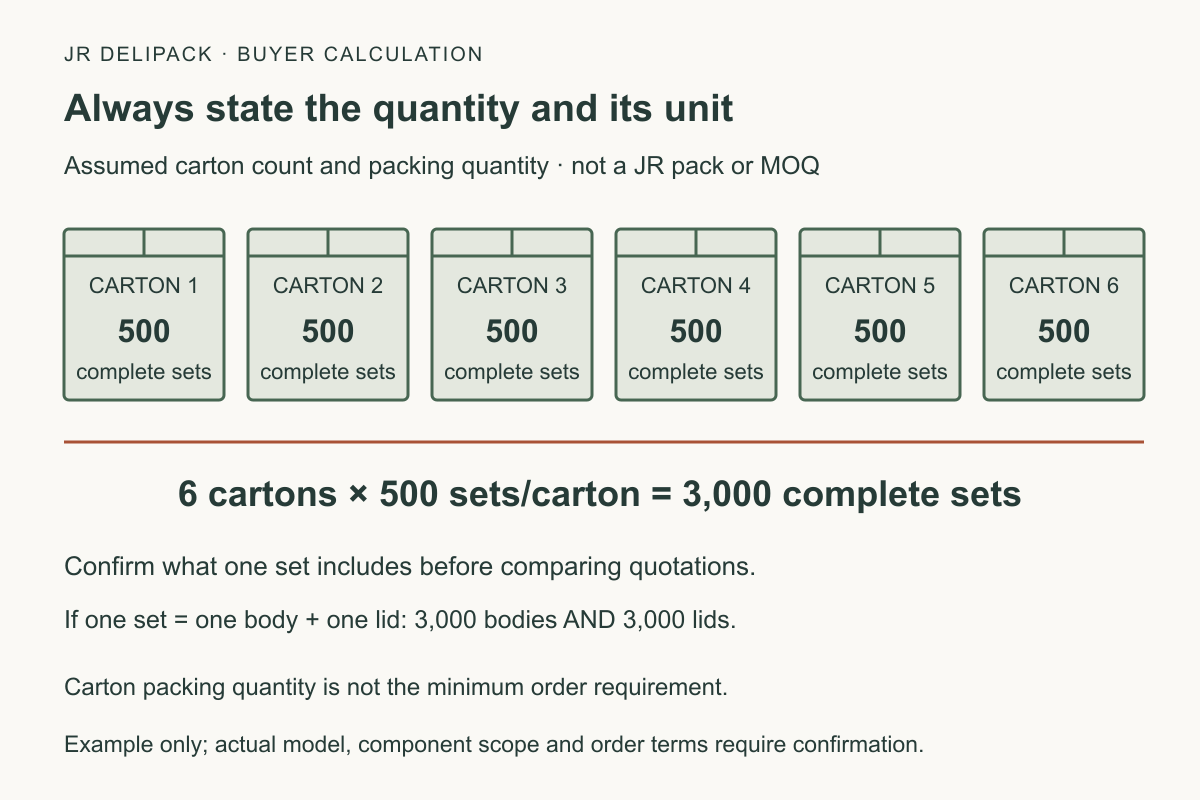
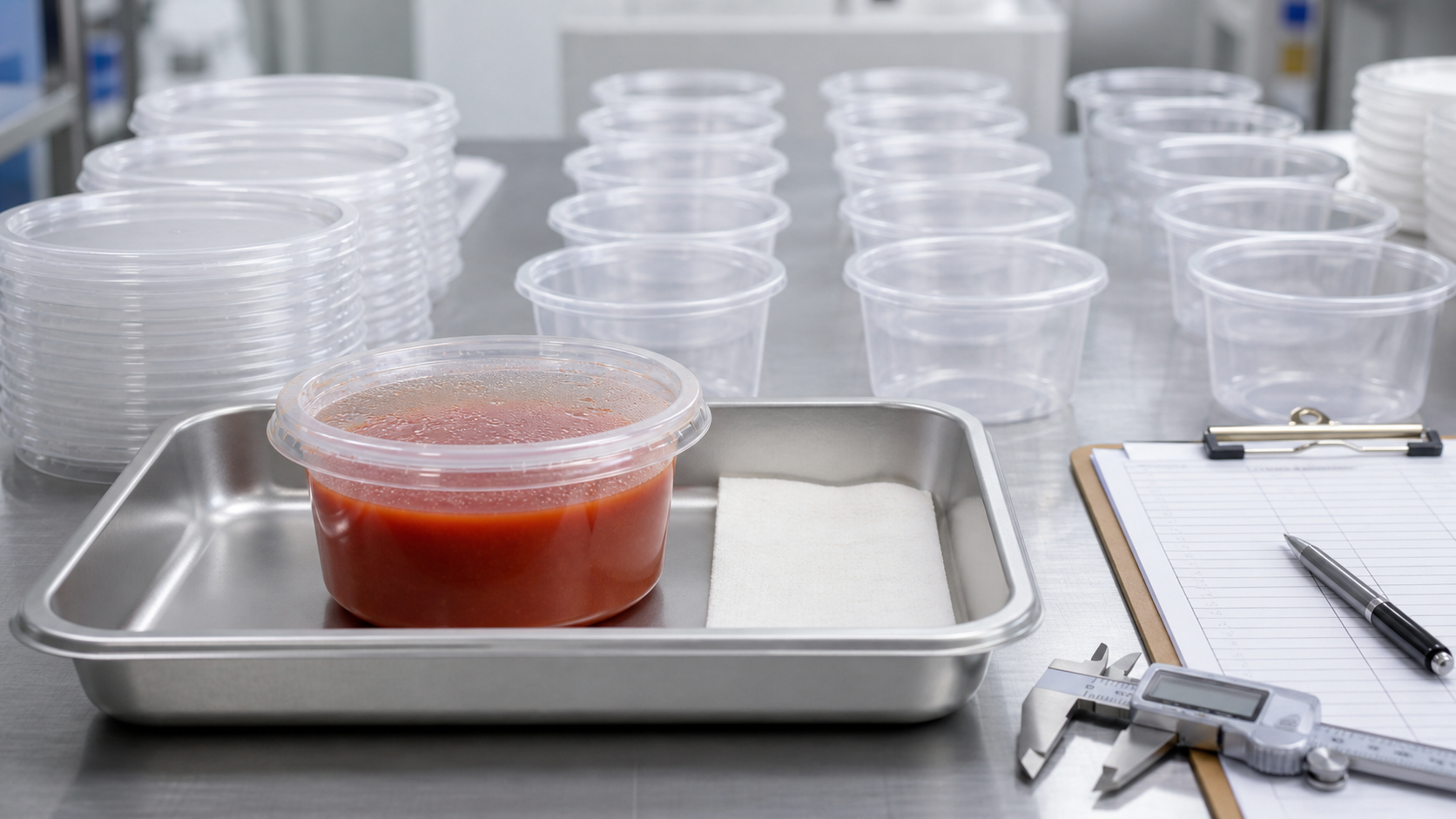
State both the quantity and its unit when requesting a food-packaging quotation: a hypothetical order of 6 cartons containing 500 complete sets each means 3,000 sets, provided the agreed pack includes every required component. These assumed numbers explain the conversion; they are not a JR DELIPACK pack count or minimum order.
Hypothetical quantity conversion, not JR DELIPACK packing quantities or minimum order terms. Confirm every component included in one complete set.
Define the quoted scope
Identify the product reference and component arrangement. Ask whether the lid is included or quoted separately, and describe materials and intended use. Start from the product range and keep unknown details visible. A base-only price must not be compared with a complete-set price without adjusting the scope.
Separate packing from order conditions
A case pack describes what is packed; a minimum order describes an ordering condition. Confirm pieces or sets per carton and the model or unit to which the MOQ applies. Do not turn a catalogue packing quantity into an order minimum. Use the packing-unit guide for more detailed cup, lid and sleeve examples.
Add destination and timing
Include the delivery destination, timing requirement and document questions. Shipment assumptions, included charges and exclusions need to be explicit. Consult the factory and quality information for the context of product-document requests; a confirmed quantity does not itself establish product suitability.
JR DELIPACK is the food-packaging brand of Dongguan JR Delipack Packaging Co., Ltd. Send your product-specific brief through the existing contact page. Request clarification of missing fields before relying on the quotation.
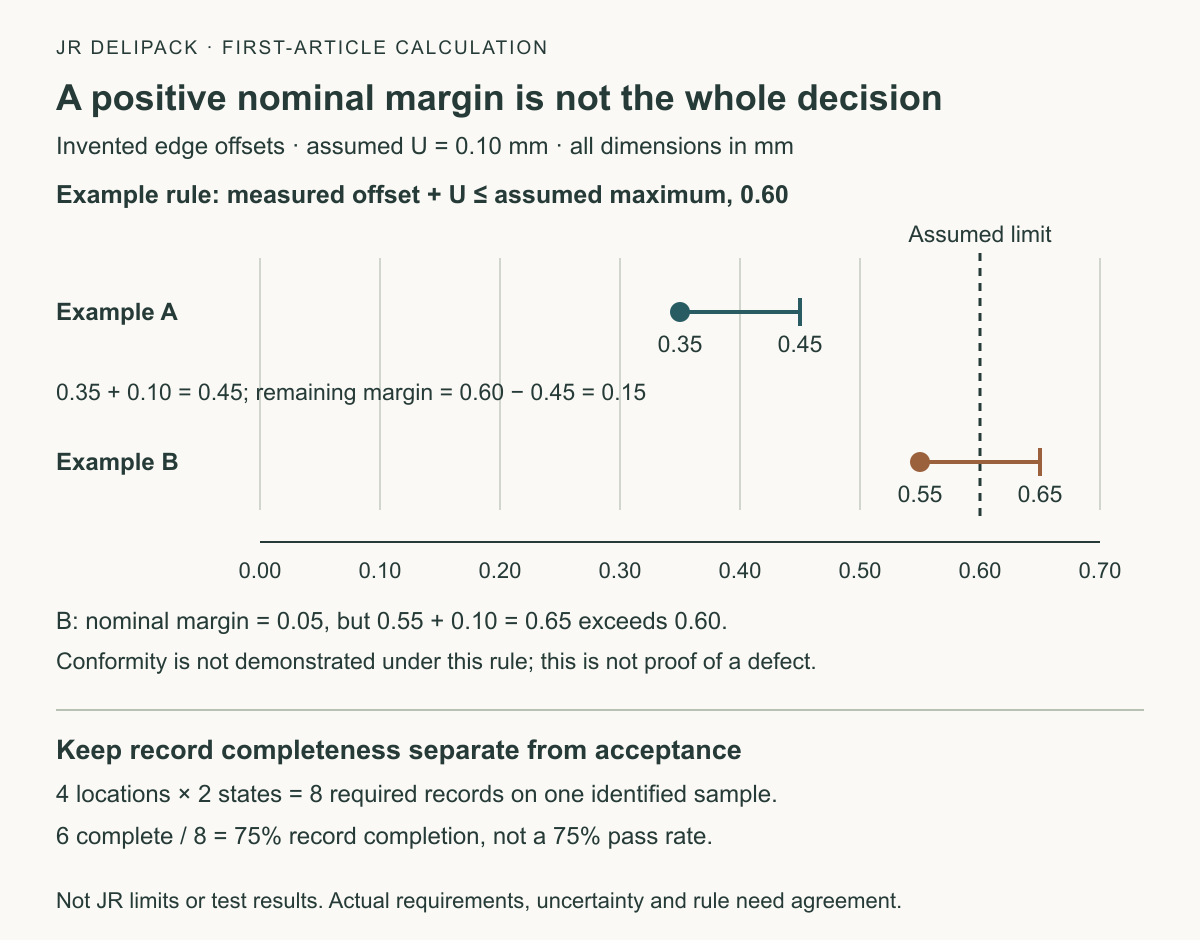
Approve hinged-container lid alignment against an identified sample, an agreed drawing and a recorded closing method: if a hypothetical maximum edge offset is 0.60 mm and the measured offset is 0.35 mm, the nominal margin is 0.25 mm, but the approval still depends on measurement uncertainty and the agreed decision rule. These invented figures demonstrate a review calculation, not a JR DELIPACK tolerance or test result.
A first article establishes what configuration the buyer is being asked to approve. It should connect the physical sample to its drawing revision and intended production arrangement, with unresolved points visible. It is not evidence that every later container will behave identically. This guide concentrates on that first geometry and approval record; checking closure consistency across fresh samples is a separate purchasing task.
Hypothetical alignment decision using assumed uncertainty and limit. Record completeness is not a product pass rate; not JR DELIPACK tolerance or qualification.
What exactly is the first article being approved?
Ask whether the submission is a prototype, a trial from the intended production tool, or an existing catalogue sample offered for comparison. Record that answer alongside the sample reference. A comparison sample can help explain a desired feature, but it should not silently become the production reference for a different construction. Identify any difference the supplier expects between this submission and the goods covered by the order.
Connect the sample to the item code, drawing revision, material description, colour and nominal size. Where tool or cavity references are relevant and available through the agreed review channel, retain them in the technical record. The public product name alone may not distinguish revisions. Do not place confidential manufacturing identities or source documents in a public-facing report simply to make the approval appear more authoritative.
Define what “alignment” means for the design. It may include the lid’s position relative to the base, the route through which it closes, the engagement of designated catches and the seated condition after hand pressure is removed. Use the drawing to distinguish intended features from discrepancies. A designed vent, relief or clearance should not be rejected merely because an earlier checklist said there must be no gap anywhere.
Keep empty-container geometry separate from filled-use performance. An aligned lid does not establish liquid retention, hot-fill suitability, microwave suitability or food-contact compliance. The container-and-lid buying checklist addresses broader application checks. Record those as separate decisions instead of extending the first-article signature beyond the evidence actually reviewed.
How should buyers agree the review before handling the sample?
Prepare a marked drawing or annotated photograph that identifies the hinge side, front, left and right from one stated viewing direction. Name the precise measurement locations rather than writing “measure the rim.” If a location cannot be seen with the lid closed, agree another method with the supplier. An improvised measurement through an inaccessible feature should not produce a seemingly precise approval value.
Describe the starting condition: empty or filled, supported or unsupported, as received or conditioned, and previously handled or untouched. For an initial empty-container alignment review, do not introduce food, heat or a transport simulation without recording it as another evaluation. Record the relevant room and sample conditions when they form part of the method. A later reviewer needs to know what was compared, not merely that both samples were called room temperature.
Specify the intended closing action. State where the operator supports the base and applies pressure, the sequence of engagement and whether either hand guides a corner. Demonstrate the method with the person who will perform the review. One-handed closure is not a universal purchasing requirement; it matters only if that is the buyer’s intended workflow and the selected format is being evaluated for it.
Separate a visual judgement from a dimension. For a visible condition, retain agreed photographs or written descriptors. For a numerical requirement, state the feature, units, limit, method and decision rule. NIST’s definition of a decision rule concerns how uncertainty is considered when deciding conformity to a requirement. Agree that treatment before looking at a borderline result, rather than changing it afterwards to obtain a preferred answer. 1: NIST decision-rule definition · reference details
What should the bench review record?
Photograph the identified sample before handling. Include an overall view that establishes orientation and closer views of the relevant features. Keep the original files; use separate annotated copies to show locations. A ruler visible in a photograph can provide context, but do not turn a perspective-distorted image into a dimensional result unless the measurement method supports that use.
With the lid open, observe the hinge and the reference features without forcing the part into a more favourable position. Close it using the agreed action, then release the hand pressure and record the seated condition. Note where guidance was needed and what happened when it was removed. Distinguish the container resting on the bench from the container being held, because the support condition is part of the observation.
Record each specified perimeter location individually. Avoid averaging an obvious local mismatch into an otherwise acceptable overall description. If the front engages but a side does not reach the agreed position, retain both observations. Ask the supplier to relate the discrepancy to the drawing rather than diagnosing a mould, material or process fault from appearance alone.
Inspect for changes during the agreed handling sequence, including newly visible marks, a changed resting position or an altered closing action. Record when the change first appeared. Whitening or another visible mark is an observation to compare with the agreed criterion; this guide does not establish its cause or a universal rejection threshold. Stop if continuing would make the sample unsafe to handle or destroy evidence needed for the review.
Keep initial and later observations distinct. If a reviewer guides the lid after an unsuccessful attempt, preserve the original result and identify the guided attempt separately. Do not replace an inconvenient first observation with a better-looking final photograph. Record the chosen cycle count and sequence, but do not present repeated handling of one article as measurements on several independent fresh containers.
How do dimensions and uncertainty change the approval decision?
Use equipment and a method suitable for the defined feature. Ask how the sample is supported, how the measurement locations are located again, and whether the contact method changes the condition being measured. A display with more decimal places does not itself establish a suitable measurement process. Where the parties cannot reproduce the measurement, settle the method before using the number as a contractual acceptance result.
NIST describes expanded uncertainty as the combined standard uncertainty multiplied by a stated coverage factor, and expresses an interval around the measurement result. The coverage factor and interpretation therefore belong with the reported uncertainty. Do not substitute instrument resolution for that evaluation, or add an arbitrary allowance because a measurement is close to the limit. 2: NIST expanded-uncertainty guidance · reference details
Consider an invented example with a maximum permitted edge offset of 0.60 mm. For this example only, assume a competent measurement report gives an offset of 0.35 mm and expanded uncertainty of 0.10 mm, with its coverage basis documented. Suppose the parties have chosen a rule requiring the measured offset plus that uncertainty to be no greater than the upper limit. This is an illustrative agreed rule, not a mandatory packaging standard.
The nominal margin is 0.60 minus 0.35, or 0.25 mm. Applying the example rule gives 0.35 plus 0.10, or 0.45 mm, leaving 0.15 mm to the upper limit. That particular result meets the selected rule for this feature. It says nothing about another measurement location, the hinge motion, another drawing revision or the production lot.
Now change only the measured offset to 0.55 mm. The nominal margin is still positive at 0.05 mm, but 0.55 plus 0.10 equals 0.65 mm. Conformity is not demonstrated under the example rule. Do not relabel this as certain proof of a defective container, round the result down to make it pass, or silently switch to a different rule. Follow the agreed process for clarification, improved measurement or a revised submission.
Keep the signed requirement and method attached to these calculations. If the parties instead select another documented decision rule, the outcome may differ; record which rule actually governs. Neither the example tolerance nor its uncertainty is a recommended specification. The dimensional example is useful because it exposes the assumptions that a bare “fits correctly” statement leaves hidden.
How much of the review is complete?
Use a review matrix to prevent missing observations from being mistaken for successful results. As a hypothetical documentation example, one identified first article has four agreed perimeter locations reviewed in two states: initially closed and after the agreed handling sequence. That produces four times two, or eight required location-state records. It is still one physical article, not eight independent samples or an industry-prescribed inspection plan.
If six records are complete and two are missing, the record-completion figure is six divided by eight, or 75%. It is not a pass rate. A completed record may contain a failure or a question awaiting disposition. Keep separate columns for whether an observation exists, what was observed and whether the authorized reviewer accepted it. This prevents administrative completeness from being confused with product approval.
Record field
What the buyer should be able to identify
Submission
Sample identity, configuration and drawing revision
Location and state
Marked point, orientation and handling stage
Method
Support, closing action and measurement procedure
Evidence
Result, units, original photograph or report reference
Decision
Agreed criterion, reviewer and unresolved action
NIST describes lot acceptance sampling as using a random sample and a specified plan to decide the disposition of a lot. It also distinguishes that decision from estimating the lot’s quality. A first article selected to establish configuration and geometry does not replace such a plan. Agree subsequent production verification separately; this article supplies neither an AQL nor a shipment acceptance sample size. 3: NIST acceptance-sampling guidance · reference details
What should happen when a first article needs correction?
Describe the discrepancy by location, condition and evidence reference. Ask the supplier for the proposed change and which other characteristics may be affected. Do not dictate a manufacturing adjustment from a photograph alone. If the change alters the drawing, material specification or intended construction, issue an identifiable revision and agree which checks must be repeated.
Give the replacement submission its own sample reference. Retain the earlier record so the reviewer can compare the same feature and closing method. A response such as “improved” is not a substitute for showing the revised result at the disputed location. Check the relevant surrounding features as agreed, because correcting one point does not automatically establish the rest of the configuration.
Write any conditional decision narrowly. An authorization to continue a trial is not necessarily permission to release a production order. Identify the open conditions, responsible party, evidence needed to close them and the person who can approve the next step. Keep commercial scheduling decisions separate from technical acceptance so an urgent shipment date does not silently remove an unresolved requirement.
Archive the approved drawing, report and identified reference sample together under appropriate storage conditions. Agree what happens if the reference becomes damaged or no longer represents the current revision. Connect subsequent changes through specification control; do not compare new goods with an unlabelled old sample whose history nobody can establish.
First-article approval checklist
Before signing, confirm that the record answers these practical questions:
Is the submission linked to the intended product configuration and the relevant order?
Are drawing revision, orientation and measurement locations unambiguous?
Was the intended closing action followed and any guidance recorded?
Are initial observations distinguishable from repeated-handling observations?
Are numerical limits, units, uncertainty treatment and decision rules documented?
Are missing records and unresolved conditions visible rather than counted as passes?
Does the approval identify its scope, reviewer, date and retained evidence?
Is later production verification assigned separately from this first-article review?
Use the checklist to organize the approval discussion, not as a substitute for a product specification. Where buyer and supplier records disagree, compare the same revision, location and procedure first. Keep both original records while resolving the difference. A revised summary should explain what changed rather than deleting the earlier observation from the history.
Frequently asked questions
Is lid alignment the same as leak resistance?
No. Alignment describes the relative position and engagement of the features being reviewed. Liquid retention depends on the complete application and requires its own evidence. A dimensional approval for an empty article should not be advertised as a leak-proof result or expanded into temperature or food-contact claims.
How many opening and closing cycles should we specify?
Choose and document the sequence for the intended handling question with the supplier. This guide does not prescribe a universal count or an extra safety margin. Record whether you are observing first closure or later handling, and keep a repeated-use question separate from initial geometric approval.
Can a lid that needs guidance be approved?
Only against the agreed process and criteria. Record where guidance is needed and whether that action is acceptable for the intended workflow. Do not describe assisted closure as unassisted. If the requirement is unclear, resolve it before signing rather than treating a reviewer’s successful second attempt as automatic acceptance.
Does a positive nominal margin mean the dimension passes?
Not necessarily. The decision depends on the specified rule and its treatment of uncertainty. The hypothetical example shows a measured value below the limit that does not satisfy the chosen rule. Report the measurement and decision separately; do not infer a universal outcome from that example.
Can the supplier’s sample photograph replace the first article?
A photograph can document appearance and location, but it cannot by itself demonstrate the agreed closing action or an unsupported dimension. Decide which questions can be reviewed remotely and which need the physical sample or an appropriate measurement report. Preserve the sample identity across those forms of evidence.
What if later production differs from the approved first article?
Record the difference against the approved configuration and the relevant production-verification requirements. Preserve the goods’ identity and seek a documented disposition. The first-article record provides a reference, not automatic proof of cause, liability or an agreed remedy. Do not overwrite the approved baseline to make the discrepancy disappear.
Prepare a focused sample enquiry
JR DELIPACK supplies PP, PLA and paper-based foodservice packaging with supply and manufacturing support. For this review, start with the relevant hinged-container family and review the factory and quality information within its stated scope. A general product image or company document does not approve the specific first article.
Send the intended container format, use, quantity, destination and closing process through the contact page. Ask how the sample will be identified, which configuration it represents and what evidence will accompany it. Keep protected source documents in the controlled review channel rather than publishing them with the enquiry.
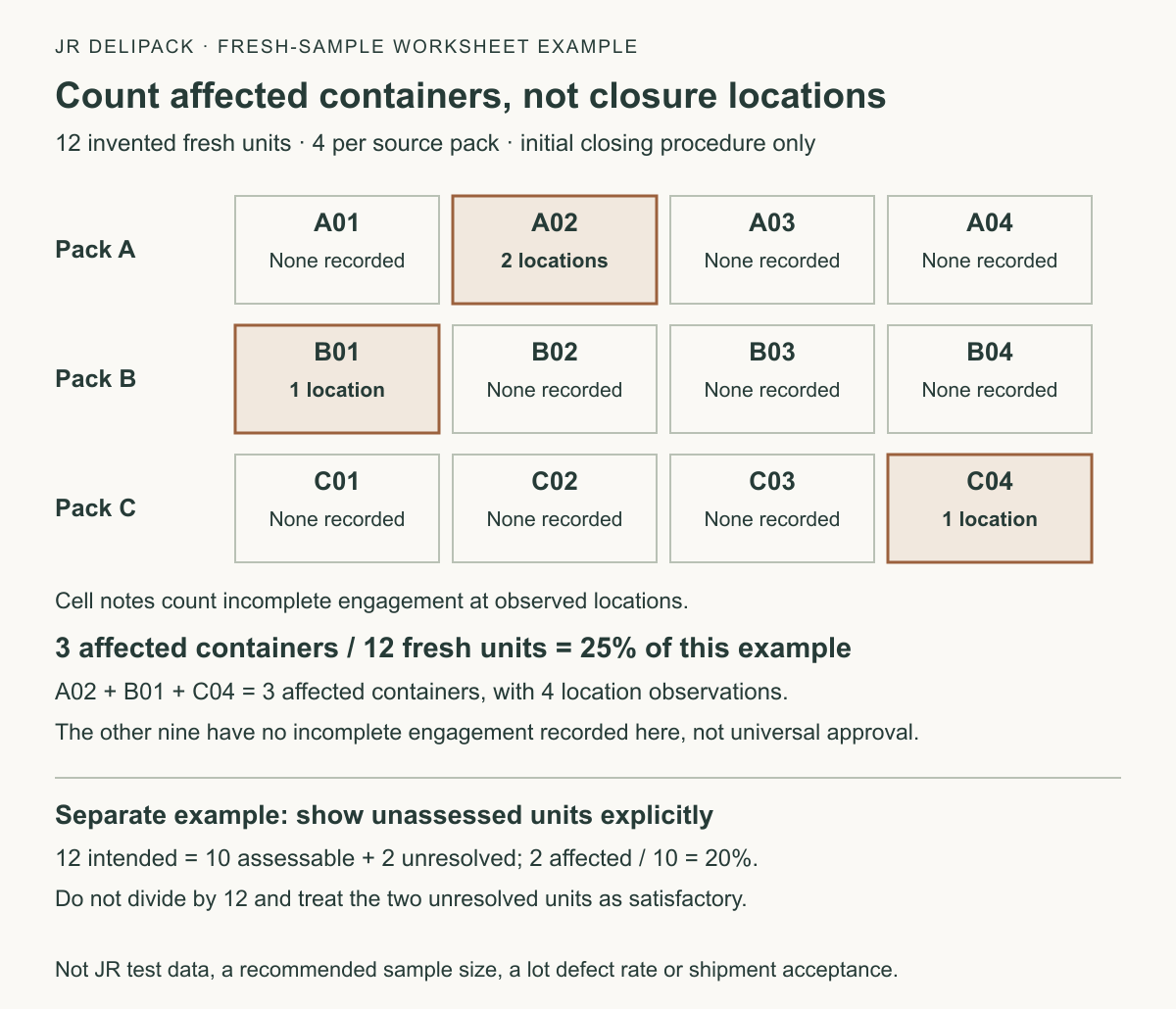
Verify closure consistency by applying one defined procedure to separately identified fresh samples and counting affected containers, not repeated attempts: in a hypothetical review of 12 containers, 3 with at least one incompletely engaged latch represent 25% of the reviewed samples. This is invented worksheet arithmetic, not a JR DELIPACK result or an estimate of an entire production lot.
The buying question is whether different new samples behave consistently enough for the next qualification decision. It is not whether one selected piece can eventually be made to close. This guide shows how to preserve sample identity, distinguish observations from conclusions and send a precise follow-up to the supplier without claiming more than the review establishes.
Hypothetical fresh-sample counts. Multiple observed latch locations on one container count once; not a JR DELIPACK product test or lot acceptance result.
What does a multi-sample closure review establish?
A useful review describes what happened to the sampled units under a stated closing procedure. It can identify differences that need investigation, help clarify handling instructions and support a decision about further evaluation. It cannot establish filled-package leak resistance, temperature suitability or the quality of every unit that will be shipped. Keep those decisions separate in the review record.
If the question concerns the geometry or alignment of a proposed design, start with the first-article lid-alignment review. Here the focus is different: once an identifiable configuration and proposed procedure exist, do several fresh samples give consistent observations? Do not repeat a full design-approval discussion inside every multi-sample worksheet.
NIST describes acceptance sampling as using a randomly selected sample to make an accept-or-reject decision about a lot under a sampling plan. It distinguishes that purpose from estimating the lot’s quality. A small convenience sample supplied for a purchasing discussion should not therefore be described as a validated lot-acceptance inspection. 1: NIST acceptance sampling · reference details
Before inspecting anything, write down the decision this exercise can support. Examples include asking for clearer closing instructions, requesting better-documented samples or proceeding to a defined application check. If shipment acceptance is the intended decision, have the responsible quality professional specify the appropriate sampling plan, criteria and risks. This article does not supply an AQL table or an accepted sample size.
How should fresh samples and source packs be identified?
Record the exact model, configuration, material description and sample source. For a separate lid, record both component references; for a hinged item, record the finished reference and any revision supplied. Keep the supplier’s lot or pack identifiers as provided. A purchase date is not automatically a manufacturing-lot identifier, and missing traceability should remain marked as missing.
Assign each fresh unit a review code that remains connected to its source pack. Mark the worksheet or a suitable external tag rather than interfering with the closure surfaces. Photograph the identifiers and overall condition when that helps a later discussion. Do not publish private factory names, shipment labels or other controlled commercial records as evidence in a public article.
If sampling across inner packs, preserve the pack distinction in the records. An illustrative plan might use four fresh units from each of three packs, making twelve units. Those quantities are invented for this worksheet, not a recommendation for shipment acceptance. Document who selected the units and how; several packs from one delivery do not automatically represent several independent manufacturing lots.
Separate damaged, used, mismatched and unidentified pieces from the intended fresh-sample set. Record their existence and why they cannot answer the current question; do not quietly replace them and report the revised group as the complete original delivery. If replacements are requested, give them new identifiers so the supplier can distinguish the first observations from the follow-up.
JR DELIPACK supplies PP, PLA and paper-based foodservice packaging with supply and manufacturing support. The hinged-container family provides product context, while the product range helps locate other formats. Availability, dimensions and suitable use conditions require confirmation for the selected model; this PP review does not certify any family.
What closing procedure should every reviewer follow?
Agree a written handling sequence before comparing candidates. Identify the supporting surface, the orientation of the container, where closing begins and how engagement will be observed. Obtain the supplier’s instructions where available and record their revision. Keep the proposed instruction separate from the actual method used, particularly if a reviewer finds the instruction incomplete or cannot follow it consistently.
Describe what an observable closure state means for this configuration. For example, the worksheet can record the specified mating points as engaged, incomplete or not assessable under the defined inspection method. Avoid a universal requirement that every design must make an audible click. A sound, visual impression or successful closing attempt should not silently replace the agreed acceptance criterion.
Use consistent lighting and positioning, and record relevant sample conditions rather than describing them as merely “normal.” If the supplier specifies conditioning requirements, follow the applicable documented procedure. Do not invent a universal waiting time or temperature range. Stop and clarify the method when a sample’s condition prevents a meaningful comparison with the rest of the set.
Observe the first defined attempt before trying corrective handling. Record an incomplete area, unexpected deformation or a need to reposition the lid. If a second attempt is appropriate, retain both observations and identify what changed. Reporting only the final successful attempt would answer a different question from whether the initial closing procedure was consistent across new samples.
Do not keep increasing hand pressure to obtain a desired result. Record a subjective “unusual force” observation as subjective. A numerical force comparison needs a defined instrument, contact location, loading direction and measurement method; hand feel alone cannot establish a force value. Stop handling when the package is visibly damaged or the procedure would create an avoidable injury risk.
Which worksheet fields make observations useful?
Use one row per independently identified fresh unit, with additional fields for locations or later attempts. Start with the sample code, source-pack reference, base and closure identity, procedure version and reviewer. Add the observed initial state, any excluded or incomplete observation, photographs where useful and the next action. Keep free-text notes alongside structured entries rather than replacing the entries.
Distinguish the container from the positions inspected on it. A single container may have more than one incompletely engaged location. Record the locations to assist investigation, but do not count that container as several affected units. Conversely, do not hide a recurring location by recording only a vague overall note such as “some closure issues.”
If more than one reviewer is involved, record who handled each unit and whether the same procedure was used. Discuss unclear observation definitions before combining their records. Disagreement may concern the criterion, visibility or technique rather than the product alone. Preserve the original observations and document the agreed interpretation; do not overwrite a dissenting entry to make the worksheet look consistent.
Keep first-use, reopening and repeated-cycle records distinguishable. Five closing cycles on one container are five observations on that item, not five fresh-container samples. Reopening may matter to the eventual application, but it introduces a different question. Identify a separate protocol and record sequence when evaluating it instead of mixing those results into the initial consistency count.
How should buyers calculate and interpret the findings?
NIST defines a sample proportion nonconforming as the number of nonconforming units divided by the sample size. Its explanation also distinguishes a unit with at least one nonconforming characteristic from the number of individual characteristics observed. Use that denominator distinction when recording closure findings; it does not make this proposed worksheet a statistically controlled production study. 2: NIST proportions and unit counts · reference details
Return to the invented twelve-container example. Suppose sample A02 has two incompletely engaged locations, B01 has one and C04 has one. That gives four recorded location observations across three affected containers. The affected-container calculation is three divided by twelve, multiplied by one hundred, or twenty-five percent. Four divided by twelve is not the percentage of affected containers because it uses a location count as its numerator.
The remaining nine containers had no incomplete engagement recorded under that initial procedure. That statement is narrower than calling nine containers universally acceptable. It says nothing about unperformed filled transport, reopening, temperature or food-contact reviews. Keep the original counts beside the percentage so the small scope of the example is visible and the arithmetic can be checked.
Missing observations need a separate denominator. In another hypothetical worksheet, twelve units were intended for assessment, ten were assessable and two of those ten showed the defined issue. The observed fraction is two divided by ten, or twenty percent, with two units unresolved. Dividing by twelve would instead give approximately sixteen-point-seven percent and would incorrectly treat the unresolved units as assessed without the issue.
Do not infer that a production lot has the same percentage, that another supplier is statistically better, or that a zero-observation sample proves zero risk. These examples illustrate record reconciliation only. An interpretation about a population or a purchasing acceptance threshold needs the relevant sampling design and decision criteria. Record those separately instead of reverse-engineering a convenient threshold after viewing the results.
When should the buyer ask for clarification or new samples?
Ask a question tied to a specific unit, location and procedure. For example, identify the sample code and describe the observed engagement state after the recorded closing sequence. Ask the supplier to confirm the matching component references and intended instruction. Send a clear photograph or short record where appropriate, without presenting your suspected cause as an established manufacturing defect.
Keep plausible explanations distinct from verified explanations. A mismatched component, handling variation, damaged rim or different revision may warrant investigation, but the worksheet alone may not identify which occurred. Request the relevant drawing reference, revision information or corrected instructions. A supplier’s explanation should be checked against the actual observation before it is recorded as the resolved cause.
When replacement samples arrive, retain the initial record and open a linked follow-up. Note what the supplier says changed and compare only the parts of the procedure that remain equivalent. If a new method is necessary, identify the new version and explain the comparison limit. Improvement after several changes does not isolate which change caused the difference.
Use a bounded decision: proceed to the next named evaluation, request clarification or corrected samples, or stop the candidate for the intended purchase. Identify the decision-maker and any conditions. “Proceed” should state what remains unproven. A sample discussion is not a signed acceptance of a future delivery, a guarantee of leak performance or a waiver of unresolved commercial terms.
How does this review connect to filled-use and evidence checks?
The National Restaurant Association advises testing packaging with the actual menu item and communicating required functions, including opening, closing and intended storage or reheating. This supports a follow-on application review; an empty closure check cannot replace it. Select conditions relevant to the real operation and handle food, liquids and temperatures under the operation’s safety controls. 3: National Restaurant Association sourcing guidance · reference details
Use the filled lid-fit and leak-evaluation guide for that separate purchasing question. The site’s lid-fit evidence guidance is another scoped reference, not proof that the particular samples passed. Carry the accepted component identity and unresolved questions forward without copying empty-sample observations into a filled-use results column.
FDA’s food-type and condition-of-use tables distinguish food categories and conditions such as room-temperature, refrigerated, frozen and reheated use for food-contact notifications. They do not certify a container’s latch or approve every PP package for every listed condition. Request evidence applicable to the selected components and intended use separately from the handling worksheet. 4: FDA food types and use conditions · reference details
Review Factory and Quality for JR DELIPACK’s public evidence approach. Keep controlled source documents private and share them only through an appropriate review arrangement. A report, product photograph or general material description should not be used to fill a missing sample observation or an unresolved applicability question.
Buyer hand-off checklist
Identify the selected configuration and keep base, closure and revision references connected to each sample.
Record source packs and how the fresh units were selected; do not describe convenience sampling as a validated lot plan.
Define the observation criteria and closing procedure before combining results from different reviewers.
Retain initial attempts, repeated attempts, missing observations and exclusions without replacing unfavorable records.
Count affected containers separately from locations, cycles and supplier responses, using a stated denominator.
State the decision, open questions and next application or evidence review; do not convert conditional progress into final approval.
Frequently asked questions
Is twelve samples the required quantity?
No. Twelve is an invented worksheet quantity used to explain identification and arithmetic. Choose an appropriate plan for the actual decision with the responsible quality reviewer. Do not use this example as an acceptance sampling standard or as permission to approve an entire shipment.
Does an audible click prove complete engagement?
Not by itself. Use the observation criteria defined for the actual closure design and check the specified locations. Record sound only if relevant to that procedure. It cannot substitute for an unobserved mating point or establish filled-package leak resistance.
How should a container with several incomplete locations be counted?
Count it once in the affected-container total and record each location separately for investigation. State both quantities with their units. Do not divide a location-event count by the number of containers and label the result a percentage of affected containers.
Can repeatedly closing one sample replace checking fresh units?
No. Repeated handling answers a different question about that particular unit and sequence. Keep those observations separate from sample-to-sample consistency. Record any changed procedure or component condition so later reviewers know what was actually compared.
What if a reviewer cannot assess a sample?
Record the reason and keep the unit unresolved rather than treating it as satisfactory. Show the intended sample count, assessable count and unresolved count. If a replacement is provided, identify it separately and retain the original gap in the record.
What is the appropriate next step after a consistent empty-sample review?
Proceed only to the next defined qualification step for the intended application, if the responsible reviewer agrees. Keep food-contact evidence, filled handling, temperatures and reopening needs distinct. A consistent initial observation does not complete those unperformed checks.
Request model-specific clarification
Contact JR DELIPACK with the sample references, intended use, procedure and specific observations. Request clarification or an appropriate sample arrangement without sending private source documents through public channels.
References
1. NIST/SEMATECH e-Handbook — What is Acceptance Sampling?Original section. Publication date not provided on the reviewed page; accessed 6 October 2026. Supports the distinction between a defined lot-acceptance decision and a convenience sample discussion. Back to supported passage.
2. NIST/SEMATECH e-Handbook — Proportions Control Charts.Original section. Publication date not provided on the reviewed page; accessed 6 October 2026. Supports the affected-unit denominator definition; no control chart or population claim is made from the invented examples. Back to supported passage.
3. National Restaurant Association — Don’t get boxed in: Do’s and don’ts in package sourcing.Original article. Published 6 April 2022; accessed 6 October 2026. Supports actual-food application evaluation and communicating required functions, not a numerical sampling plan. Back to supported passage.
4. U.S. Food and Drug Administration — Food Types & Conditions of Use for Food Contact Substances.Original tables. Publication date not provided on the reviewed page; accessed 6 October 2026. Provides notification context, not approval of a particular package or latch. Back to supported passage.
Control a takeout-container supplier change by approving the exact base–lid combination and counting usable matched sets before the cutover: in a hypothetical inventory of 9,000 compatible bases and 6,500 lids, only 6,500 complete sets are available—26 days at an assumed 250 sets per day. Those figures illustrate the calculation, not JR DELIPACK stock or a guaranteed supply forecast.
A purchasing team can receive both components on time and still lack the approved pair needed for service. This guide sets out a proposed change-control workflow for that problem. It separates component identity, suitability review, inventory allocation and the commercial decision about leftover stock. It is not a promise that every disruption can be prevented.
Illustration of a packaging transition, not evidence that particular old and new components are interchangeable.
What exactly is changing in the supplied container and lid?
Start with a written description that identifies both the current and proposed configuration. A supplier name, nominal capacity or familiar product photograph is not enough to define a replacement. Record separate base and lid codes, the drawing or specification revision, the intended food application and the effective production lot. Keep the actual old and new samples identifiable throughout the review.
Ask whether the change concerns tooling, a cavity repair, the rim or closure geometry, material formulation, colour, manufacturing location, packing arrangement or labelling. These are questions to investigate, not assertions that every listed change makes a product unsuitable. The purpose is to understand which existing evidence remains relevant and which assumptions require a fresh check.
Build a controlled master record for the approved pair. Include supplier identity, internal item codes, dimensions and agreed tolerances, component material, application limits, carton configuration, sample references and the dated approval decision. Link supporting documents to that configuration rather than storing an unexplained certificate beside a generic product family. Restrict access to commercially sensitive source records; the public article does not need factory identifiers or original certificates.
Keep item identity, revision and lot identity distinct. An item code identifies what the business purchases; a revision distinguishes an agreed specification; a lot connects delivered stock to production records. A copied label cannot resolve conflicting physical parts. If the supplier retains a code through a design change, agree another reliable way to distinguish the versions before they enter shared bins.
How should a supplier change notice work?
Request notice early enough to evaluate the proposal and manage existing orders. Do not insert a universal number of notice days: the necessary interval depends on sampling, review, remaining approved stock and the confirmed replenishment route. Name the people who can accept or reject a change, and define where their decision will be recorded. Silence should not be treated as approval in the proposed workflow.
A useful notice states the reason, affected item and revision, planned effective lot, last available old-version shipment and proposed first new-version shipment. It should identify open orders and stock already in transit, explain what documents or samples are changing, and distinguish a confirmed date from a target. Ask the supplier to flag whether both components change together or on different schedules.
Check the purchase order against the notice rather than relying on an email subject line. Record whether the buyer accepts the new version for that particular order, requests the old version, or needs an agreed alternative. Confirm any effect on quantities, packing, lead time and price separately. This prevents a technical sample acceptance from being mistaken for approval of every commercial change.
Maintain one decision record with responsibilities for purchasing, quality, warehouse operations and the foodservice user. Small businesses may assign several roles to one person; the important point is that each decision has an owner. If an urgent supply issue arises, document the limited alternative considered and its unresolved conditions instead of silently replacing the approved specification.
Which evidence needs checking before approval?
Review food-contact documentation against the actual replacement and intended market. FDA explains that effective food-contact notifications are specific to the identified manufacturer, substance and conditions of use. Where a supplier relies on that route, apparently similar material from another source is not automatically covered. Other authorization routes also exist; this does not mean every supplier change requires a new notification. 1: FDA component regulatory status · reference details
Ask a suitably qualified reviewer to resolve a mismatch in scope. Keep the conclusion specific: which component, food, contact conditions and destination does the available evidence support? A successful fit check cannot answer that regulatory question. Conversely, relevant documentation does not establish that an old lid physically closes on a new base. Retain separate decisions so neither is substituted for the other.
Evaluate replacement samples with the actual menu and intended functions. The National Restaurant Association recommends trying samples with the food being served and considering required functions such as freezing and reheating. That supports an application-based review, not a universal sample quantity or a performance claim about this replacement. 2: National Restaurant Association sourcing guidance · reference details
For separate components, list old base with old lid, old base with new lid, new base with old lid, and new base with new lid. Mark each combination approved, rejected or not evaluated for the stated use. This four-cell comparison is a planning aid, not a requirement to approve cross-version mixing. If only the new matched pair is supported, identify it clearly and keep unapproved combinations out of routine use.
Select observations according to the change: closure engagement, handling, nesting, filled transport, stacking or the relevant thermal cycle. Specify conditions and acceptance criteria before observing the samples. Use appropriate safety controls; do not improvise hot-liquid squeezing or unstable loaded stacks. Keep actual findings, photographs, interruptions and sample identities. The separate lid-fit and leak checklist covers the detailed closure investigation.
How many usable complete sets do you actually have?
Count by approved compatibility group and revision, not simply by product category. Within one group using one base and one lid per serving, the smaller usable component count limits complete sets. Exclude damaged, quarantined or otherwise unavailable units and identify stock already committed elsewhere. Do not include a promised delivery as physical stock merely because an order exists.
In the opening hypothetical example, assume all 9,000 bases and 6,500 lids are usable, unreserved and approved together. The minimum is 6,500 sets. At a constant assumed demand of 250 sets per day, dividing 6,500 by 250 gives 26 days. The remaining 2,500 bases lack lids within that inventory allocation; they are not automatically waste and should not immediately be written off.
Suppose a further 1,500 compatible old-version lids become physically available, pass the required checks and are allocated to this stock. Lids then total 8,000, allowing 8,000 matched sets and 32 days under the same demand assumption. There would still be 1,000 unmatched bases. This illustrates the effect of a component-specific action, not a recommendation to purchase that quantity without reviewing future demand and cost.
Where one lid serves several approved bases, allocate it explicitly. Counting the entire shared lid balance against every base type would promise the same lid more than once. Record the priority or reservation rule and calculate the remaining balance after each allocation. Likewise, do not combine stock from different sites if it cannot arrive where needed before service; transfer availability is a separate condition.
Keep demand assumptions visible. A daily average may hide a large event, seasonal change or uneven weekday use. Recalculate with the actual demand pattern and usable-stock records available to your business. The result is a planning estimate, not certainty about future supply. An unexplained “days of stock” figure is less useful than a dated calculation showing its components and exclusions.
Is there enough coverage for the proposed cutover?
Compare matched-set coverage with the time until replacement stock is usable, not only the supplier’s production duration. Include the relevant confirmed stages: production, transport, import processing, local delivery, receiving and release. Some stages may overlap; map the actual sequence instead of adding every quoted duration mechanically. The full-lead-time reorder guide addresses that planning question in more detail.
For a separate hypothetical calculation, assume replacement stock becomes usable in 24 days and the buyer chooses a four-day planning buffer. The resulting target is 28 days, or 7,000 sets at the assumed daily demand of 250. Against 6,500 available matched sets, the planning gap is 500 sets, equivalent to two days at that demand. The buffer is a chosen assumption, not an industry requirement.
That gap is not proof of an inevitable stockout. It signals that the selected target exceeds current matched availability. Possible responses include confirmed compatible replenishment, a revised delivery arrangement, demand allocation or another approved complete set. Compare their confirmed timing, suitability and commercial consequences. Do not assume expedited freight resolves missing compatibility evidence or makes an unapproved substitute acceptable.
Decide what happens if the cutover date slips. Record who reviews the revised matched balance, which orders are affected and when an alternative must be chosen. Keep pending stock separate from released stock in that decision. If the new version arrives before the old inventory is consumed, segregate it until the intended transition plan allows its issue.
Do packing changes need their own review?
A change can affect receiving and ordering even when the food-contact components remain physically unchanged. Compare pieces per sleeve, sleeves per carton, whether lids are included, and the order unit used on the quotation and invoice. Preserve the conversion in the item record. The portion-cup order-unit guide explains those definitions; this change-control record tracks when a conversion changes.
For businesses using GS1 identifiers, the GTIN Management Standard addresses changes to pack or case quantity, including the relevant higher packaging levels. Review section 2.8 when changing the number of items in a case or cases in a predefined pallet configuration. The standard concerns identification; a barcode does not certify lid compatibility or food-contact suitability. 3: GS1 pack and case quantity rules · reference details
Coordinate the effective change in ordering records, labels and receiving instructions. A buyer expecting the previous carton configuration needs a clear quantity reconciliation, not just a replacement item description. Keep the original order and the accepted amendment together. Do not assume the supplier’s internal code change automatically updates the distributor’s catalogue or a restaurant’s replenishment settings.
Release the transition and monitor the first deliveries
Before release, confirm the approved pair, accepted documents, identified samples, current stock allocation and dated commercial agreement. State which lots may be issued together and how old stock will be handled. Give receiving staff a practical visual or code reference and a route for escalating mismatches. Retire obsolete instructions from active use while retaining the history needed to explain earlier orders.
Use this release checklist to make the decision inspectable:
Identify the exact old and replacement base and lid revisions, together with the permitted combinations and the person authorizing them.
Reconcile usable balances with reservations, holds and incoming orders. Attach the date of the physical count and explain any difference from the purchasing record.
Confirm the effective shipment or lot and the location where each version will be stored. Specify which label or code receiving staff should expect.
Record the agreed disposition of unmatched components. Keep a requested credit or return separate from one the supplier has actually accepted.
Confirm that ordering descriptions, packing conversions and warehouse issue instructions agree. Give the responsible team the revised information before the first affected delivery.
Name the person who can stop release if the delivered version differs, and record when the first-delivery review will be completed.
For the first deliveries, reconcile what was ordered, shipped, received and released. Keep a discrepancy specific to its item, revision, lot and quantity. If closure problems or unexpected labels appear, hold the affected stock for investigation rather than casually returning it to a shared bin. Compare it with identified reference samples and seek a documented supplier response before extending any decision to unaffected lots.
Monitor operational signals with their context: mismatched components, damaged receipts, interrupted packing, customer-reported closure issues and emergency replenishment. A complaint count alone is not a defect rate. Record the relevant quantity and reporting period before comparing deliveries, and distinguish observations from confirmed causes. The review should improve the next transition, not retrospectively invent a product test result.
A backup supplier should be evaluated as a source of an approved complete combination. Nominally similar spare lids are not a continuity plan without documented compatibility and availability. Keep the backup’s minimum order, confirmed lead time, packing and application scope current. A supplier that has only been contacted is different from one whose proposed replacement has been evaluated and accepted.
Frequently asked questions
Can I mix the old lid with the new container if the diameter matches?
Not on diameter alone. Identify the exact components and the supported application, then review closure geometry and appropriate handling observations. Until that combination is accepted, keep it separate from approved stock. Similar nominal dimensions do not establish an interchangeable pair.
Who pays for lids left over after a supplier change?
The answer depends on the applicable contract, accepted orders and circumstances. Agree the commercial treatment in writing before cutover where possible, including returns, continued old-version supply or another negotiated arrangement. This checklist does not establish a legal entitlement or assign liability.
How many days of advance notice should I require?
Choose an interval based on the evaluation work, remaining approved stock and the full replenishment route. Include the time needed for a decision and any agreed contingency. There is no universal notice period supplied by this article; document the particular commitment accepted by both parties.
Does a new material supplier always require a new FDA notification?
No blanket conclusion follows from a supplier change. The authorization route and its scope must be checked. Where an effective food-contact notification is relied upon, its manufacturer, substance and use limitations matter. Have the specific evidence reviewed rather than treating a generic statement as approval.
Should uninspected incoming cartons count toward available coverage?
Keep them visible as incoming or pending stock, not released inventory. Show the expected arrival and outstanding conditions separately. Update usable coverage when the relevant quantities are actually available and accepted; otherwise the same calculation can hide a late delivery or an unresolved mismatch.
Is a backup supplier enough to prevent stockouts?
No supplier relationship guarantees continuity. Review the backup’s actual combination, supporting evidence, capacity commitment and delivery route before relying on it. Keep a dated decision on what can be purchased and used, and revisit it when the product or operating conditions change.
Prepare a clear continuity enquiry
JR DELIPACK supplies PP, PLA and paper-based foodservice packaging with supply and manufacturing support. Review the product range and factory and quality information. Availability, component pairing and supporting documents must be confirmed for the selected product and destination.
Contact JR DELIPACK with the current base and lid codes, proposed change, intended application, required quantities and delivery destination. Include the remaining matched stock and the dates that need confirmation, rather than describing a replacement only as the same size. For the wider purchasing sequence, use the complete wholesale buying guide before releasing the order.
References
1. U.S. Food and Drug Administration — Determining the Regulatory Status of Components of a Food Contact Material.Original guidance. Publication date not provided on the reviewed page; accessed 6 October 2026. Supports authorization-route and notification-scope distinctions, not approval of a JR product. Back to supported passage.
2. National Restaurant Association — Don’t get boxed in: Do’s and don’ts in package sourcing.Original article. Published 6 April 2022; accessed 6 October 2026. Supports evaluation using actual food and required functions, not the hypothetical inventory calculations. Back to supported passage.
3. GS1 — GTIN Management Standard, release 1.1, section 2.8, Pack/case quantity.Original standard. Ratified September 2023; accessed 6 October 2026. Supports trade-item identification review when packing quantities change; it does not establish physical compatibility. Back to supported passage.
Choose hinged or separate-lid sauce cups by comparing the complete filling workflow, usable stock and performance with your sauce: an assumed saving of 1 second per accepted portion equals 1,000 seconds, or about 16.7 minutes, across 1,000 portions. That arithmetic can explain why handling deserves attention, but it does not prove that either format is faster or cheaper in your operation.
The numerical examples below use invented planning inputs, not JR DELIPACK prices, trials or customer results. Replace them with documented observations before making a purchasing decision. A cup that is convenient to fill must also suit the food, hold the intended portion and remain correctly closed through the defined service journey.
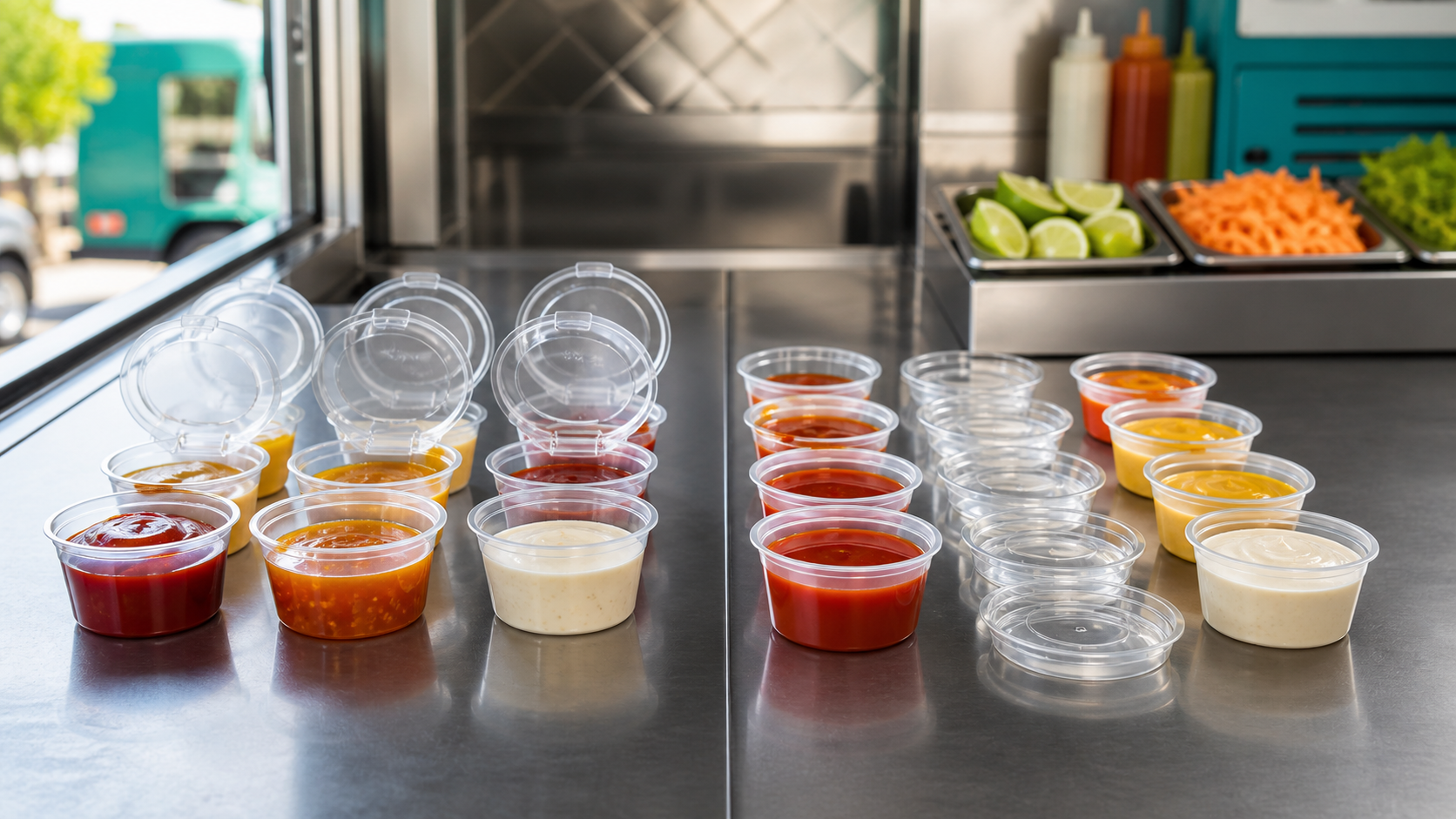
Illustrative sauce-cup workflow, not a record of the timing or cost examples in this guide. Confirm the selected cup, lid and intended application.
What actually changes when the lid is attached?
A hinged design joins the lid and cup in one supplied item. The packing station does not need a separately stocked lid for that item. Staff still need to separate nested pieces, hold the lid clear while filling, close it correctly and check the result. Fewer separate components do not automatically establish fewer errors or a faster complete cycle.
A separate-lid arrangement requires the correct cup and compatible lid to be available together. It allows the lid to be staged independently and removed completely during use. Those characteristics can be useful in a particular layout, but they also create matching and replenishment tasks. Evaluate the actual station rather than treating the number of components as the whole decision.
Do not describe hinged stock as immune to shortage. A damaged hinge, contaminated interior or rejected closure may make the whole item unavailable. With separate components, a sound cup may remain usable when its intended lid is missing, but not as a complete lidded portion. Define what counts as usable for the service being purchased.
Keep the comparison at model level. The hinge geometry, rim, lid engagement, nesting and supplied packaging can differ between products with the same nominal capacity. Confirm a shared lid arrangement in the supplier’s product information and review each proposed pairing; a matching volume label alone is not evidence that two rims fit.
Specify the sauce and service before comparing formats
Describe the actual food, portion, filling conditions and intended storage or delivery. Include whether the cup will hold a thin dressing, an oily sauce or a thicker condiment, and whether it is filled at the counter or under an approved advance-preparation process. Avoid selecting packaging from a photograph and only later asking whether the use is supported.
FDA’s food-contact reference tables distinguish aqueous, acidic and fatty food categories, as well as different filling and storage conditions. The tables were created for food-contact-substance notifications; they do not approve every cup made from a named resin. Ask for documentation that matches the selected components and intended use, with destination requirements considered separately. 1: FDA food types and conditions of use · reference details
State the required portion and how it is measured. A nominal cup capacity, a practical filling level and a recipe’s portion weight are different descriptions. Do not convert sauce weight into volume without the necessary product information. Leave sufficient operating space according to the selected product’s supported use, rather than inventing a universal fill percentage.
Include customer handling in the brief. Will the cup sit beside fries, inside a meal box or in a delivery bag? Must a customer open it without a work surface? Does an attached lid interfere with dipping or another item? These are practical questions for the sample review, not reasons to declare one closure style universally superior.
How should buyers time the complete filling workflow?
Define the start and finish before timing. A useful comparison might start when an operator reaches for packaging and finish when a correctly filled, closed and identified portion reaches its staging position. Use the same boundary for both candidates. Timing only the final closing motion omits picking, separation and any arrangement needed to present the parts.
The National Restaurant Association advises using packaging samples with the actual food and examining required functions rather than judging empty packages alone. Its guidance includes opening, closing and leakage observations. Apply that practical principle to the sauce station; it does not prescribe a sauce-cup timing result or a universal sample quantity. 2: National Restaurant Association sourcing guidance · reference details
Give operators a clear demonstration of both supplied configurations before recording comparable runs. Keep the dispenser, sauce, portion, layout and identification step consistent where possible. Record operator and run order, and vary the order across the planned comparisons so that the first unfamiliar attempt is not silently compared with a practiced attempt for the other format.
Record accepted portions separately from attempts. Retain reclosures, dropped components, rim contamination and restocking interruptions in the log. Decide whether replenishment is inside the main timing boundary or measured separately, and use that choice consistently. An attractive average is not helpful if it excludes the recurring task that slows the actual service.
Compare each operator’s runs before pooling the results. If one person is quicker with hinged cups but another is quicker with separate lids, preserve that difference and investigate the station layout or familiarity. Selecting the fastest run from each format hides ordinary variation. Also record assistance: a second person supplying lids creates labor that a single operator’s stopwatch may miss. Keep active person-time distinct from elapsed batch time when several people contribute. The simple calculation below assumes one operator works throughout each timed run; a team process needs the contributing time of each person, without counting simultaneous minutes as though they belonged to only one worker.
Calculate the time difference without claiming unearned savings
Suppose, only as an example, a separate-lid run takes 260 seconds and a hinged run takes 210 seconds to produce fifty accepted portions each. Assume the same timing boundary includes the relevant observed rework. The difference is 260 − 210 = 50 seconds, and 50 ÷ 50 = 1 second per accepted portion. These are assumed values, not measured results.
At one thousand portions, that difference becomes 1 × 1,000 = 1,000 seconds, or exactly sixteen minutes and forty seconds. Dividing by sixty gives approximately 16.7 minutes. Projecting the trial to that volume assumes the difference persists; fatigue, replenishment, interruptions and different operators may change the actual result, so check the projection against later observations.
For a separate cost illustration, assume labor is allocated at USD 24 per hour. The arithmetic is 1,000 ÷ 3,600 × 24 = USD 6.67, rounded to cents, per thousand portions. This is an allocated time value, not automatically a cash saving. Payroll falls only if an actual staffing or paid-time decision changes; released time may instead be used for another task.
Now assume the hinged item costs USD 0.004 more per complete portion package. Its added purchase cost across one thousand is 0.004 × 1,000 = USD 4.00. Under these narrow assumptions, the allocated labor difference less the purchase premium is USD 2.67. No conclusion follows about net operational savings until other relevant costs and acceptable performance have been checked.
Use a sensitivity check when the claimed advantage is small. With the same assumed hourly allocation and purchase premium, the break-even difference is 0.004 × 3,600 ÷ 24 = 0.6 seconds per portion. A measured difference below that would not offset the assumed premium through labor allocation alone. This is a decision threshold derived from inputs, not a product speed claim.
Compare storage at the station and in the stockroom
Record two storage situations: unopened supply and packaging ready for use. A compact carton does not establish a compact filling station, and a tidy station does not establish low stockroom demand. Measure the actual supplied carton dimensions, nesting arrangement, opened sleeve footprint and required access space rather than judging storage from a single empty cup.
For separate components, count complete usable sets and unmatched stock separately. In a hypothetical inventory of 1,200 usable cups and 1,000 confirmed compatible lids, only min(1,200, 1,000) = 1,000 complete sets are available, leaving 1,200 − 1,000 = 200 unmatched cups. This is arithmetic, not a JR packing specification or a recommended purchasing ratio.
An attached lid removes that particular two-component mismatch, but the buyer must still subtract unusable whole items and maintain enough of the correct model. Do not treat unmatched cups as automatically wasted: they may become usable after compatible replenishment. Record their status and intended resolution instead of immediately charging them as destroyed stock.
Keep ordering units separate from the format decision. Cup pieces, lid pieces, sleeves and complete sets should be explicit in purchase records. The portion-cup order-unit guide addresses those definitions in detail; this comparison uses complete accepted portions to avoid confusing a cheap cup-only price with a supplied cup-and-lid system.
Review question
Hinged configuration
Separate-lid configuration
What is stocked?
Usable complete items of the exact model
Usable compatible cups and lids, plus unmatched stock
What is timed?
The complete defined filling and staging cycle
The same cycle, including the defined component-picking steps
What space is measured?
Supplied cartons and opened-item staging
Supplied cup/lid cartons and both staging positions
What proves closure suitability?
Recorded observations for the actual item and sauce
Recorded observations for the exact cup/lid pair and sauce
What changes at transition?
Complete-item stock and associated workflow
Both component inventories and associated workflow
What should the closure and delivery review include?
Record the exact cup and lid identity, food, portion and supported conditions before evaluating closure. Observe how the operator seats the lid, whether the rim remains clear and how the filled item is staged. Distinguish an incorrectly assembled sample from a correctly assembled sample that later opens or leaks; the corrective actions may differ.
Use controlled handling representative of the intended service. Do not casually invert hot or hazardous contents, squeeze filled cups toward people or create an unsupported temperature exposure. Have responsible staff define a safe observation method and stopping conditions. The separate lid-fit and leak checklist provides the dedicated component-review framework.
Record individual outcomes, not just a single overall impression. Include where moisture or sauce appeared, whether the lid disengaged, whether the body changed shape and what happened when the customer-style opening was attempted. Photographs can support these observations, but an image of a closed cup is not evidence that it survived the complete journey.
Do not trade an unacceptable closure result for a favorable stopwatch result. Decide the required performance before reviewing the comparison and keep unsuccessful samples visible. A candidate may warrant another evaluation after a defined adjustment, but a trial on one sauce or temperature does not establish suitability for every condiment in the operation.
Consider staff handling and advance preparation separately
Ask staff about reaching, grip, repeated closing effort and access to packaging while keeping food-handling controls intact. Speed alone does not describe the quality of a task. If an operator must adopt an awkward movement to make a candidate appear fast, include that observation in the purchasing review rather than rewarding the shortest time.
OSHA’s ergonomic guidance recommends designing tasks to reduce exposure to risk factors, including physical changes that reduce excessive reaching and support neutral postures. It distinguishes engineering changes from administrative or work-practice controls. This supports reviewing the station as well as the package; it does not certify a lid style or establish a safe closure-force value. 3: OSHA ergonomic hazard controls · reference details
Advance filling is a separate operational decision. Before comparing prefilled and filled-to-order portions, confirm the sauce’s applicable handling, identification, storage and disposal procedures with the responsible food-safety lead. A closed cup does not create a shelf-life claim, and a convenient stacking arrangement does not establish that advance preparation is suitable.
FDA publishes the Food Code as a model for jurisdictions developing their own rules. Its current page identifies the 2026 edition; local adoption and applicable requirements must still be confirmed. Do not borrow a generic holding period from a packaging comparison and apply it to all house-made sauces. 4: FDA Food Code model status · reference details
Record a purchasing decision and manage the changeover
Summarize the comparison in a short decision record: exact models, application, timing boundary, accepted counts, rework, storage observations, closure results and unresolved questions. State whether the evidence supports a limited operational evaluation, another sample request or an order for the defined use. Avoid an unrestricted approval that loses the conditions of the review.
If switching formats, identify remaining usable stock before ordering replacements. Keep old and new separate-lid components clearly identified until compatibility and the transition plan are settled. An attached-lid change also needs a plan for remaining old complete items. Do not blend stock merely because the packages share a color or nominal size.
Include the reference sample and agreed product information with the purchasing record. Ask for notification of changes relevant to the accepted configuration, such as lid, rim, material, nesting or supplied packing. The broader supplier change-control guide addresses transitions; this article’s decision remains the specific sauce-cup format and workflow.
Packets or sauce applied directly to food may belong in a different comparison if the menu and service allow them. They change preparation, portion choice and customer handling, so do not add them to a cup trial and claim that only lid style changed. Set a new comparison boundary before drawing an economic conclusion.
Frequently asked questions
Are hinged sauce cups always cheaper to use?
No. Compare the complete package and observed workflow with the intended sauce. The illustrative labor calculation only shows how to value an assumed time difference. It does not include every operating cost or demonstrate that one format lowers payroll, waste or total purchasing expenditure.
Can one separate lid fit several cup sizes?
Only rely on combinations identified as compatible in the relevant product information and reviewed for your use. Confirm exact cup and lid references rather than inferring compatibility from capacity alone. Keep each accepted pairing in the purchasing record so that a future substitution does not silently change the combination.
Is fifty portions a required test quantity?
No. Fifty accepted portions is an invented example used to explain timing arithmetic. It is not a validated acceptance sample size or evidence of statistical confidence. Select the actual comparison scope according to the purchasing question, operating variability and the review needed by responsible staff.
Should I count rejected portions in the timing?
Define a consistent boundary and retain the time and reason for observed rework or rejection. Reporting time per accepted portion prevents an apparently fast run with incomplete output from being compared as if it produced the same usable result. Record rejected packaging and food separately to avoid double-counting losses.
Does an attached lid eliminate inventory risk?
It removes the need to match a separately stocked lid for that item, but it does not eliminate damage, contamination, shortage or wrong-model selection. Count usable whole items. For separate components, distinguish complete compatible sets from unmatched stock and decide how that stock will be resolved.
What should be included in a sample request?
Describe the sauce, portion, supported filling and service conditions, quantity and destination. Request exact component references, dimensions, supplied packing and relevant documentation. Explain the closure, handling or storage question to be evaluated, so that the sample request serves a defined decision rather than an unsupported general performance claim.
Define the application with JR DELIPACK
JR DELIPACK supplies PP, PLA and paper-based foodservice packaging with supply and manufacturing support. Review the product range and factory and quality information when preparing an enquiry. Availability, configuration and supporting evidence must be confirmed for the selected product and destination.
Contact JR DELIPACK with your sauce, portion, weekly requirement, service conditions and preferred closure arrangement. Include the specific workflow or compatibility questions that should guide sample discussions.
4. FDA, Food Code. Publication date not provided for this overview. Read 6 October 2026. Model-code status and current edition; local applicability requires separate confirmation. Back to the relevant paragraph.
Approve the exact container-and-lid pairing under its intended use conditions before placing a wholesale order: a hypothetical comparison of 3 pairings, 2 food types, 2 handling conditions and 3 separate specimens per combination requires 36 filled sets. That arithmetic is a planning example, not a recommended minimum sample size, an acceptance standard or evidence that any product has passed testing.
A useful approval record connects the product references, how staff close the lid, the intended contents and the journey to the customer. A matching capacity label or similar photograph cannot supply all that information. Buyers need to know what was checked, what was observed and what remains outside the approval before committing to repeated supply.
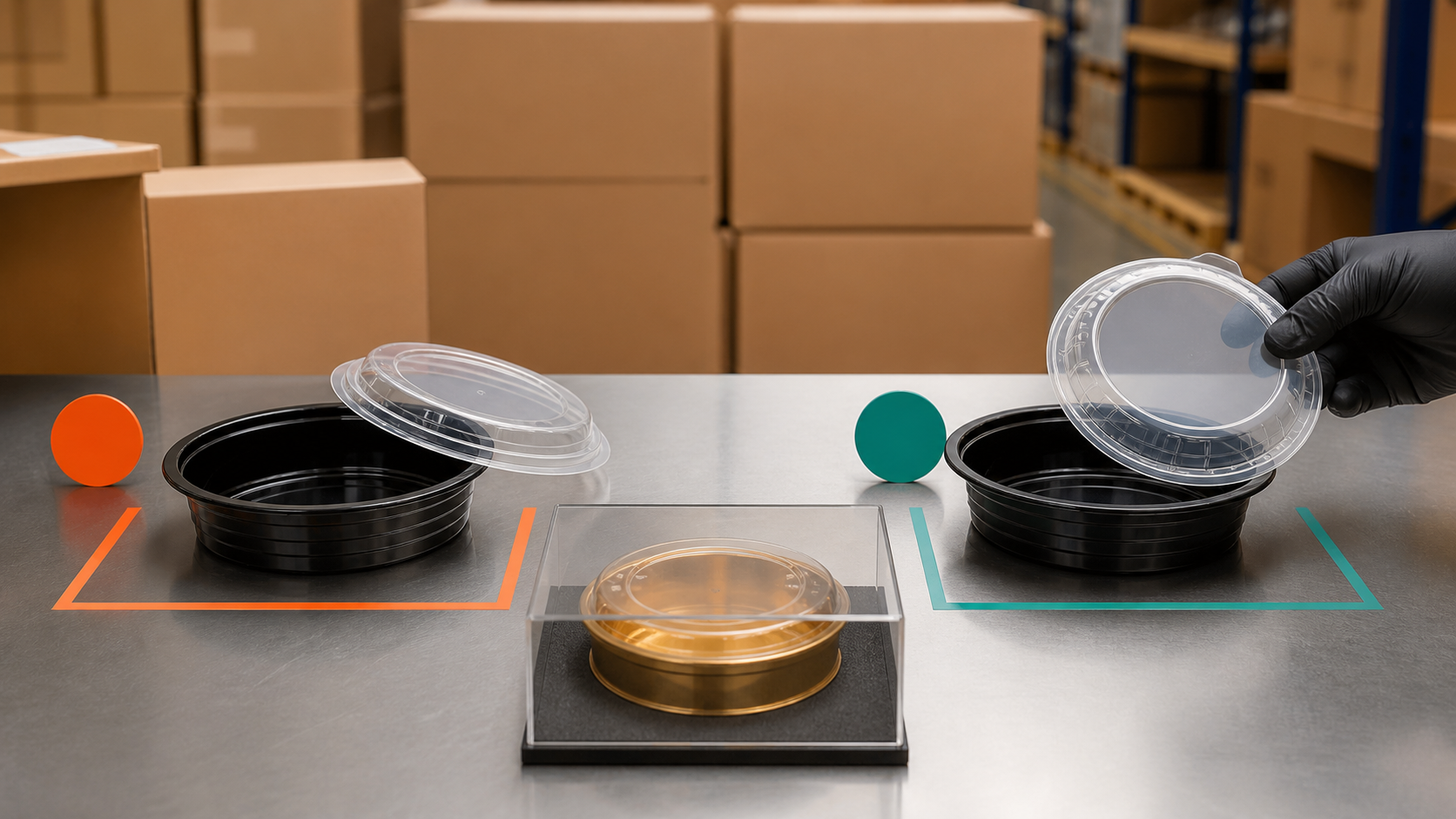
Illustrative pairing-review scene, not a JR DELIPACK test record or proof of food-contact suitability, lid fit or leakage performance.
This guide preserves an eight-point pre-order checklist and adds a way to organise observations and manage component changes. It addresses purchasing controls, not a new JR DELIPACK test dataset. Reported observations and their limitations belong on the separate leak and lid-fit evidence page. The examples here remain hypothetical and do not extend those results to other models or uses.
For purchasing quantities, use the separate portion cup packing-unit guide; for commercial scope, use the quotation checklist. Neither an accurate count nor a clear quotation proves closure performance.
Define the pairing and the approval question
Give each proposed base-and-lid combination its own reference. Record the base model, lid model, revision, material declaration and sample identification. If one lid is proposed for several bases, list each pairing rather than writing “universal lid” as the approval. A change to one component should be traceable without requiring staff to reconstruct which samples were used months earlier.
Describe the actual foodservice task. A buyer might need a container for upright counter collection, a stacked delivery bag or refrigerated storage followed by transport. Specify fill level, holding time, orientation and handling sequence. Keep the intended task distinct from a marketing claim: “evaluated upright for this route” is narrower than “leak-proof in every situation.”
Separate physical fit from food-contact documentation. FDA’s food-contact substance tables distinguish food categories and conditions including room-temperature, refrigerated, frozen and reheating uses. These categories concern substance notifications; they are not lid-fit methods or permission to expose an unverified container to those conditions. Use the intended food and treatment to frame the supplier-document review alongside the physical checks. FDA food types and conditions of use[1]
Use the eight-point pre-order checklist
1 Record the approved component pair in writing
Connect the quotation, drawing or specification, sample labels and purchase order to the same component references. Ask the supplier to identify any lid revision or alternative being offered. Where a photograph shows several sizes, label the actual proposed combination. Do not substitute an unlisted lid merely because its colour and nominal diameter look similar to the original sample.
For a shared-lid programme, make a small pairing table with one row per base. Give every row a separate status, such as awaiting samples, evaluated for a named use or not approved. This prevents approval of one base from being unintentionally extended to every product in the family. Keep unresolved rows visible rather than treating silence as acceptance.
2 Identify samples and measurement conditions
Record where the samples came from, their lot or other available identifiers, and whether they were supplied specifically for evaluation. Agree which dimensions matter and how they will be measured. If variation across stacks, production lots or tooling positions matters to the buying decision, discuss that coverage with the supplier or testing specialist before selecting specimens.
Use a written measurement method and record the instrument and units. A nominal catalogue dimension is not automatically the same as a measured sealing surface. Avoid presenting a single measurement as the tolerance range of an entire production lot. Where drawings or tolerances are unavailable, note that limitation and seek clarification instead of inventing a dimensional acceptance band.
3 Observe the normal closing process
Ask the intended operators to close representative samples using the proposed work method. Record whether they needed to press particular corners, reseat a section, clear the rim or restart. If closing time is commercially important, define a local trial and measure it consistently. Do not claim an improvement in line speed merely because a sample feels easier to close.
Where closing force is a specified requirement, agree the measurement method with an appropriately equipped reviewer. A subjective description such as “firm” or “easy” is useful feedback but not a force measurement. Keep operator observations separate from measured results, and do not introduce hot contents or unfamiliar equipment into a trial without an appropriate safe procedure.
4 Check engagement around the complete rim
Inspect the whole perimeter under an agreed visual method rather than relying on a sound from one location. Record gaps, lifted corners, deformation or incomplete engagement and identify the affected specimen. A photograph should show the relevant area clearly and remain linked to the sample record. Record the condition before opening or otherwise changing the sample for investigation.
Ask the supplier what complete engagement looks like for that design, including hinge or tab areas where relevant. Do not assume every lid uses the same closure geometry. If operators disagree about whether a sample is properly closed, resolve the instruction before evaluating the remaining set; inconsistent preparation makes later observations harder to interpret.
5 Define the fill and orientation check
Agree the intended contents or an appropriate safe substitute, fill quantity, headspace, orientation sequence and observation time. These fields belong in the method before the check starts. If the intended food differs from the substitute, describe that difference and avoid generalising the result. A simple water observation should not be presented as proof for every sauce, oil content or meal configuration.
For any local exploratory check, record where liquid appeared and under which step, not just a final yes-or-no score. Distinguish liquid at the rim, external wetting and a lid that disengaged. Keep deliberate opening or destructive examination separate from the initial observation, and do not reopen and reclose the same sample while still counting it as an untouched replicate.
6 Consider the actual stacking and transport arrangement
Describe the filled container, bag, dividers and outer packaging as used together. Record the proposed stack, orientation and handling route instead of applying an unexplained hand squeeze and calling it a transport test. If a formal distribution test is needed, agree an appropriate current protocol with a capable laboratory; the product and outer package must match the intended evaluation.
ISTA distinguishes early screening tests from general transport simulations. Its 1-Series challenges the product/package combination without simulating distribution, while its 3-Series addresses transport hazards. Those categories help frame a laboratory discussion; the checklist here is not an ISTA procedure, certification or verified simulation of a restaurant delivery route. ISTA test procedure categories[2]
7 Keep temperature checks inside the declared use
Confirm the product’s documented intended conditions before choosing a thermal sequence. Record the actual starting condition, elapsed time and observation point. A room-temperature result should remain a room-temperature result; it does not independently settle hot-fill, freezing, reheating or repeated-use questions. Use qualified support where evaluating those conditions requires specialist equipment or safety controls.
FDA’s substance inventory links entries to specific intended uses and conditions, and notes other authorisation inventories. It is not a catalogue of finished containers certified for every application. Ask for documentation applicable to the exact product and intended use rather than treating the material name, a generic logo or a passing lid check as the whole food-contact assessment. FDA food-contact substance inventory scope[3]
8 Retain the approval record and reference samples
Label and retain the agreed base and lid reference samples with their approval date and applicable specification. Save the method, original observations, photographs and decision together. A reference sample is useful for comparison, but it does not replace a written specification or prove that every later delivery matches it. Make responsibility for checking incoming changes explicit.
ISTA’s selection guidance emphasises representative samples, criteria established before testing and records made as testing proceeds. It also distinguishes investigative inspections from complete certification testing. Keep those boundaries when commissioning formal work; do not describe a modified local exercise as an unmodified ISTA test. ISTA selection and documentation guidance[4]
Build a comparison matrix before collecting results
Use one row for each combination that answers a purchasing question. In the opening hypothetical example, three component pairings are compared across two food types and two handling conditions. That creates twelve combinations. Assigning three separate filled specimens to each combination gives thirty-six specimens in total. The example illustrates workload only; it does not establish statistical confidence or an adequate acceptance sample for a real order.
Write the actual combinations rather than just the total. If a product is not documented for one proposed condition, remove that use from consideration or obtain the necessary evidence before testing it. Do not expose it to the condition merely to complete a symmetrical table. Different intended uses may require different methods and should not be combined into a single score without explanation.
Field in the local review record
Information to enter
Pair and revision
Exact base and lid references
Specimen identity
Lot and individual sample label
Contents and preparation
Food or substitute, quantity, closing method
Conditions
Agreed time, orientation and temperature scope
Observation
What happened, where and at which step
Method deviation
Any departure from the agreed sequence
Decision
Scope approved, unresolved issue or rejection
Evidence
Linked photograph, measurement or laboratory report
Keep missing observations distinct from successful ones. If a specimen was not evaluated because its label was lost or the sequence was interrupted, record that status. Replacing a missing result with “pass” would make the comparison misleading. A replacement specimen should receive its own identity and reason, preserving the original incomplete record.
Interpret observations without overstating the evidence
Suppose, hypothetically, Pair A has two observations of external liquid among twelve evaluated specimens, while Pair B has none among twelve. The observed proportions are two divided by twelve, or 16.7%, and zero divided by twelve, or 0%, for those specimens under those conditions. They are not established shipment defect rates, supplier-wide failure rates or guaranteed future performance.
Look at the combinations behind the totals. If both observations for Pair A occurred with the same food and handling condition, that detail matters more to the next investigation than the combined percentage alone. Equally, Pair B cannot be declared universally leak-proof because this small illustrative set had no observed leaks. The decision should state the actual approved task and remaining uncertainty.
Do not erase an initial failure after a modified sample passes. Record what changed, why, which new specimens were used and whether the same method was repeated. If a laboratory is involved, use its report and limitations rather than rewriting the conclusion into a broader marketing claim. A buyer can request further work without asserting that the first observation proves the whole production lot defective.
Prevent incompatible stock during a component change
Before approving a new base, identify the lids already held, the old bases still available and orders that remain committed. Ask the supplier which pairings will continue to be supported and whether any proposed substitution needs a fresh review. Keep old and new revisions separated in stock records and at the packing station until the transition is clear.
For an illustrative transition, assume a buyer has 5,000 old-revision lids and only 2,000 matching old-revision bases, with no approved use for those lids on the new base. The buyer can form at most 2,000 old-revision sets, leaving 3,000 lids requiring a documented plan. That is 60% of the old-lid stock, not a demonstrated financial loss or proof that the new base is defective.
Possible actions include obtaining confirmed compatible bases, an agreed return arrangement or another documented use supported by compatibility evidence. Do not force a pairing to consume inventory. Record who owns the transition decision and when old stock should stop being issued. A purchasing-system note is not enough if mixed lids remain physically indistinguishable to operators.
Compare separate and hinged formats for the actual workflow
With separate lids, verify the picking, storage and approved pairing for each component. A shared-lid arrangement should have a maintained list of compatible bases. With a hinged format, verify the attached closure, storage arrangement and how staff handle the open lid during filling. Neither format deserves an automatic speed, space or leakage advantage without a defined comparison.
Run any operational comparison against the same intended task and record the differences. If pack counts, working space or food portions differ, keep those differences visible rather than attributing the whole outcome to the lid format. A dry-item trial should not become the evidence for a liquid-filled application. The purchase decision should explain which observations support the selected configuration.
Put the agreed scope into the purchase order
The order should identify both components, the specification revision, permitted substitutions if any, packing quantities, relevant product documents and the approved use. Link the closure and leakage review by record number or agreed description. Keep quantities and price units in the commercial schedule, while leaving technical acceptance conditions precise enough that both parties understand what will be checked.
Add a change-notification process for relevant component or specification changes and a defined route for reporting discrepancies. A complaint record should name the order, component pair, affected lot, observation and evidence. Do not publish private supplier documents or unrelated upstream identifiers as part of a routine buying guide; share necessary product-specific evidence through an appropriate controlled review.
JR DELIPACK supplies PP, PLA and paper-based foodservice packaging with supply and manufacturing support. Use the product range to identify the proposed format and the factory and quality information to frame document questions. Product-specific suitability and component pairing require confirmation for the intended application.
For a sample enquiry, contact JR DELIPACK with the proposed base and lid, food type, fill conditions, destination, handling sequence and order quantity. Request confirmation of the applicable product documents and a practical review plan rather than asking for an undefined universal performance guarantee.
Frequently asked questions
Can lids from different suppliers be interchangeable?
Do not assume interchangeability from capacity or appearance. Identify the exact pair, review the specification and evaluate the intended use before approving a substitution. Keep any approval limited to the documented combination and revision rather than extending it to every similarly named product.
Is a snap sound enough to approve the closure?
No. An approval record should establish engagement around the complete rim and observations under the agreed method. Record any corners or sections requiring attention. A sound alone does not document the whole closure or establish performance during storage and delivery.
Does a successful local check justify a leak-proof claim?
Only describe what the evidence supports. Record the contents, preparation, orientation, time and other relevant conditions. A limited local check should not become an unrestricted performance claim, and it does not establish food-contact suitability or formal third-party certification.
How many specimens should a buyer evaluate?
Agree the plan with the supplier or a qualified testing specialist based on the decision, variation and intended use. The thirty-six-specimen example explains a matrix calculation only. It is not a universal minimum, a statistical sampling standard or an acceptance rule for commercial shipments.
Should failed samples be checked again after an adjustment?
Retain the original result and document the adjustment before further evaluation. Use clearly identified specimens and distinguish diagnostic work from the agreed acceptance method. A later successful observation does not justify deleting earlier evidence or claiming that no issue occurred.
What should happen to lids when the matching base changes?
Reconcile existing stock and outstanding orders before the change. Confirm approved pairings, separate revisions physically where necessary and agree a transition plan for components without a supported use. Do not assume a new base can consume old lids solely because the nominal size is unchanged.
Verified quality issues attributable to us will be resolved by replacement or credit, as agreed with the buyer. Third-party inspection welcome.
Report visible issues within 10 calendar days of receipt at the agreed destination. Report defects not reasonably identifiable during the initial inspection promptly after discovery.
For issues attributable to us, we cover reasonable remedial freight costs, with arrangements agreed in writing in advance.