
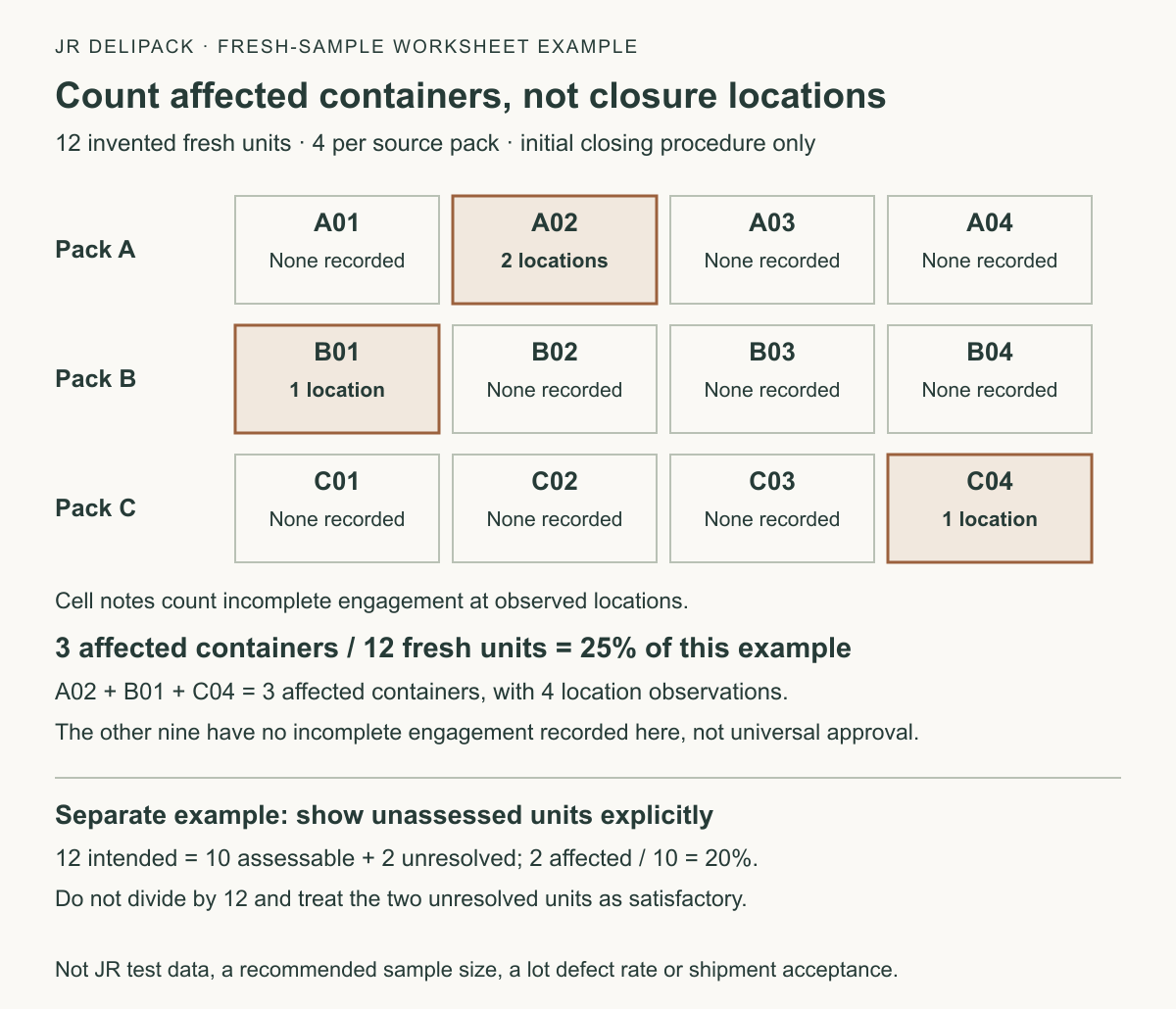
Verify closure consistency by applying one defined procedure to separately identified fresh samples and counting affected containers, not repeated attempts: in a hypothetical review of 12 containers, 3 with at least one incompletely engaged latch represent 25% of the reviewed samples. This is invented worksheet arithmetic, not a JR DELIPACK result or an estimate of an entire production lot.
The buying question is whether different new samples behave consistently enough for the next qualification decision. It is not whether one selected piece can eventually be made to close. This guide shows how to preserve sample identity, distinguish observations from conclusions and send a precise follow-up to the supplier without claiming more than the review establishes.
What does a multi-sample closure review establish?
A useful review describes what happened to the sampled units under a stated closing procedure. It can identify differences that need investigation, help clarify handling instructions and support a decision about further evaluation. It cannot establish filled-package leak resistance, temperature suitability or the quality of every unit that will be shipped. Keep those decisions separate in the review record.
If the question concerns the geometry or alignment of a proposed design, start with the first-article lid-alignment review. Here the focus is different: once an identifiable configuration and proposed procedure exist, do several fresh samples give consistent observations? Do not repeat a full design-approval discussion inside every multi-sample worksheet.
NIST describes acceptance sampling as using a randomly selected sample to make an accept-or-reject decision about a lot under a sampling plan. It distinguishes that purpose from estimating the lot’s quality. A small convenience sample supplied for a purchasing discussion should not therefore be described as a validated lot-acceptance inspection. 1: NIST acceptance sampling · reference details
Before inspecting anything, write down the decision this exercise can support. Examples include asking for clearer closing instructions, requesting better-documented samples or proceeding to a defined application check. If shipment acceptance is the intended decision, have the responsible quality professional specify the appropriate sampling plan, criteria and risks. This article does not supply an AQL table or an accepted sample size.
How should fresh samples and source packs be identified?
Record the exact model, configuration, material description and sample source. For a separate lid, record both component references; for a hinged item, record the finished reference and any revision supplied. Keep the supplier’s lot or pack identifiers as provided. A purchase date is not automatically a manufacturing-lot identifier, and missing traceability should remain marked as missing.
Assign each fresh unit a review code that remains connected to its source pack. Mark the worksheet or a suitable external tag rather than interfering with the closure surfaces. Photograph the identifiers and overall condition when that helps a later discussion. Do not publish private factory names, shipment labels or other controlled commercial records as evidence in a public article.
If sampling across inner packs, preserve the pack distinction in the records. An illustrative plan might use four fresh units from each of three packs, making twelve units. Those quantities are invented for this worksheet, not a recommendation for shipment acceptance. Document who selected the units and how; several packs from one delivery do not automatically represent several independent manufacturing lots.
Separate damaged, used, mismatched and unidentified pieces from the intended fresh-sample set. Record their existence and why they cannot answer the current question; do not quietly replace them and report the revised group as the complete original delivery. If replacements are requested, give them new identifiers so the supplier can distinguish the first observations from the follow-up.
JR DELIPACK supplies PP, PLA and paper-based foodservice packaging with supply and manufacturing support. The hinged-container family provides product context, while the product range helps locate other formats. Availability, dimensions and suitable use conditions require confirmation for the selected model; this PP review does not certify any family.
What closing procedure should every reviewer follow?
Agree a written handling sequence before comparing candidates. Identify the supporting surface, the orientation of the container, where closing begins and how engagement will be observed. Obtain the supplier’s instructions where available and record their revision. Keep the proposed instruction separate from the actual method used, particularly if a reviewer finds the instruction incomplete or cannot follow it consistently.
Describe what an observable closure state means for this configuration. For example, the worksheet can record the specified mating points as engaged, incomplete or not assessable under the defined inspection method. Avoid a universal requirement that every design must make an audible click. A sound, visual impression or successful closing attempt should not silently replace the agreed acceptance criterion.
Use consistent lighting and positioning, and record relevant sample conditions rather than describing them as merely “normal.” If the supplier specifies conditioning requirements, follow the applicable documented procedure. Do not invent a universal waiting time or temperature range. Stop and clarify the method when a sample’s condition prevents a meaningful comparison with the rest of the set.
Observe the first defined attempt before trying corrective handling. Record an incomplete area, unexpected deformation or a need to reposition the lid. If a second attempt is appropriate, retain both observations and identify what changed. Reporting only the final successful attempt would answer a different question from whether the initial closing procedure was consistent across new samples.
Do not keep increasing hand pressure to obtain a desired result. Record a subjective “unusual force” observation as subjective. A numerical force comparison needs a defined instrument, contact location, loading direction and measurement method; hand feel alone cannot establish a force value. Stop handling when the package is visibly damaged or the procedure would create an avoidable injury risk.
Which worksheet fields make observations useful?
Use one row per independently identified fresh unit, with additional fields for locations or later attempts. Start with the sample code, source-pack reference, base and closure identity, procedure version and reviewer. Add the observed initial state, any excluded or incomplete observation, photographs where useful and the next action. Keep free-text notes alongside structured entries rather than replacing the entries.
Distinguish the container from the positions inspected on it. A single container may have more than one incompletely engaged location. Record the locations to assist investigation, but do not count that container as several affected units. Conversely, do not hide a recurring location by recording only a vague overall note such as “some closure issues.”
If more than one reviewer is involved, record who handled each unit and whether the same procedure was used. Discuss unclear observation definitions before combining their records. Disagreement may concern the criterion, visibility or technique rather than the product alone. Preserve the original observations and document the agreed interpretation; do not overwrite a dissenting entry to make the worksheet look consistent.
Keep first-use, reopening and repeated-cycle records distinguishable. Five closing cycles on one container are five observations on that item, not five fresh-container samples. Reopening may matter to the eventual application, but it introduces a different question. Identify a separate protocol and record sequence when evaluating it instead of mixing those results into the initial consistency count.
How should buyers calculate and interpret the findings?
NIST defines a sample proportion nonconforming as the number of nonconforming units divided by the sample size. Its explanation also distinguishes a unit with at least one nonconforming characteristic from the number of individual characteristics observed. Use that denominator distinction when recording closure findings; it does not make this proposed worksheet a statistically controlled production study. 2: NIST proportions and unit counts · reference details
Return to the invented twelve-container example. Suppose sample A02 has two incompletely engaged locations, B01 has one and C04 has one. That gives four recorded location observations across three affected containers. The affected-container calculation is three divided by twelve, multiplied by one hundred, or twenty-five percent. Four divided by twelve is not the percentage of affected containers because it uses a location count as its numerator.
The remaining nine containers had no incomplete engagement recorded under that initial procedure. That statement is narrower than calling nine containers universally acceptable. It says nothing about unperformed filled transport, reopening, temperature or food-contact reviews. Keep the original counts beside the percentage so the small scope of the example is visible and the arithmetic can be checked.
Missing observations need a separate denominator. In another hypothetical worksheet, twelve units were intended for assessment, ten were assessable and two of those ten showed the defined issue. The observed fraction is two divided by ten, or twenty percent, with two units unresolved. Dividing by twelve would instead give approximately sixteen-point-seven percent and would incorrectly treat the unresolved units as assessed without the issue.
Do not infer that a production lot has the same percentage, that another supplier is statistically better, or that a zero-observation sample proves zero risk. These examples illustrate record reconciliation only. An interpretation about a population or a purchasing acceptance threshold needs the relevant sampling design and decision criteria. Record those separately instead of reverse-engineering a convenient threshold after viewing the results.
When should the buyer ask for clarification or new samples?
Ask a question tied to a specific unit, location and procedure. For example, identify the sample code and describe the observed engagement state after the recorded closing sequence. Ask the supplier to confirm the matching component references and intended instruction. Send a clear photograph or short record where appropriate, without presenting your suspected cause as an established manufacturing defect.
Keep plausible explanations distinct from verified explanations. A mismatched component, handling variation, damaged rim or different revision may warrant investigation, but the worksheet alone may not identify which occurred. Request the relevant drawing reference, revision information or corrected instructions. A supplier’s explanation should be checked against the actual observation before it is recorded as the resolved cause.
When replacement samples arrive, retain the initial record and open a linked follow-up. Note what the supplier says changed and compare only the parts of the procedure that remain equivalent. If a new method is necessary, identify the new version and explain the comparison limit. Improvement after several changes does not isolate which change caused the difference.
Use a bounded decision: proceed to the next named evaluation, request clarification or corrected samples, or stop the candidate for the intended purchase. Identify the decision-maker and any conditions. “Proceed” should state what remains unproven. A sample discussion is not a signed acceptance of a future delivery, a guarantee of leak performance or a waiver of unresolved commercial terms.
How does this review connect to filled-use and evidence checks?
The National Restaurant Association advises testing packaging with the actual menu item and communicating required functions, including opening, closing and intended storage or reheating. This supports a follow-on application review; an empty closure check cannot replace it. Select conditions relevant to the real operation and handle food, liquids and temperatures under the operation’s safety controls. 3: National Restaurant Association sourcing guidance · reference details
Use the filled lid-fit and leak-evaluation guide for that separate purchasing question. The site’s lid-fit evidence guidance is another scoped reference, not proof that the particular samples passed. Carry the accepted component identity and unresolved questions forward without copying empty-sample observations into a filled-use results column.
FDA’s food-type and condition-of-use tables distinguish food categories and conditions such as room-temperature, refrigerated, frozen and reheated use for food-contact notifications. They do not certify a container’s latch or approve every PP package for every listed condition. Request evidence applicable to the selected components and intended use separately from the handling worksheet. 4: FDA food types and use conditions · reference details
Review Factory and Quality for JR DELIPACK’s public evidence approach. Keep controlled source documents private and share them only through an appropriate review arrangement. A report, product photograph or general material description should not be used to fill a missing sample observation or an unresolved applicability question.
Buyer hand-off checklist
- Identify the selected configuration and keep base, closure and revision references connected to each sample.
- Record source packs and how the fresh units were selected; do not describe convenience sampling as a validated lot plan.
- Define the observation criteria and closing procedure before combining results from different reviewers.
- Retain initial attempts, repeated attempts, missing observations and exclusions without replacing unfavorable records.
- Count affected containers separately from locations, cycles and supplier responses, using a stated denominator.
- State the decision, open questions and next application or evidence review; do not convert conditional progress into final approval.
Frequently asked questions
Is twelve samples the required quantity?
No. Twelve is an invented worksheet quantity used to explain identification and arithmetic. Choose an appropriate plan for the actual decision with the responsible quality reviewer. Do not use this example as an acceptance sampling standard or as permission to approve an entire shipment.
Does an audible click prove complete engagement?
Not by itself. Use the observation criteria defined for the actual closure design and check the specified locations. Record sound only if relevant to that procedure. It cannot substitute for an unobserved mating point or establish filled-package leak resistance.
How should a container with several incomplete locations be counted?
Count it once in the affected-container total and record each location separately for investigation. State both quantities with their units. Do not divide a location-event count by the number of containers and label the result a percentage of affected containers.
Can repeatedly closing one sample replace checking fresh units?
No. Repeated handling answers a different question about that particular unit and sequence. Keep those observations separate from sample-to-sample consistency. Record any changed procedure or component condition so later reviewers know what was actually compared.
What if a reviewer cannot assess a sample?
Record the reason and keep the unit unresolved rather than treating it as satisfactory. Show the intended sample count, assessable count and unresolved count. If a replacement is provided, identify it separately and retain the original gap in the record.
What is the appropriate next step after a consistent empty-sample review?
Proceed only to the next defined qualification step for the intended application, if the responsible reviewer agrees. Keep food-contact evidence, filled handling, temperatures and reopening needs distinct. A consistent initial observation does not complete those unperformed checks.
Request model-specific clarification
Contact JR DELIPACK with the sample references, intended use, procedure and specific observations. Request clarification or an appropriate sample arrangement without sending private source documents through public channels.
References
1. NIST/SEMATECH e-Handbook — What is Acceptance Sampling? Original section. Publication date not provided on the reviewed page; accessed 6 October 2026. Supports the distinction between a defined lot-acceptance decision and a convenience sample discussion. Back to supported passage.
2. NIST/SEMATECH e-Handbook — Proportions Control Charts. Original section. Publication date not provided on the reviewed page; accessed 6 October 2026. Supports the affected-unit denominator definition; no control chart or population claim is made from the invented examples. Back to supported passage.
3. National Restaurant Association — Don’t get boxed in: Do’s and don’ts in package sourcing. Original article. Published 6 April 2022; accessed 6 October 2026. Supports actual-food application evaluation and communicating required functions, not a numerical sampling plan. Back to supported passage.
4. U.S. Food and Drug Administration — Food Types & Conditions of Use for Food Contact Substances. Original tables. Publication date not provided on the reviewed page; accessed 6 October 2026. Provides notification context, not approval of a particular package or latch. Back to supported passage.
KEEP READING