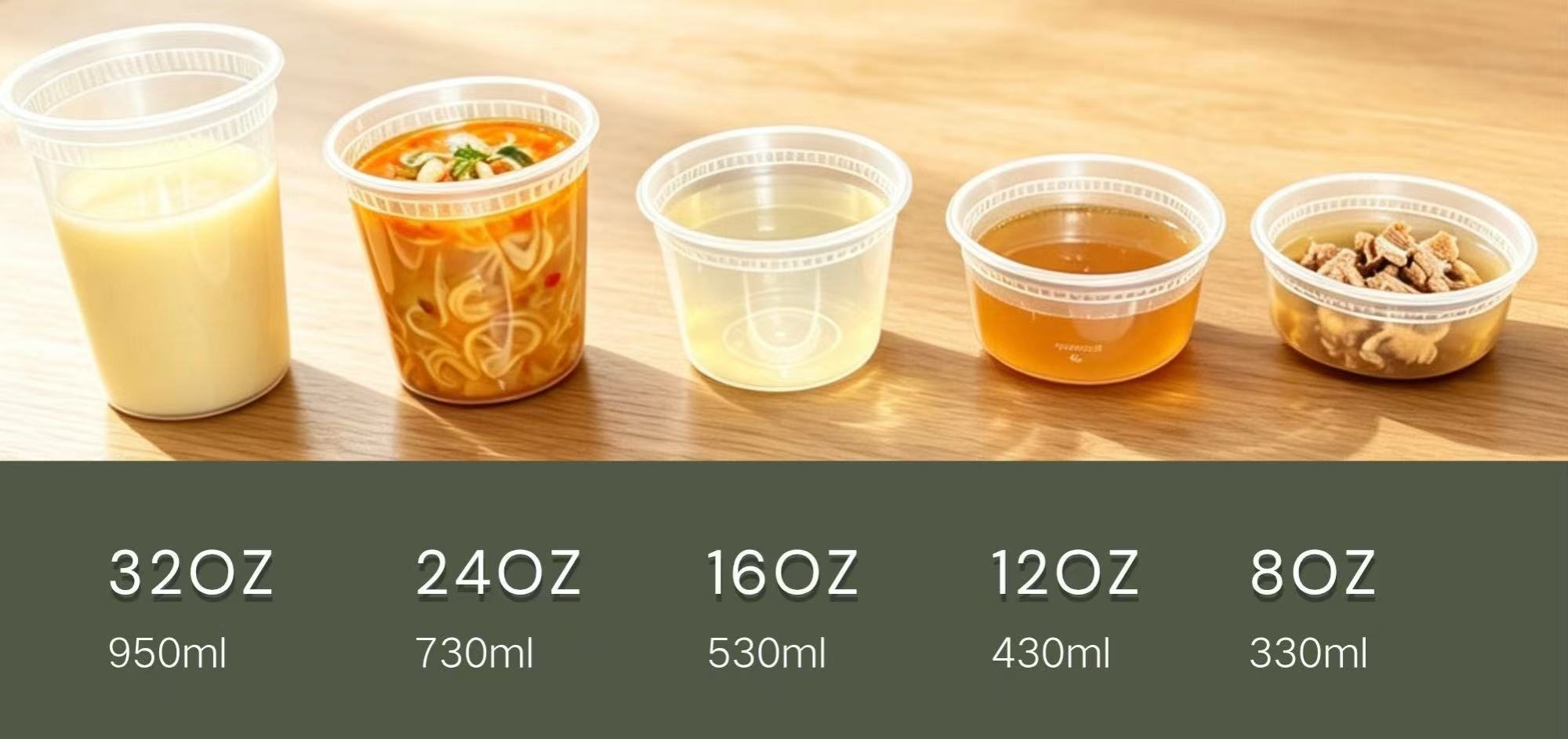
Buy disposable food containers by confirming the application, complete container-and-lid set, packing basis and evidence before comparing offers: a hypothetical order of 120 cartons containing 400 complete sets each supplies 48,000 sets, not 48,000 bases plus an unspecified lid quantity. These are assumed planning figures, not JR DELIPACK packing specifications or a quotation.
For distributors, importers and restaurant groups, the purchasing process should connect the foodservice need to an identifiable item and an agreed order. A catalogue description starts the conversation; it does not settle suitability, quantity or delivery responsibility. Use the following sequence to build a request that suppliers can answer consistently and your receiving team can later check.
What foodservice problem must the order solve?
Begin with the menu, portion and service route. Describe what goes into the package, how it is filled, how long it is held, how it is transported and what the customer is expected to do with it. Keep required functions separate from preferences. A colour preference should not obscure a missing answer about the intended food-contact conditions.
The National Restaurant Association advises evaluating packaging during menu development, communicating required functions and trying samples with the actual food. Its sourcing guidance asks about portions, order volumes, service functions and whether the package must support freezing or reheating. This supports an application-led enquiry rather than a decision based only on a product photograph. 1: National Restaurant Association packaging sourcing · reference details
Write the brief so someone outside the kitchen can understand it. Replace “suitable for delivery” with the actual food, portion, handling steps and delivery conditions to be reviewed. Record seasonal or event-related changes separately from routine demand. Do not invent exact temperatures or durations to make a form look complete; identify who must confirm them and before which decision.
Use the menu-to-container selection guide for detailed format questions. At this stage, keep the overall brief focused on the purchase you are making. Separate requirements for different applications instead of asking one sample to represent every meal, operating condition and destination market.
For a group buying for several sites, ask each operation to confirm its own constraints before consolidating demand. A central buyer may prefer fewer formats, while individual sites have different portions, storage space or service routines. Record which requirements are shared and which belong to a particular application. Consolidation is a proposed purchasing decision, not evidence that every location can use the same item. Resolve those differences before requesting an aggregate price, so the quotation does not hide an unresolved suitability question.
Where disposal arrangements affect the brief, use the compostable-versus-PP comparison and disposal-infrastructure guide to frame the questions. Identify the intended collection and processing route without assuming that a material label guarantees access to it. Keep that decision distinct from the supplier’s ability to provide the selected format.
Which product and lid references belong on the request?
Identify the container base and closure as a usable combination. For separate components, record both references and the supplier-confirmed pairing. For a hinged format, identify the exact finished item. Include capacity description, dimensions, colour, component material and relevant limitations. Treat an unconfirmed value as unknown; do not copy a specification from a visually similar model.
A nominal capacity does not describe the entire portioning decision. Ask how that capacity is defined and compare the intended portion with the actual sample. Food mass and container volume are different quantities. Where the meal contains separate elements, explain the intended arrangement and any divider needs, then check the selected format rather than inferring suitability from a general family name.
Keep requested and accepted specifications distinct. If a supplier suggests an alternative, give it a separate reference until the buyer has reviewed the difference. A changed lid, packing arrangement or material is not merely an administrative substitution. Record what the alternative resolves, what remains unanswered and whether the original request is still being considered.
JR DELIPACK supplies PP, PLA and paper-based foodservice packaging with supply and manufacturing support. This guide focuses on the PP purchasing workflow. Use the product range to identify relevant formats; availability and specifications are confirmed for the selected model and order. A material category does not establish universal performance or certification.
How should carton quantities be translated into complete sets?
Ask what the order unit includes before using a carton count to estimate supply. Specify whether a quotation covers bases, lids, paired sets or a hinged item. Record the number of saleable units per inner pack and carton, and identify any separately packed components. Do not treat the supplier’s abbreviation for a unit as self-explanatory.
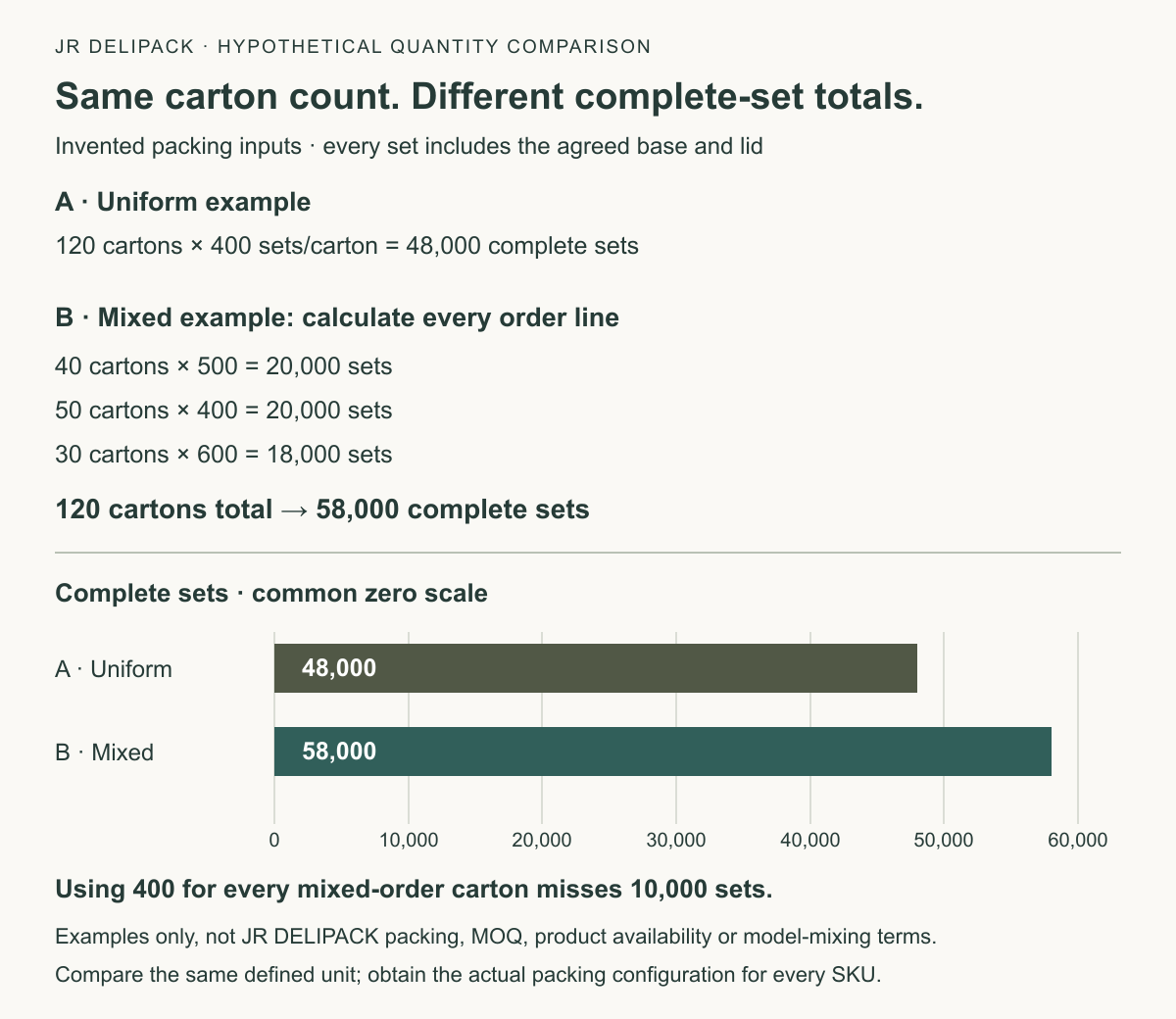
In the opening hypothetical order, 120 cartons multiplied by 400 complete sets per carton equals 48,000 complete sets. That calculation assumes each stated set includes the agreed container and closure. If the offer instead covers bases alone, the same arithmetic counts bases and says nothing about available lids. The item description and unit definition determine what the result means.
A mixed order requires a separate conversion for every line. Consider another invented example: 40 cartons at 500 sets each, 50 cartons at 400 sets each and 30 cartons at 600 sets each. The lines provide 20,000, 20,000 and 18,000 sets respectively, totalling 58,000 sets across 120 cartons. Applying a single 400-set conversion to that mixed order would understate it by 10,000 sets.
These examples show why equal carton totals do not imply equal quantities. They do not establish actual JR carton configurations, minimum-order combinations or interchangeable products. Keep the assumptions beside the calculation and verify each conversion against the accepted packing specification. For sleeve, piece and order-unit definitions, use the portion-cup packing guide rather than combining unlike units in one total.
Also request carton dimensions and gross weight for shipment and storage planning. Keep those measurements attached to the confirmed packing configuration and state their units. A change in pieces per carton may invalidate an earlier loading estimate. Compare practical storage and handling implications separately from quantity; more sets in a carton are not automatically better for every receiving operation.
What should the sample stage establish?
Use samples to resolve defined questions before committing to the selected configuration. Label the received components and retain the accompanying specification revision. Decide which menu items, handling steps and use conditions need evaluation. A clear sample request explains the decision it will support, rather than asking for a random assortment of popular products.
Plan a repeatable comparison with recorded conditions and acceptance criteria. Include the observations relevant to the application, such as closure engagement, filled handling, nesting, delivery presentation or the intended storage cycle. Choose quantities and repetitions for the risks being investigated; this overview does not prescribe a universal sample size. Preserve unsuccessful and interrupted observations as well as favorable ones.
Application checks and food-contact review answer different questions. A sample that closes neatly has not thereby established regulatory suitability, and a relevant document does not show how staff will handle the package. Use suitable safety precautions during evaluation. Avoid improvised tests involving unstable stacks, uncontrolled hot contents or food tasting as a substitute for the operation’s safety controls.
JR DELIPACK’s current buyer FAQ describes free standard samples, with the available quantity limited to a maximum of one carton and selection confirmed before dispatch. The buyer prepays shipping; eligible sample freight may be credited against a subsequent formal order under arrangements confirmed in writing before dispatch. Custom-made samples and samples requiring separate production are charged separately. Confirm the applicable selection, charges and credit record for the enquiry rather than extending the standard-sample policy to development work.
The sample-cost and approval guide separates the relevant cost lines. Keep commercial acceptance and technical acceptance in separate fields: agreeing to shipment charges does not approve the sample, and accepting the sample does not settle all order terms. Record the person responsible for each decision and any remaining conditions.
Which documents actually support the selected application?
Request evidence that identifies the component or material under review and its intended food-contact conditions. FDA explains that the regulatory status of food-contact materials depends on the substances involved and applicable authorizations. An effective food-contact notification has a defined manufacturer, substance and use scope; other authorization routes also exist. A generic “FDA” claim does not establish the selected order’s suitability. 2: FDA food-contact component guidance · reference details
Match the evidence to the actual base, lid and relevant construction. Record what a document supports, its limitations and any unresolved differences from the requested item. Ask for clarification when the sample identity or use conditions do not align. Do not infer that a report for one model, colour or material covers every product offered by the supplier.
Separate authenticity from applicability. A document can be genuine yet irrelevant to the proposed application; a blurry preview alone does not establish either conclusion. Arrange an appropriate controlled review of sensitive records without copying private factory identities or original certificates into public marketing. The food-contact document verification guide explains the evidence-matching process in more detail.
For JR DELIPACK’s publicly described evidence approach, review Factory and Quality. Any hot-food, microwave, freezer or dishwasher claim still needs support for the selected configuration and use. Keep destination-specific questions with the responsible reviewer; this procurement sequence is not a substitute for the applicable regulatory assessment.
The site’s general buyer FAQ is a navigation resource for recurring enquiries, not a replacement for model-specific confirmation.
How do you turn the brief into comparable quotations?
Send the same dated specification and packing basis to each supplier being considered. Ask suppliers to identify departures explicitly rather than replacing your assumptions silently. Compare complete usable configurations, not a base-only price against a paired-set offer. Keep quantity breaks, inclusions, exclusions, validity and any separate development charges visible before choosing a preferred offer.
Record the agreed trade term and the named location or port, then confirm the responsibilities that matter to the shipment. ICC’s Incoterms 2020 overview describes the rules as allocating costs, risks and obligations between buyer and seller. That is a reason to specify the transaction basis, not to assume that a familiar three-letter term answers every commercial question. 3: ICC Incoterms 2020 overview · reference details
Confirm payment arrangements, delivery milestones, document requirements and any order-specific agreements explicitly. Distinguish a requested arrival date from a confirmed production or shipment commitment. Where the buyer uses separate purchasing and logistics providers, identify the hand-offs and contacts without assuming either party has accepted tasks that were never discussed.
For standard PP products, JR DELIPACK’s current buyer FAQ states a 100-carton minimum per SKU; different SKUs do not combine to meet that minimum. Qualifying SKUs may be coordinated in one shipment when confirmed. The FAQ describes a planning allowance of 30 days or more from the factory-confirmed production start date for FOB shipment through Shekou, Shenzhen, excluding ocean transit. Custom colour, printing, packing, PLA and paper-product terms are quoted separately. Confirm the selected order’s terms and schedule in the written quotation; these statements do not guarantee an arrival date or unrestricted model mixing.
Use the quotation-scope guide for the detailed inclusion check. When evaluating operational costs, keep the packaging-cost analysis separate from the supplier’s quoted unit price. Unverified estimates should not be presented as confirmed savings or used to erase a missing suitability decision.
What must be agreed before the purchase is released?
Create a concise order record that ties the accepted specification to the quotation, sample findings and evidence review. Identify the approved product and closure, packing configuration, quantities, destination and commercial terms. Record unresolved items with an owner and a due date. A general statement that the supplier is acceptable should not conceal a model-specific question still awaiting an answer.
Distinguish requested, confirmed and conditional entries in the order record. Requested means the buyer has specified a need; confirmed means the relevant party has accepted the stated commitment; conditional means the decision still depends on an identified event or answer. This is a suggested working convention, not a supplier certification system. For example, a proposed shipment date should remain conditional if the artwork approval it depends on has not occurred. Do not erase the dependency when copying the date into an internal planning sheet.
Assign each unresolved item to someone able to answer it. Purchasing may reconcile the quotation, kitchen staff may document application observations, and a qualified reviewer may assess evidence applicability. These are example responsibilities rather than prescribed job titles. The release decision should identify which answers were received and which conditions remain open. When a condition changes, circulate the revised decision to the people whose work depends on it; an updated attachment is ineffective if receiving staff or the supplier still use an earlier version.
Use this final procurement checklist:
- The intended food, portion, handling and customer-use conditions are clear enough to evaluate the selected configuration.
- The container and closure references match the accepted samples and the supporting specification revision.
- Each order line states its own unit and packing conversion, with separately packed components identified.
- Relevant evidence has been matched to the item, use and destination, with limitations carried into the purchase record.
- Sample observations and open issues have a recorded decision; unresolved critical suitability questions are not hidden by a favorable price.
- The quotation states quantities, inclusions, exclusions, validity and agreed commercial responsibilities.
- Receiving staff know which references, carton counts and documents to expect and whom to contact about differences.
Keep artwork approval separate where printing or labels are involved. The artwork version-control guide covers that workflow. The purchase order should identify the accepted version rather than relying on an attachment name such as “final.” A later artwork or specification change needs a recorded review of the affected commitments.
How should receiving and reordering use the same records?
Give receiving staff the accepted order basis before the shipment arrives. Compare delivered item references and quantities with that record, and distinguish a visible discrepancy from an assumed cause. Preserve carton labels, counts and relevant photographs when something differs. The carton-arrival shortage guide provides the focused receiving workflow.
Use the first delivery to close the purchasing loop. Record whether the supplied configuration matches what was approved and whether any agreed conditions remain outstanding. Update future enquiries from verified observations, not from memory. If the supplier proposes a change, review its effect on the approved pair and remaining inventory before treating it as the same purchase.
For split purchasing and logistics arrangements, follow the separate-sourcing responsibility guide. Keep named responsibilities, documents and hand-offs together. The aim is a traceable order that can be evaluated and received consistently, not a larger collection of disconnected certificates, sample photographs and email promises.
Frequently asked questions
Should I begin with a price request or a sample request?
Begin with a defined application and enough product detail to make either request meaningful. A supplier can then identify available options and the questions a sample should resolve. A price for an unspecified configuration is not a reliable basis for selecting an order.
Can different products share one carton-to-set conversion?
Only where the accepted packing specifications genuinely use that same conversion. Otherwise calculate each line separately, then total comparable quantities. Keep bases, lids, complete sets and hinged items distinct; an unchanged total number of cartons can represent a different usable quantity.
Does JR DELIPACK only supply PP packaging?
No. Current supply includes PP, PLA and paper-based foodservice packaging, with availability and specifications confirmed for the selected product and order. This guide focuses on PP procurement; it does not transfer PP use assumptions or documentation to another material category.
Does a successful sample check approve future deliveries automatically?
No. Keep the accepted configuration, conditions and findings identifiable, then check that delivered items match that basis. Address changes and discrepancies through the agreed review process. A sample observation should not be extended to unspecified models, materials or operating conditions.
Are the carton quantities in this guide JR packing specifications?
No. The 120-carton calculations use invented packing inputs to explain quantity reconciliation. Obtain the actual inner-pack and carton configuration for each selected item. The examples do not establish product availability, order acceptance, a model-mixing policy or a quoted price.
What information should I include in the first enquiry?
Provide the food application, intended use, preferred format, container and closure references if known, estimated quantity, destination and required timing. Identify any documentation or customization needs. Mark unknown values clearly so the supplier can answer them without silently substituting assumptions.
Send a defined procurement enquiry
Contact JR DELIPACK with the application brief, selected formats, quantities and destination. Request confirmation of the exact model, packing basis, evidence scope and quotation terms before placing the order.
References
1. National Restaurant Association — Don’t get boxed in: Do’s and don’ts in package sourcing. Original article. Published 6 April 2022; accessed 6 October 2026. Supports application-led sourcing and actual-food sample evaluation. Back to supported passage.
2. U.S. Food and Drug Administration — Determining the Regulatory Status of Components of a Food Contact Material. Original guidance. Publication date not provided on the reviewed page; accessed 6 October 2026. Supports component authorization and notification-scope distinctions, not blanket approval of a finished product. Back to supported passage.
3. International Chamber of Commerce — Incoterms 2020. Official overview. Publication date not provided on the reviewed webpage; accessed 6 October 2026. Supports the allocation-of-responsibilities description. The full commercial publication was not purchased or reproduced. Back to supported passage.
KEEP READING
“Disposable Food Containers Wholesale: A B2B Buyer’s Guide for PP Foodservice Packaging”的10个回复