When PP food container cartons arrive short, compare what this delivery was expected to contain with what you actually received. Keep carton counts, base counts and separate-lid counts distinct. Record the unit and the document behind each expected quantity before deciding what is missing. GS1's receiving-advice guidance separates shipment information from received and accepted goods; the checklist below adapts that distinction for a buyer's own receiving record. [2]
This is our suggested receiving checklist, not a finding about a JR DELIPACK shipment. ITA describes export documents; GS1 describes healthcare supply-chain EDI. Neither source specifies our carton contents, proves a shortage's cause or establishes a remedy. Use the actual product, order and shipment records for those questions. [1] [2] [3]
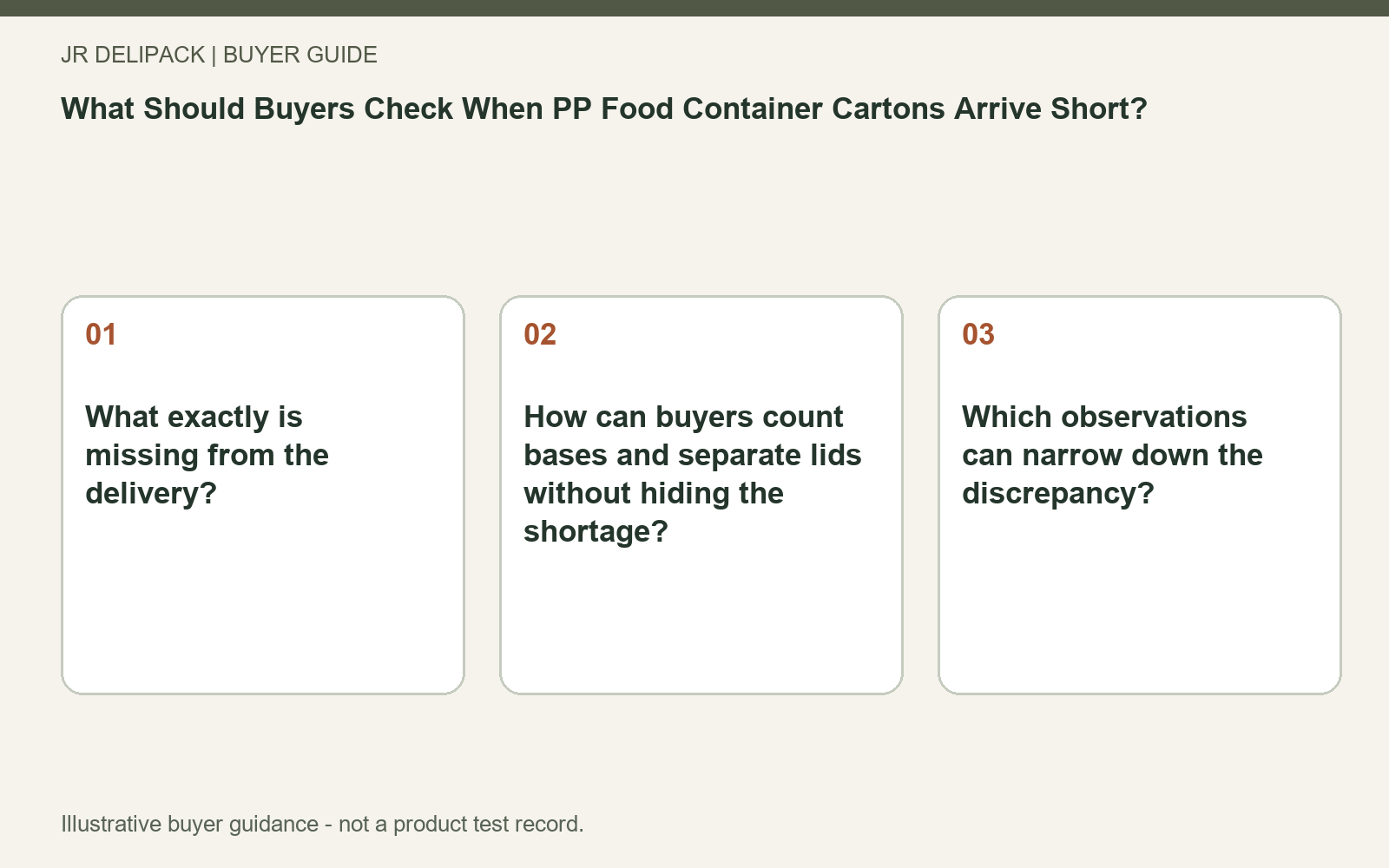
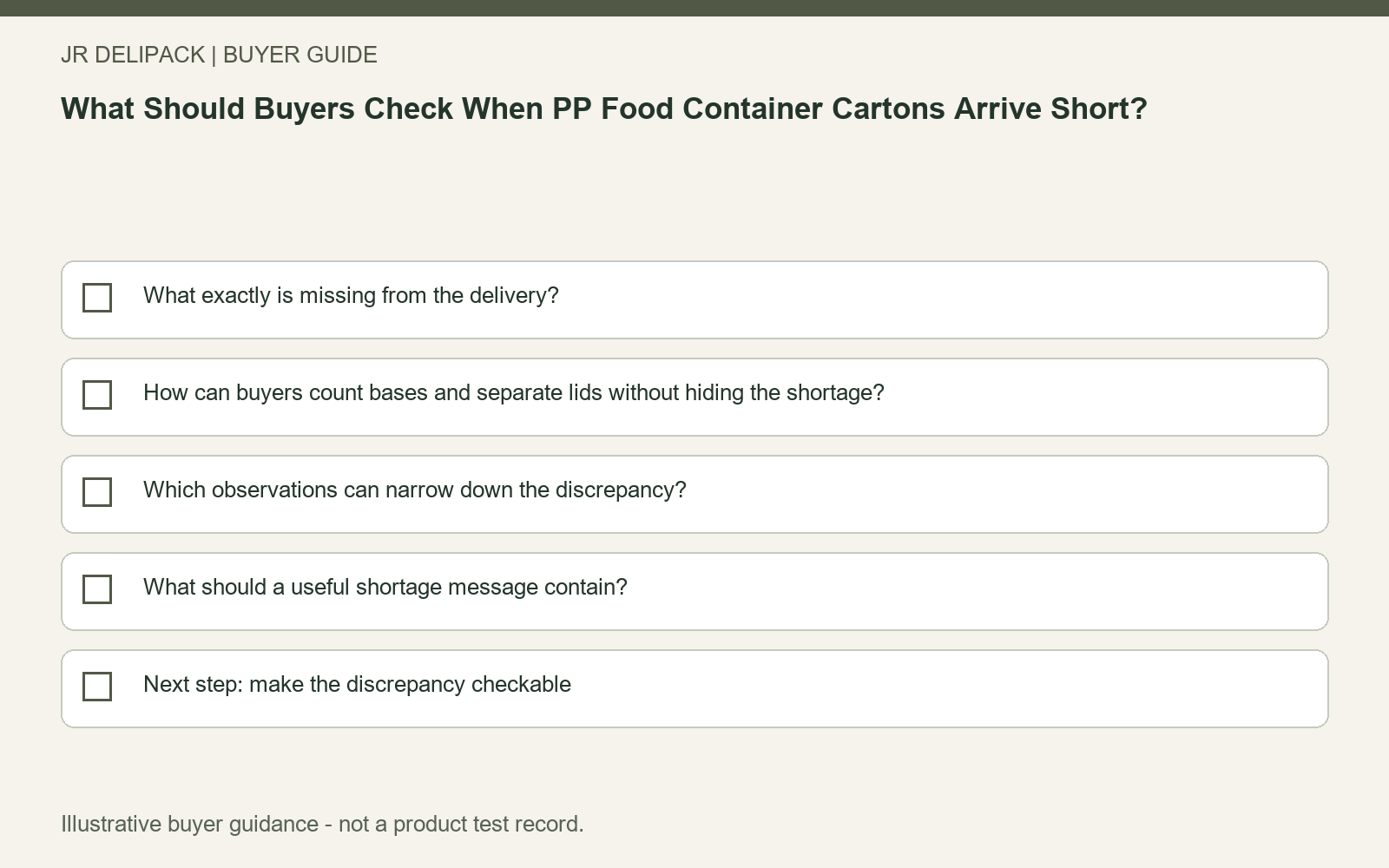
What exactly is missing from the delivery?
Start with the physical delivery, not the entire purchase order. In its export-document guidance, ITA lists package numbers, descriptions, quantities and marks among packing-list information. Our recommendation is to use those identifiers to establish which cartons were expected in this particular arrival. Keep the document's stated quantity alongside the observed quantity rather than replacing one with the other. [1]
GS1's healthcare receiving process distinguishes checking delivered logistic units from unpacking them and checking their contents against despatch information. Apply that distinction as two separate questions: did the identified outer package arrive, and have its contents been checked? A checked carton count is not automatically a checked base or lid count. This is an adaptation for your receiving sheet, not a claim that JR uses GS1 systems. [2]
- Carton absent: record the missing package mark, if the expected record supplies one. ITA identifies marks as packing-list information. [1]
- Carton present, contents unchecked: keep the item count open. GS1 separates checking units from checking the items inside them. [2]
- Carton opened, count differs: record expected and received quantities separately, following the distinction in GS1's receiving advice. [2]
How can buyers count bases and separate lids without hiding the shortage?
Write down the exact descriptions from your order and packing record before counting. ITA's packing-list description includes itemized quantities and descriptions. Our proposed sheet adds a receiving line for each component that your own documents identify separately. Do not invent a separate lid line for a hinged container, or assume a base carton includes lids when the agreed description does not say so. [1]
The table is a hypothetical arithmetic example, not a JR pack specification, customer incident or reported measurement. It demonstrates our way of applying GS1's expected-versus-received distinction. The figures are invented solely for the example; your actual quantities and units must be copied from the relevant records and count. [2]
| Illustrative line | Expected | Received | Difference |
|---|---|---|---|
| Outer base cartons | 4 cartons | 3 cartons | 1 carton unresolved |
| Bases in one checked carton | 100 pieces | 100 pieces | 0 pieces |
| Separate lids in one checked carton | 100 pieces | 90 pieces | 10 pieces unresolved |
Do not add the one-carton difference to the ten-piece difference: they concern different units and different lines. In this example, the count says nothing about the contents of the absent carton. GS1's item-level receiving record includes the quantity received; our recommendation is to report each observed difference at its own identified level, leaving uncounted contents unconfirmed. [2]
For sleeves versus pieces, obtain the agreed conversion from the selected order's packing record before comparing totals. ITA provides no universal pieces-per-sleeve figure for food containers. Its description establishes that the packing list itemizes quantity and description; our recommendation is to preserve the original unit and flag an unclear conversion rather than guess one. [1]
Which observations can narrow down the discrepancy?
Make the record traceable to the count you performed. GS1's receiving-advice specification includes goods-receipt date, trade-item identity and received quantity. Our proposed record below uses those documentary ideas without requiring EDI software. Use your actual component description or model; an identifier in a standard is not evidence that a particular shipment carries that identifier. [2]
| Record field | What the buyer enters |
|---|---|
| Receipt reference | Order, shipment and receiving date |
| Package identity | Observed mark; absent, present or opened |
| Item identity | Exact base or lid description |
| Count | Expected quantity, observed quantity and matching unit |
| Count scope | Which packages were actually checked |
| Open question | What remains uncounted or unexplained |
A proposed split delivery needs records, not reassurance. ITA describes air waybills as shipment information that allows tracking. Ask the appropriate party for the applicable transport reference and the outstanding package identities. That is our recommendation for testing the explanation; the source does not prove that your missing cartons are still moving or that an air waybill applies to ocean freight. [1]
What should a useful shortage message contain?
Send the observed difference and a question the recipient can answer. GS1 describes receiving advice as reporting delivery reconciliation, including discrepancies between expected and received goods. Our suggested message is: identify the arrival, name the component, give expected and counted quantities in the same unit, state the packages checked, and ask which record or action resolves the remaining difference. [2]
For example, write “The marked lid carton was received; our count was 90 pieces against the packing record's 100 pieces. Other cartons have not been checked. Please confirm the relevant packing line and the next checking step.” These are hypothetical numbers, not a claim against a real supplier. This example illustrates our message format rather than quoting GS1 or an actual buyer. [2]
When the question concerns a transport document, ask the relevant forwarder or carrier for that record. ITA describes freight forwarders' export-document review and routing services. A request for clarification is not an assumption that the forwarder packed the goods, caused the discrepancy or owes compensation. Keep transport questions separate from the supplier's component-packing questions. [3]
Next step: make the discrepancy checkable
JR DELIPACK's current About profile identifies Dongguan JR Delipack Packaging Co., Ltd. as the brand operator and describes current PP, PLA and paper-based foodservice packaging supply. This is our first-party introduction, not independent verification. It also states that product format, container-and-lid configuration, packing units, documents and terms are reviewed for the selected product and order. [4]
For an existing delivery, use that selected order's product and packing records: the public plastic food containers with lids range is a discovery starting point, not proof of your shipment's contents. The profile directs buyers toward Factory & Quality evidence; public evidence likewise does not establish a component count or cover every SKU. [4]
Use Contact to ask JR DELIPACK to review your order reference and receiving record. Request confirmation of the relevant packing line and the information needed next.
Frequently Asked Questions
Should I change the packing list to match my receiving count?
Our recommendation is to preserve both records and ask the issuer to clarify the difference. ITA distinguishes the commercial invoice from the packing list and says their information should correspond; it does not authorize a receiver to rewrite them. [1]
Does one checked carton establish the contents of all unopened cartons?
No. Our checklist keeps the count scope explicit. GS1 distinguishes checking logistic units from checking their contents; report the packages and items actually examined rather than treating an unexamined package as a counted one. [2]
Does an observed shortage prove who must replace the goods?
No. Our recommended next step is to review the actual order and transport arrangements. ITA discusses trade terms and transport responsibilities, but its general guidance does not decide liability, claim deadlines or compensation for this delivery. [3]
References
- [1] Common Export Documents — International Trade Administration. https://www.trade.gov/common-export-documents. Publication date not provided.
- [2] GS1 Model for Supply Chain Processes in Healthcare, Part II - EDI Guideline — GS1. https://ref.gs1.org/guidelines/edi-healthcare/part-2/. Publication date not provided. Release 1.2, Sep 2017; receiving sections, printed pages 65-70. Healthcare EDI guidance, not a food-container regulation.
- [3] Shipping Options — International Trade Administration. https://www.trade.gov/shipping-options. Publication date not provided.
- [4] A practical packaging partner for international buyers. — JR DELIPACK. https://jrdelipack.com/about-us/. Publication date not provided. First-party company introduction, not independent verification.