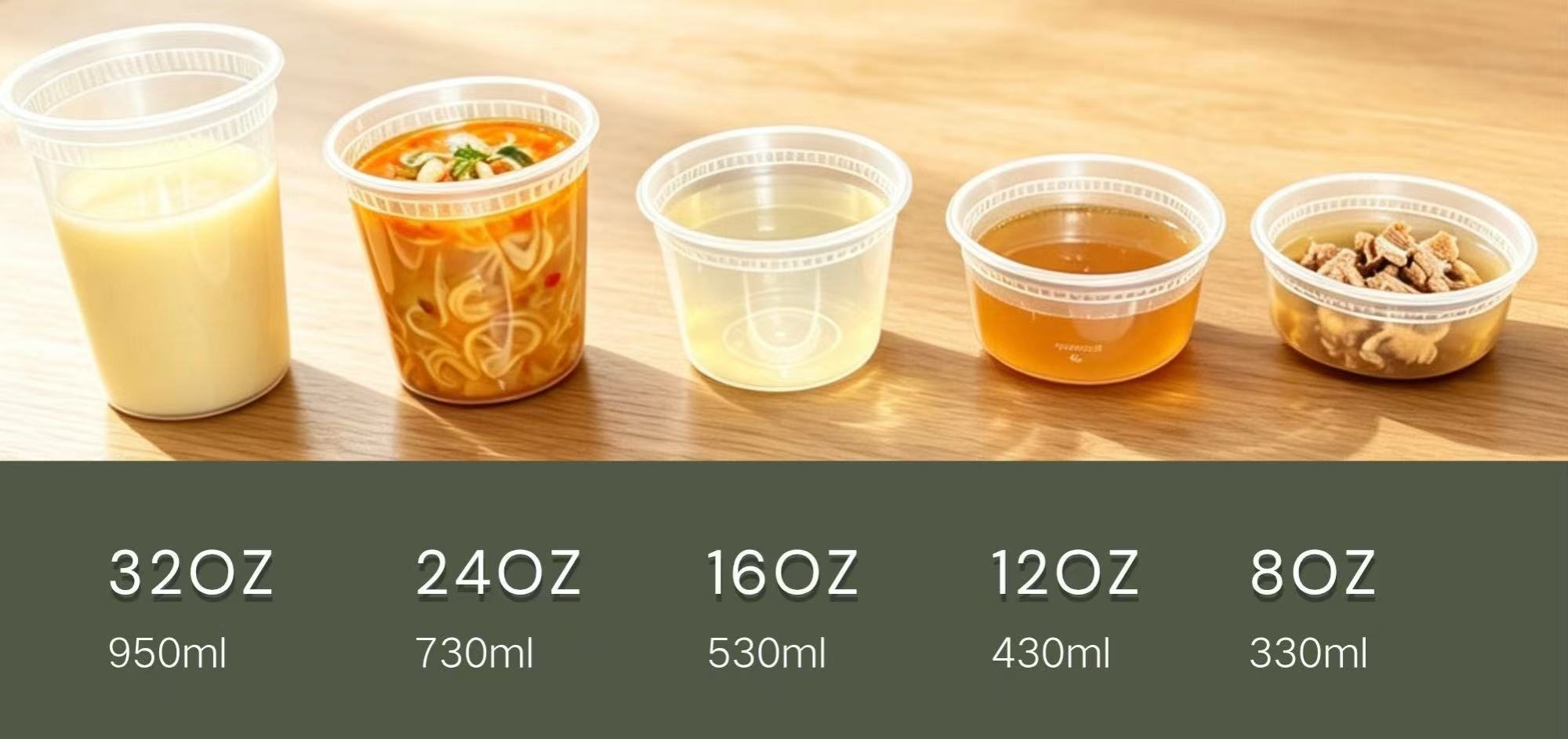

Compare takeout packaging by the full cost of the usable complete set: in a hypothetical batch, USD 300 spent to make 950 sets available equals about USD 0.316 per usable set, not USD 0.300 from dividing by 1,000 purchased sets. The difference comes from the denominator; a low component price alone cannot show what the operation actually has available to pack and serve food.
All amounts, quantities, timing observations and event rates below are invented examples for checking a buyer’s calculation. They are not JR DELIPACK quotations, customer savings, measured product performance or market averages. The framework is for operational purchasing comparisons, not statutory accounting or a destination-specific tax calculation. Replace each assumption with evidence from the order and service being evaluated.

What is included in your packaging cost comparison?
Begin by naming the purchasing unit and the point where the calculation stops. A base, a lid, a complete set and a delivered meal are different units. For a distributor, the useful denominator may be saleable sets received into stock. For a restaurant, it may be sets issued to the kitchen or customer orders completed under a defined service standard.
Write that choice above the worksheet. A receipt-stage comparison should include costs incurred to reach the stated receiving point; an operational comparison can add separately identified storage, picking and packing costs for a defined period. Do not call a receipt-stage result the full cost of serving a meal when later activities have not been included.
The International Trade Administration describes landed cost as including product price, insurance, freight, tariffs, taxes and other fees, and cautions that it remains an estimate until applicable charges are known. Use that as a reminder to reconcile the complete delivery scope, not as a tariff schedule or a guaranteed final cost for a particular shipment. 1: ITA landed-cost guidance · reference details
Record each input’s source, currency and effective date. Separate a confirmed invoice from an estimate and a disputed charge from an agreed credit. If comparing two options in different currencies, show the exchange assumption and its date. A missing input should remain visible rather than becoming zero merely because the supplier or forwarder has not answered yet.
How do you make quotations comparable before adding operating costs?
Identify the exact base-and-lid pairing, required accessories and pack configuration for each candidate. Confirm what the quoted selling unit contains. Then normalize the quotations to the same complete usable set. The quotation scope guide covers those commercial inclusion questions; this article carries the comparison forward into receipt and service costs.
Do not treat a familiar trade abbreviation as a complete explanation of an offer. ICC states that Incoterms rules allocate specified obligations, risks and costs, but do not replace the sales contract or determine matters such as product specifications, payment terms or ownership transfer. ICC also emphasizes identifying the applicable rule, version and precise named place. 2: ICC explanation of Incoterms and commercial contracts · reference details
Use the agreed delivery basis to assign each cost once. If an invoice already includes a transport leg, do not add the same leg again from a forwarder’s full-route estimate. When an estimate covers several legs together, request the detail needed to reconcile it. Keep the buyer’s cost comparison separate from any unresolved contractual liability question.
Also separate one-time sample, artwork or setup charges from repeat-order costs. Show both the initial order and the repeat scenario when those differences matter. State how many sets carry the initial charge in the comparison; spreading it over an assumed lifetime volume can make a low-volume trial look cheaper than the commitment the buyer is actually making.
Why does USD 300 become USD 0.316 per usable set?
Assume a buyer purchases one thousand complete sets for two hundred forty US dollars. The hypothetical batch also incurs forty dollars of inbound charges and twenty dollars of receiving and handling cost, with no overlap between the three amounts. The defined receipt-stage cost is therefore three hundred dollars before any recovery credit.
Suppose fifty sets are unavailable for issue at the review date, leaving nine hundred fifty usable complete sets. For this example, the unavailable sets have no recognized recovery value and no confirmed credit. Dividing three hundred dollars by nine hundred fifty gives approximately thirty-one point six cents per usable set, rounded to three decimal places in dollars.
| Hypothetical receipt-stage field | Assumed value | Treatment |
|---|---|---|
| Complete sets purchased | 1,000 | Quantity basis, not the usable denominator |
| Purchase cost | USD 240 | Includes the purchased packaging |
| Inbound charges | USD 40 | Assumed additional, not already in the purchase cost |
| Receiving and handling | USD 20 | Assumed additional cost for this batch |
| Total before credit | USD 300 | USD 240 + USD 40 + USD 20 |
| Unavailable sets | 50 | Excluded from usable quantity at the review date |
| Usable complete sets | 950 | 1,000 − 50 |
| Cost per usable set | USD 0.316, rounded | USD 300 ÷ 950 |
Dividing by all purchased sets instead would produce thirty cents. That result describes cost per purchased set, not cost per usable set. Neither denominator should be hidden. Recording both makes it easier to explain whether a change comes from the purchasing amount, additional charges or the quantity available for use.
Now assume a fifteen-dollar supplier credit becomes confirmed and is assigned to this batch. The net cost becomes two hundred eighty-five dollars, so the usable-set calculation becomes exactly thirty cents. An expected but unresolved credit should remain a separate scenario. Updating the record when it is confirmed is more reliable than treating a hoped-for recovery as money already received.
How do you avoid counting the same failure cost twice?
The purchased packaging for all one thousand sets is already inside the example’s purchase cost. Reducing the denominator to nine hundred fifty reflects the smaller usable quantity. Adding the purchase value of the same fifty unavailable sets again as a separate expense would count that packaging expenditure twice. Additional inspection, disposal or replacement-transport costs are different only when actually incurred and not already included.
Use either a clearly defined observed-cost record or a forward-looking scenario for the comparison, and label which it is. An observed record draws on the batch or service-period costs and outcomes already recorded. A forecast estimates future events under stated assumptions. Do not add a generic expected-failure allowance on top of observed event costs for the same population and period.
Keep different consequences of one incident distinguishable. A replacement meal, a refund and a delivery charge are not automatically all incurred for every complaint. Record what actually happened, then link the amounts to the incident. If one labor allocation already covers the service call, do not add those same minutes again in a separate handling total.
Uncertain cause also matters. Record whether the issue concerns the package, the chosen lid, filling practice, transport or an unresolved combination. A complaint is evidence that an event needs review; it is not automatically proof of a manufacturing defect. Keep purchasing decisions, supplier claims and operational improvement records connected without treating them as the same conclusion.
How can packing time be converted into a useful cost estimate?
Measure a defined task such as selecting a matching lid, closing the filled container and placing the set into the delivery bag. Use the same task boundary for each candidate. Record the operator, menu application and service conditions. Include corrections and interruptions consistently instead of timing only the smoothest attempts for the preferred option.
For a separate hypothetical example, assume one method takes twelve seconds per set and another takes eight. The difference is four seconds. Across one thousand eight hundred sets, that equals seven thousand two hundred seconds, or two labor hours. At an assumed allocated labor cost of eighteen dollars per hour, the modeled difference is thirty-six dollars, or two cents per set.
That is a time-cost allocation, not a promise that payroll falls by thirty-six dollars. Whether time released changes overtime, staffing or productive capacity depends on the operation. Report the measured time difference first and explain the costing assumption separately. A fixed shift cost and an incremental overtime payment should not be described as interchangeable savings.
Keep the compatibility check separate from the timing result. Faster closure is not acceptable if the pairing fails the required use. Use the lid-fit and leak-check guide for the physical questions. Bring the approved combination back into the time study rather than assuming that visually similar lids can be substituted to improve the result.
How should carton volume and storage enter the worksheet?
Compare the outside dimensions and confirmed contents of the actual shipping cartons. A smaller carton is not automatically more efficient if it contains fewer complete sets. Equally, a higher carton count does not necessarily mean more total volume. Keep carton quantity, component quantity and usable complete-set quantity visible as separate fields.
As an explicitly hypothetical geometry example, a carton measuring half a meter by four-tenths of a meter by three-tenths of a meter occupies six-hundredths of a cubic meter. Thirty such cartons total one point eight cubic meters of carton volume. This excludes pallets, gaps, wrapping and access space; it is not a verified warehouse footprint or freight loading plan.
Use a carrier or forwarder’s quoted charging basis rather than assuming that the geometric volume determines the bill. Record the service, route, quotation date and included charges. If comparing a consolidated load with an individual shipment, account for the different scope before attributing the price difference to container nesting or packaging design.
For storage, connect the cost to the time and space actually used. Distinguish a charge that would change with the purchasing decision from an allocation of an existing fixed warehouse expense. Also record leftover or obsolete components: a cheap lid purchased in excess can remain inventory without helping the restaurant assemble another approved complete set.
What evidence should a restaurant collect during a packaging trial?
The National Restaurant Association’s packaging-sourcing guidance recommends testing samples with actual menu items, considering holding conditions, leakage and opening or closing, and not choosing solely by the lowest price. Those questions support a service-based comparison. Its article does not establish a defect rate or a fixed qualification duration for a particular JR DELIPACK product. 3: National Restaurant Association packaging-sourcing guidance · reference details
Choose a trial period that covers the intended service conditions and record its limits. A week may be a practical planning period for one operation, but it is not a universal approval standard. Likewise, use the operation’s real delivery and holding requirements rather than assuming that a fixed simulation duration represents every route or menu.
Record sets issued, the menu and portions, packaging references, closing observations and service incidents. Agree in advance what counts as a completed customer order. A replacement can eventually satisfy the customer while using another package, so a count of customer orders and a count of sets consumed should not silently be treated as equal.
Include a waste record where it informs the purchase. EPA’s commercial-building waste guidance recommends establishing a tracking baseline and assessing the quantity and composition of the waste stream before selecting improvements. A measured record is more useful than attributing every discarded component to the supplier, or assuming a disposal-cost saving without examining the actual service arrangement. 4: EPA commercial waste tracking and assessment guidance · reference details
How much improvement would justify a higher price?
Use a break-even question instead of claiming that the more expensive package must save money. In another hypothetical forecast, an alternative costs two cents more per set, and an avoidable service event would add eight dollars of separate incremental cost. Two cents divided by eight dollars equals a required reduction of two and a half events per thousand issued sets.
If the event is binary, with at most one such event per set, that reduction is one quarter of a percentage point in the event rate. It is not a twenty-five-percent relative improvement. The calculation assumes the eight-dollar amount excludes costs already included elsewhere and that all other relevant costs are unchanged. It identifies a decision threshold, not evidence that a candidate achieves it.
Compare that threshold with appropriately collected evidence, including uncertainty. A small trial without incidents does not establish a zero future event rate. If the observed range is too uncertain to choose confidently, retain a limited trial or request better evidence. Do not insert a favorable industry average merely to force the preferred purchasing decision through the calculation.
Test the conclusion against the inputs most likely to change, such as freight, usable quantity, labor allocation or order volume. Show the scenario that reverses the decision, if one exists. This makes the review useful when actual conditions change and prevents a narrow initial result from becoming a permanent claim that one supplier or material is always cheapest.
What should the buyer approve and retain?
Keep the final comparison short enough to use during purchasing but traceable to the underlying records. Name the complete set, intended service, comparison period and cost boundary. Identify the chosen option and the conditions on which the decision depends. Preserve the alternative’s valid information so a later review does not begin again from a collection of disconnected emails.
- Confirm the base, lid and accessories that constitute the comparison unit.
- Link prices and included charges to their quotation or invoice versions.
- Reconcile purchased, unavailable, usable and consumed quantities.
- Separate initial charges from repeat-order costs and forecasts from actuals.
- Record labor and service-event assumptions without counting costs twice.
- Keep the selection conditional on product suitability and current evidence.
- Reopen the comparison when the package, service or cost boundary changes.
JR DELIPACK supplies PP, PLA and paper-based foodservice packaging with supply and manufacturing support. Use the product range to identify the relevant configuration and the factory and quality information to understand supporting-document boundaries. Product-specific suitability and order terms require confirmation; the hypothetical figures above are not an offer.
Contact JR DELIPACK with the product, intended use, quantity and destination. Specify the complete set, required packing and delivery basis, and ask for the information needed to compare quotations consistently. Keep sample and initial setup costs visible separately from repeat purchasing assumptions.
Frequently asked questions
Is the lowest unit price the lowest packaging cost?
Not necessarily. First establish whether the quoted unit includes the required base, lid and accessories, then compare additional charges and the quantity actually usable at the chosen stage. A lower displayed component price may describe a different purchasing scope. It cannot on its own establish a lower cost per usable set or completed customer order.
Should damaged packaging be added as a second purchase cost?
Not when its purchase cost is already in the batch total. Keep that total and adjust the usable denominator consistently. Add only separately incurred costs that are not already included, and record confirmed recovery credits once. A forward-looking loss allowance and an observed loss record for the same events should not both be added to the comparison.
Does a faster packing method guarantee a payroll saving?
No. Timing can show a difference in the labor required for a defined task, but cash savings depend on how staffing and capacity change. Report the time observation and the hourly costing assumption separately. If a shift costs the same either way, describe the result as allocated time cost or capacity released, not a proven reduction in wages paid.
Can carton cubic volume be used as the final freight price?
No. Geometric volume describes one input, not the carrier’s complete charging arrangement. Reconcile the route, service, charging basis and included fees against a current quotation. Pallets and unused space can also make the physical shipment differ from the sum of carton volumes. A volume calculation does not establish how a specific load will be billed or packed.
How should a distributor compare costs with a restaurant?
Keep their different boundaries explicit. A distributor may compare saleable complete sets at receipt or after warehouse handling, while a restaurant may compare sets consumed and service-event costs over a meal period. Share product and packing information, but do not assume the same denominator or operating-cost allocation answers both businesses’ questions.
Can a pilot’s result be used as a permanent failure-rate forecast?
Not automatically. Retain the sample context, menu, package pairing, service conditions and period. Changes to any of those can affect how useful the observation is for a later purchase. Use an uncertain result as a range or a reason for more evidence, rather than promoting a small successful trial into a universal product-performance or savings claim.
References
- 1. International Trade Administration — Determine Total Export Price. Read 7 October 2026. Supports landed-cost components and estimate limitations. Its illustrative tariff and tax percentages are not applied to JR DELIPACK shipments or used as current destination rates. Return to citation.
- 2. International Chamber of Commerce — Incoterms and Commercial Contracts. Incoterms 2020 explanatory sections read 7 October 2026. Supports cost/risk/obligation scope and specifying the named place and version; not a substitute for the full sales contract. Return to citation.
- 3. National Restaurant Association — Don’t get boxed in: Do’s and don’ts in package sourcing. Published 6 April 2022; read 7 October 2026. Used for practical sourcing and sample-use guidance, not as evidence of current consumer percentages or a particular product’s performance. Return to citation.
- 4. U.S. EPA — Managing and Reducing Wastes: A Guide for Commercial Buildings. Page updated 30 September 2026; relevant tracking and assessment sections read 7 October 2026. Supports establishing a baseline and examining waste composition; does not substantiate a specific savings amount. Return to citation.
KEEP READING
“The Real Cost of Takeout Packaging for Restaurants and Distributors”的2个回复