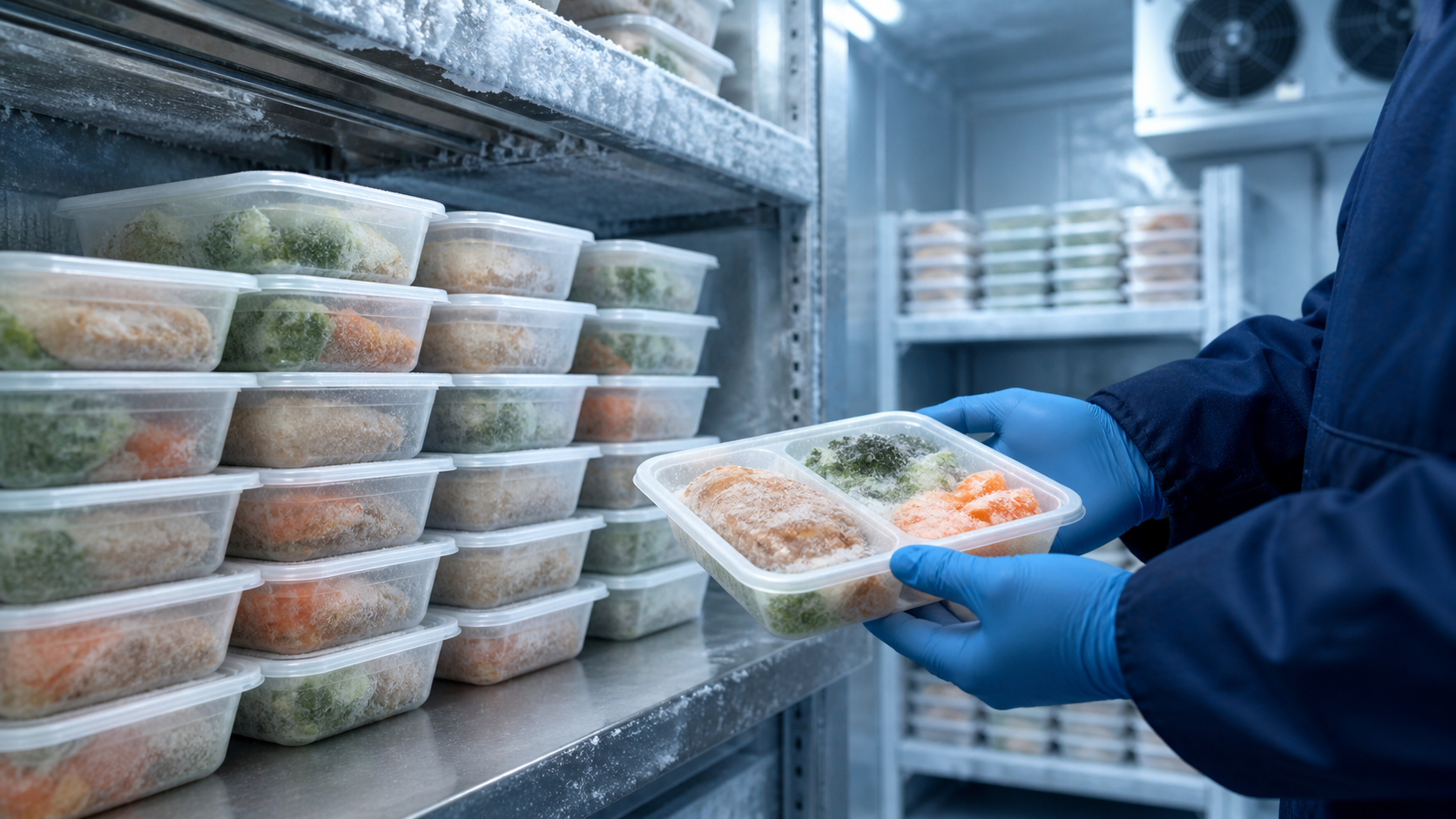
Buy freezer-safe PP food containers by verifying the exact container, lid and operating cycle, including filled-stack loading: in a hypothetical five-high stack of 0.55 kg filled packages, the bottom package has 2.20 kg of package mass above it. That calculation defines a question for evaluation; it is not a permitted stack height or proof of freezer performance.
For a frozen-meal program, the purchasing decision extends beyond whether an empty sample closes. Filling, cooling, frozen storage, movement, thawing and any reheating must fit the supported application. Keep the food-safety decision separate from the packaging-performance decision, and document both before accepting a configuration for routine service.
What does freezer safe need to mean in your purchase specification?
Define the food, portion, filling conditions, storage duration and intended handling before requesting a performance claim. Name the base and lid separately where they are separate components. A family description or a resin label does not identify the particular finished combination being purchased, and an alternative lid needs its own compatibility review.
FDA’s food-contact reference tables distinguish refrigerated storage, frozen storage without thermal treatment, and frozen or refrigerated foods intended for reheating in the container. They also distinguish food categories. These are reference categories for food-contact-substance notifications, not blanket approvals of finished containers. Match the supporting documentation to the actual food and use. 1: FDA food types and use conditions · reference details
Ask the supplier which conditions are supported and what evidence identifies the supplied model. Record restrictions as well as favorable statements. If a document concerns only the base, do not silently extend it to the lid, printing or another material. Resolve unclear scope before treating the combination as suitable for a frozen-food program.
Separate three questions in the decision record: food-contact suitability, physical package performance and the food operation’s safety controls. A successful closure observation answers a physical question under the observed conditions. It does not replace the relevant food-contact documentation, establish shelf life or authorize a different thawing process.
Define the full freezing and use cycle
Map the route from filling to final use in its actual order. Record whether food is filled hot or cold, how cooling is managed, when the lid is applied, how packages enter storage and how they leave it. Include transfers between facilities when relevant. An omitted transition can leave the purchase specification incomplete.
Write down the intended freezer setting, measured conditions and storage duration as separate fields. Equipment settings describe the control requested, not necessarily the temperature of the food throughout the load. Agree with the responsible process owner what measurements are needed and where they should be taken; retain the relevant records with each evaluation run.
FDA’s consumer storage guidance gives a freezer temperature of 0°F, approximately −18°C, and explains that freezing does not kill most bacteria. This is food-storage guidance, not a temperature rating for every PP package. A commercial operation still needs its applicable process controls; a sound-looking container cannot establish that food has been handled safely. 2: FDA food-storage guidance · reference details
State how the customer is expected to thaw and use the meal. Frozen storage followed by transfer to another vessel differs from reheating in the original base. If the same package is intended for reheating, review that combined application and the exact lid instructions. The separate microwave verification guide addresses the reheating decision.
How should you identify and prepare representative samples?
Give each configuration an unambiguous identifier tied to the supplier’s base, lid and production references. Record sample origin and any known lot information. Keep photographs of markings and the supplied packing. A later comparison is difficult to interpret if the samples cannot be distinguished from an earlier design or a replacement component.
Inspect before filling. Note existing rim damage, visible distortion, contamination or closure problems rather than discovering them only after freezing. Set aside unsuitable samples and retain the reason. Do not replace a failed or inconvenient specimen silently; the record should show what entered the evaluation and what was removed before it began.
Define the role of reference samples. An unused package can help compare original markings or shape; it cannot stand in for a filled package that completed the cycle. If comparing lots, identify each lot and distribute the comparison conditions deliberately. Otherwise, a difference between storage endpoints may also be a difference between the production lots used at those endpoints.
The National Restaurant Association’s sourcing guidance recommends evaluating samples with the actual menu item and the required functions, including intended freezing or reheating. That supports testing a real application rather than judging an empty package alone. It does not supply a universal freezer-test sample quantity, duration or acceptance limit. 3: National Restaurant Association sourcing guidance · reference details
Use the planned portion and food preparation, with the fill level defined for the selected package. Record both portion mass and how fill position was checked; mass is not interchangeable with volume. Confirm headspace through the relevant product and process review instead of adopting a generic percentage from a different food or container.
Plan the comparison without inventing a pass rate
Prepare a compact list of the conditions that need evidence. For example, suppose a buyer wants to compare two exact configurations with two food profiles at three storage endpoints. The hypothetical matrix contains 2 × 2 × 3 = 12 configuration–food–endpoint combinations. That is a planning count, not twelve containers, twelve independent tests or a statistically sufficient sample size.
Decide separately how many runs and specimens each combination needs, including repeat observations, baseline references and any destructive checks. A loaded stack is not the same experimental unit as one loose container. Several containers within one stack share conditions, so do not describe their observations as independent merely because each has its own identifier.
If two of those twelve planned combination records are incomplete, ten remain complete on the defined checklist. The completion fraction is 10 ÷ 12 × 100 = 83.3%, rounded to one decimal place. This reports documentation coverage only. It is not a package pass rate, confidence level or percentage of the order considered safe.
Before starting, agree what counts as a complete record and what observations require stopping or further investigation. Keep the planned sequence, missing fields and deviations visible. Select actual quantities and acceptance criteria with the people responsible for packaging and the food process, using the risks and intended decision rather than the convenient numbers in this illustration.
| Evaluation stage | Information to retain | Question it can address |
|---|---|---|
| Before filling | Sample identity, component pairing, original condition | Was the intended configuration evaluated? |
| Filling and closure | Food, portion, fill position, closure observations | Was preparation consistent with the defined use? |
| Frozen storage | Measured conditions, duration, location, load arrangement | What exposure did the samples actually experience? |
| Handling and final use | Transfer method, condition at observation, damage and opening | Did relevant functions remain acceptable through the route? |
| Decision | Results, deviations, unresolved scope, responsible reviewer | Which limited application does the evidence support? |
What load does a filled stack place on the bottom package?
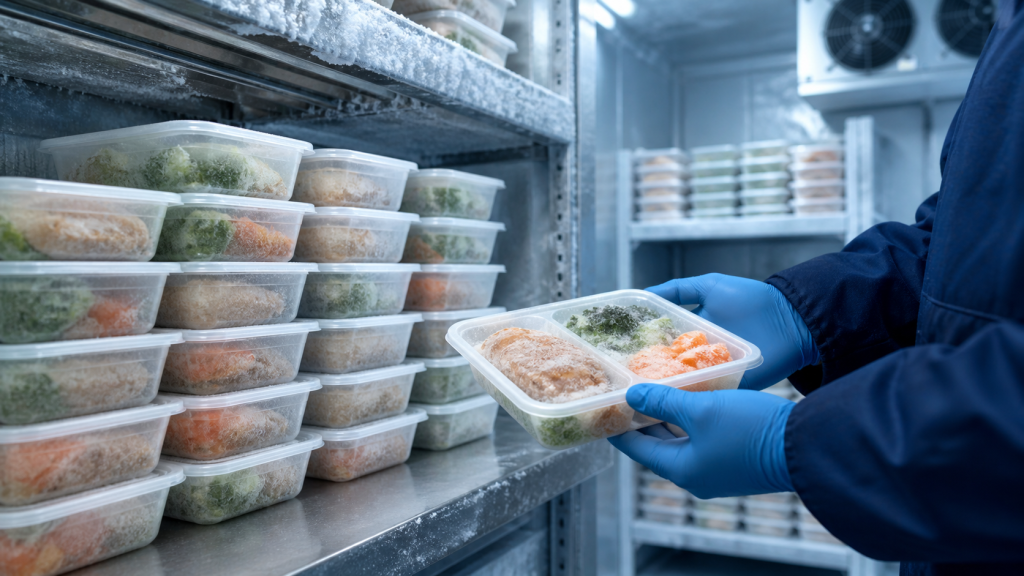
Use actual filled-package mass and the intended load arrangement when defining the question. In the opening illustration, each of five packages weighs an assumed 0.55 kg, including food, base and lid. Four packages sit above the bottom one, so their combined mass is 4 × 0.55 = 2.20 kg. The entire stack weighs 2.75 kg.
If that illustrative stack becomes six packages high without changing individual mass, the mass above the bottom package becomes 5 × 0.55 = 2.75 kg. The additional 0.55 kg is a 25% increase over 2.20 kg. This describes the changed loading assumption, not a recommended increase or evidence that the lower package can carry it.
Mass alone does not describe local pressure or a verified compression rating. Contact position, support, orientation and any shared load path must also be defined. Do not convert this arithmetic into a drop height, transport approval or safe stacking instruction. Use it to tell the evaluator what arrangement needs to be represented and measured.
ASTM D642’s public scope covers compression testing of shipping containers, components and unit loads; its significance section relates compressive resistance to storage and distribution forces. A buyer’s freezer-stack observation is not automatically an ASTM D642 test. Where formal compression evidence is required, agree the applicable method and conditions with a competent laboratory. 4: ASTM D642 public scope · reference details
Observe the loaded configuration during storage and handling
Document whether packages are directly stacked, separated by trays or supported by a carton arrangement. Identify the shelf or supporting surface and photograph the initial positions. Keep the observation setup consistent with the agreed application. Loose filled packages, nested empty stock and packed distribution cartons answer different questions and should not be treated as interchangeable demonstrations.
Check the bottom, middle and upper positions as appropriate to the planned evaluation. Record lid displacement, base shape, contact marks, leaning or visible damage by specimen identifier and observation time. Describe what happened instead of assigning an unexplained overall score. A photograph should identify the relevant feature rather than merely show that a stack existed.
Represent the relevant handling sequence using an agreed, safe method. Do not introduce an arbitrary drop height or improvise an unstable loaded tower. If impact or distribution testing is needed, define the purpose, equipment, restraints and safety precautions with qualified staff. A hand-carried demonstration cannot be expanded into a claim covering every delivery route.
Where the objective is to compare configurations, keep food preparation, loading and observation boundaries aligned. Record changes in equipment, operator or storage position that could complicate interpretation. If one configuration receives a different treatment, retain that fact and decide whether a like-for-like comparison is still meaningful rather than concealing the difference in an average.
Check closure and condition at the intended end of use
Inspect at the agreed endpoints without allowing the inspection itself to create an uncontrolled food-handling process. Record whether the package is still frozen, has been thawed under the defined procedure or has undergone an approved reheating step. State the condition at observation so that later reviewers do not confuse different stages of the cycle.
Separate visible cracks, rim distortion, lid disengagement, exterior moisture and confirmed leakage in the record. Moisture on an exterior surface is not by itself enough to identify the mechanism. Preserve photographs and observations needed to investigate, without inventing a cause. The dedicated lid-fit and leak checklist provides a more detailed component review.
Link every photograph to the specimen, stage and written observation. Retain an overall view as well as any useful detail, and note whether the lid was opened before the image was taken. If a sample cannot be identified or the sequence is uncertain, mark that limitation rather than assigning the image to whichever result it appears to support.
Examine practical opening and handling as well as the closed appearance. Record whether the intended opening sequence can be followed and whether the package remains suitable for its defined role. Do not ask untrained staff to taste questionable food as a packaging check, and do not use an absence of odor or damage as proof of food safety.
Decide in advance which observations require rejecting a configuration, investigating a cause or repeating a defined comparison. Keep unsuccessful and interrupted runs in the record. Replacing them with a favorable rerun erases information that may matter to purchasing. A revised product or revised operating condition should be identified as a new comparison, not silently merged with earlier results.
Turn the evidence into a controlled supplier specification
Compile the exact model references, agreed operating conditions, relevant supporting documents, observation records and remaining limitations. State whether the evidence supports another trial, a limited initial order or routine supply for the defined application. The conclusion should be no broader than the configurations and conditions reviewed, and it should identify who is responsible for accepting them.
Include packing, lot identification and handling information needed to receive the same configuration that was evaluated. Ask how changes to material, lid, geometry or supplied packing will be communicated. Keep a reference sample where appropriate. Use the supplier change-control guide for transition planning rather than relying on a product name alone.
Compare commercial offers only after resolving the required function and evidence scope. Confirm whether bases and lids are supplied together, the stated order unit, included documentation and any agreed testing charges. A lower bare-container price is not directly comparable with a complete supported package. Keep proposed tests distinct from tests already performed and included in the quotation.
Retain a concise decision checklist: identified configuration, defined cycle, applicable documentation, traceable observations, resolved exceptions and controlled supply reference. If any item remains open, record its owner and the purchasing consequence. This keeps a sample discussion connected to a specific decision without turning an attractive photograph or a generic product label into unrestricted acceptance.
Frequently asked questions
Does PP automatically mean freezer safe?
No. Specify and review the exact finished base and lid for the intended food, storage and handling cycle. A material description helps identify what is being discussed, but it does not replace configuration-specific evidence or show that a particular package remained functional under your actual loading and use conditions.
How much headspace should a buyer specify?
Use the fill position established for the selected food and process, supported by the relevant product review and operational evaluation. There is no universal percentage in this checklist. Record portion mass, fill position and closure condition separately so that a later change in recipe or portion does not silently alter the accepted arrangement.
Does the five-high calculation authorize five-high storage?
No. Five packages and 0.55 kg per filled package are invented arithmetic inputs. They show how to describe the mass above the lowest package, not a safe loading limit. Actual stacking requires a defined support arrangement, exposure conditions and suitable evidence for the particular configuration and operation.
Can a freezer-safe package go directly into a microwave?
Only follow the supported instructions for that exact product and application. Frozen storage and reheating are different conditions that must be considered together if the intended route includes both. Confirm the base, lid, food and required preparation; do not infer microwave suitability solely from a freezer statement or a PP marking.
Does a complete test record mean the package passed?
No. Completeness means the required observations and identifiers are present. Acceptance depends on what the observations show and the criteria agreed beforehand. A well-documented failure remains a complete record. Keep coverage, outcome and uncertainty separate so that a documentation percentage is never presented as a product-success rate.
What should a distributor send with a sample request?
Provide the food, portion, destination, expected quantities and complete filling-to-use route. Include intended storage duration, loading arrangement and whether thawing or reheating occurs in the package. Ask for exact component references and relevant supporting information, then identify the specific performance questions that the samples are meant to help resolve.
Discuss the application with JR DELIPACK
JR DELIPACK supplies PP, PLA and paper-based foodservice packaging with supply and manufacturing support. Review the product range and factory and quality information. Suitability, availability and supporting documents must be confirmed for the selected product and destination; no entire material family is approved by this guide.
Contact JR DELIPACK with your intended food, portion, freezing and use cycle, loading arrangement and quantities. Describe the questions that should guide sample selection and supporting-document review.
References
- FDA, Food Types and Conditions of Use for Food Contact Substances. Publication date not provided. Read 6 October 2026. Notification reference categories, not finished-package approvals. Back to the relevant paragraph.
2. FDA, Are You Storing Food Safely?. Publication date not provided. Read 6 October 2026. Consumer food-storage guidance; the cited freezer temperature is not a product rating or a complete commercial process specification. Back to the relevant paragraph.
3. National Restaurant Association, Don’t get boxed in: Do’s and don’ts in package sourcing. Published 6 April 2022; read 6 October 2026. Actual-menu and intended-function evaluation; survey percentages are not used. Back to the relevant paragraph.
4. ASTM International, D642-25 public scope and significance. Listing last updated 17 April 2025; read 6 October 2026. Public description only, not the purchased full method. No claim that this checklist or a JR product is tested or certified to the standard. Back to the relevant paragraph.
KEEP READING
“Freezer-Safe PP Food Containers: A Freeze-Thaw and Stacking Buyer Checklist”的一个回复