
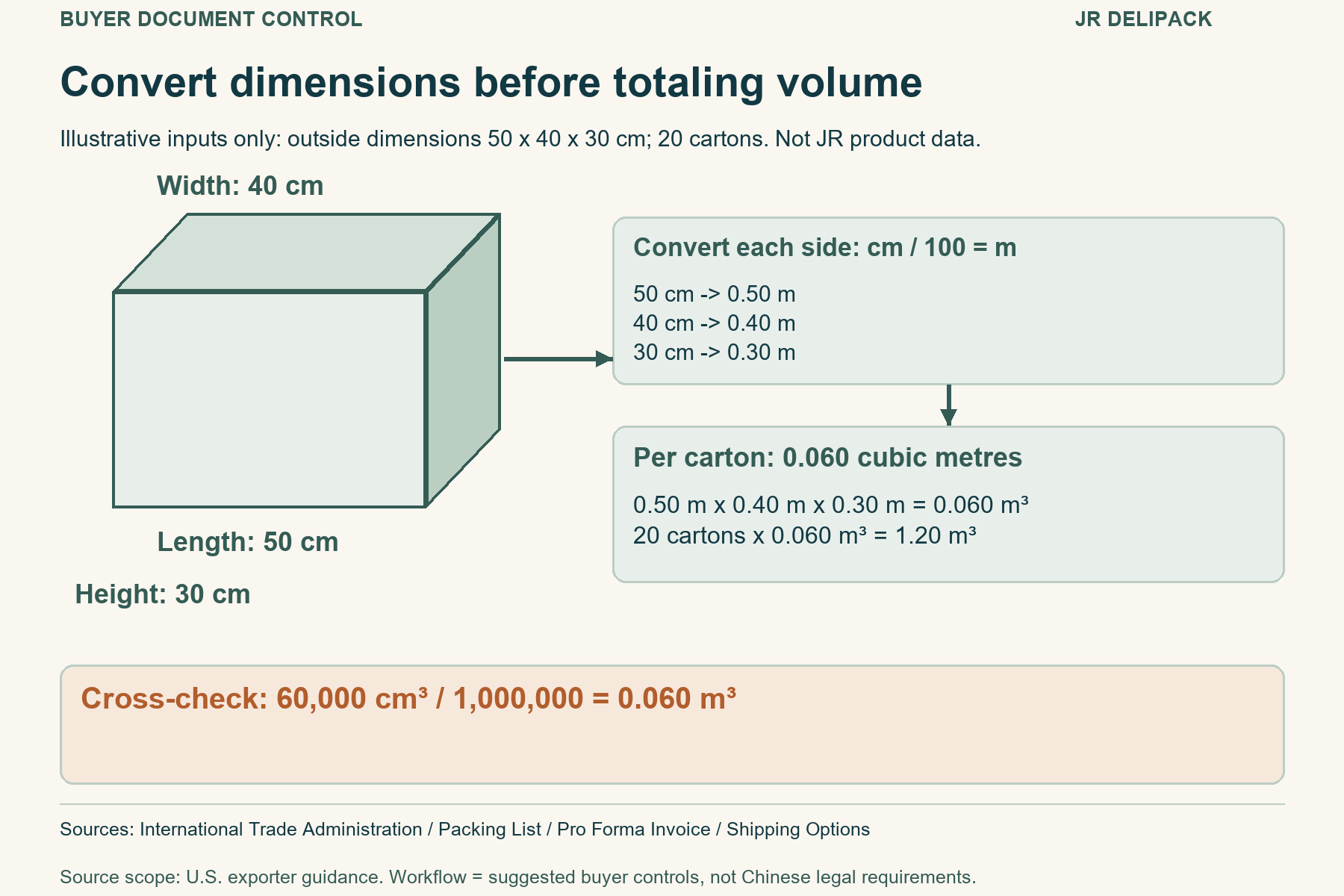
Using assumed dimensions, a 50 × 40 × 30 cm carton occupies 0.060 m³; under the DHL Express UK educational method, that same volume produces 12 kg of volumetric weight before service-specific rounding. DHL Express UK — Weight and Dimensions [5] The buyer's pre-booking check therefore has two parts: verify the carton geometry, then identify the rating method used for the number being compared. A correct cubic-meter sum is not automatically the correct chargeable-weight input.
This guide provides a suggested dimension-unit and volume worksheet for importers and distributors sourcing from Chinese factories. Carton sizes, counts and gross weights in our worked shipment are assumed, not observed JR DELIPACK specifications. We first calculate rectangular carton geometry, then apply explicitly named carrier education methods to show why a booking figure can differ. None of the examples supplies a price, a Chinese factory packing specification or a promise about the service available for a particular shipment. The cited International Trade Administration pages describe U.S. export-document practice, not Chinese law or filing requirements. Their role is to identify relevant document fields; the arithmetic and checking procedure are explained separately.
Which dimensions belong in the carton-volume calculation?
Start with the outside dimensions of the packed shipping carton. A product's width, a nested stack's height and a carton's external measurements describe different objects. Copy the measurement label as well as its value. If the supplier writes only “50 × 40 × 30,” ask for the unit and the measured object rather than choosing the unit that makes the total look plausible. A calculation can be internally correct while referring to the wrong physical object.
For each dimension group, retain four identifiers: the item or packing configuration, the measurement object, the unit, and the source record. Add whether the figures were measured, taken from a sample or estimated. These are worksheet labels proposed here, not official classifications. A sample measurement can be a starting point, but ask whether it still represents the ordered packing configuration. For estimated booking inputs, retain the estimate label and agree when the shipment-specific measurements will be reconfirmed.
The International Trade Administration lists package count and dimensions, where appropriate, among export packing-list information. International Trade Administration — Common Export Documents [1] Its packing-list page describes contents, weights and measurements for each package. International Trade Administration — Packing List [3] For this audit, request the dimension-bearing line for the actual carton configuration. Do not replace that line with a product catalogue size just because both appear in the same document bundle.
At quotation stage, another place to look is the pro forma invoice. The official guidance describes it as a quote in invoice format and lists quoted-product weights and dimensions among the information to include. International Trade Administration — Pro Forma Invoice [2] A quoted dimension is therefore a useful comparison input, but its presence does not prove that it was measured from the final packed carton. Ask which configuration and measurement record it represents.
Convert the lengths, then calculate each dimension group
Choose the volume unit required by the actual booking request. The examples here use meters and cubic meters. Convert each length from its original stated unit to meters and retain the original beside the converted value. Do not change units midway through multiplication. One conversion route forms the working calculation; a second route is a cross-check, not a second transformation of the already converted result.
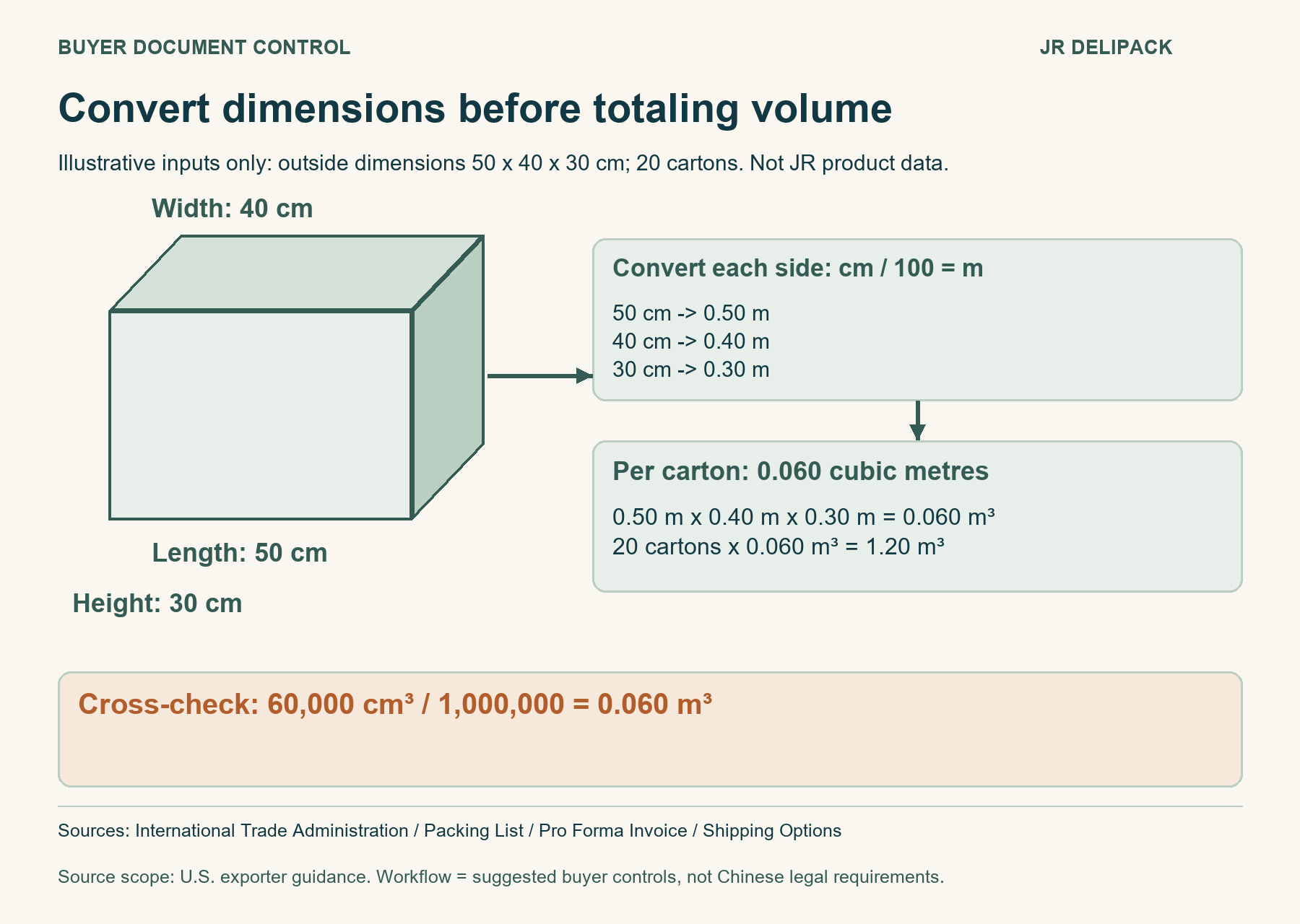
For the invented first carton, divide each centimeter length by 100: 50 cm becomes 0.50 m, 40 cm becomes 0.40 m, and 30 cm becomes 0.30 m. Multiplying those converted lengths gives 0.060 m³. The cross-check begins from the original dimensions: 50 × 40 × 30 equals 60,000 cm³, then 60,000 divided by 1,000,000 gives the same 0.060 m³. The divisor is cubed because there are three length factors; it is not the divisor used for a single length.
Calculate per-carton volume first, multiply by the number of cartons in that dimension group, then add the group totals. The second invented carton measures 45 × 35 × 30 cm, or 0.45 × 0.35 × 0.30 m. Its exact product is 0.04725 m³. Twelve such cartons contribute 0.567 m³. Adding the first group's 1.200 m³ produces a geometric total of 1.767 m³ across 32 cartons.
Illustrative inputs only: the table uses invented carton sizes and counts, not measured JR DELIPACK packing data. Line totals are displayed to three decimal places; per-carton products remain unrounded.
| Line | Carton (cm, assumed) | Carton (m, converted once) | Volume per carton (m³) | Cartons | Line volume (m³) |
|---|---|---|---|---|---|
| A | 50 × 40 × 30 | 0.50 × 0.40 × 0.30 | 0.060 | 20 | 1.200 |
| B | 45 × 35 × 30 | 0.45 × 0.35 × 0.30 | 0.04725 | 12 | 0.567 |
| Total | — | — | — | 32 | 1.767 |
Keep separate rows when carton dimensions differ. Multiplying separately averaged lengths, widths and heights does not in general reproduce the sum of the individual carton volumes. A count-weighted average of per-carton volumes can give the same total, but individual rows are easier to compare with the supplied measurements. When one dimension group changes, the affected row and the sum can be checked without reconstructing an average.
What does a large discrepancy reveal?
Check whether the two figures are expressed in the same cubic unit before looking for a measurement difference. In this example, 60,000 cm³ and 0.060 m³ describe the same carton. Dividing the cubic-centimeter result by 1,000 instead of 1,000,000 would produce 60, a result one thousand times too large if labeled m³. Likewise, converting one length twice changes the product even if the other two lengths are correct. Inspect the original unit, each conversion and the final cubic-unit label in that order.
Keep enough precision for the comparison to be reproducible
Distinguish a conversion mistake from a changed dimension
A mixed-unit entry can be identified by inspecting the individual factors, not just the total. For the same assumed first carton, entering 0.50 × 40 × 0.30 into a formula intended for meters produces 6 instead of 0.060. The middle value was left in centimeters while the other two were converted. Correct the converted width using its original unit, then recalculate the product. Do not replace the final total with the expected answer while leaving the inconsistent width in the worksheet; that hides the reason the calculation differed.
A changed measurement is a different case. Suppose the assumed first carton's height is revised from 30 cm to 31 cm while its length and width stay unchanged. The converted product becomes 0.50 × 0.40 × 0.31 = 0.062 m³, and twenty cartons total 1.240 m³. The difference from 1.200 m³ is caused by the changed height, not by a unit-conversion error. Confirm which height applies to the current packed carton. Retain the superseded measurement rather than forcing the current row to match the earlier result.
A different way of writing a length need not indicate a changed measurement. In an assumed comparison, 50 cm and 0.50 m represent the same length. Normalize both records to the worksheet's unit before deciding they conflict. Compare the other two lengths the same way, while also confirming that both records describe the same external carton configuration. Record an equivalent-unit result as such; request a measurement clarification only when the normalized values or their physical objects still differ. This keeps a notation change separate from a real dimension revision.
Retain the available measurement precision through the intermediate products. Round the reported total only after the carton groups have been summed, using the precision agreed for the actual worksheet or quotation. Three decimal places is the reporting convention in the example above, not an official carrier rule. A displayed total should be traceable to the unrounded products so another reader can reproduce it.
For the invented second carton, rounding 0.04725 m³ to 0.047 m³ before multiplying by 12 gives 0.564 m³ instead of 0.567 m³. The 0.003 m³ difference is introduced by that rounding step, not by a new carton measurement. If your comparison shows such a difference, first recalculate from the original lengths. Do not change a physical dimension merely to force the displayed total to agree.
Preserve the source string as well as the numeric cell: “50 cm → 0.50 m (÷100)” is more informative than an isolated “0.50.” Use a separate unit field if the spreadsheet stores only numbers. The converted value and its unit should travel together when a row is copied into a booking request. Check that headings still match the values after a template is reused; a meter value under a centimeter heading creates a different problem from a correctly labeled rounded result.
Treat an unexplained decimal separator or dimension order as a question for the sender. Confirm the three lengths and their units before entering them, rather than silently interpreting an ambiguous source. Once confirmed, keep the original text and your normalized entry together. Multiplication itself does not depend on the order of the three lengths, but the labels help identify which physical side was remeasured if a later record changes.
Make a comparison sheet the forwarder can read
Use one row per external-carton dimension group. Keep the source dimensions, converted lengths, per-carton product, group count and group total together. Add a shipment-sum row and a separate field for the figure being compared. The aim is to compare the same geometry on both sides, not to infer an invoice amount from a cubic-meter result.
The packing-list guidance states that freight forwarders use the document to determine weights and freight costs. International Trade Administration — Packing List [3] That describes a document's use; it does not supply a billing formula for your shipment. Send the dimension rows and ask which measurement basis the actual quotation uses. If the quotation measures a palletized load instead of individual cartons, record that distinction before interpreting a difference as an arithmetic error.
A compact worksheet can contain the following fields. They are proposed checking fields for this task, not a complete export-document template:
- Source record, date or revision, and carton configuration.
- Original external length, width and height, with their stated unit.
- Measurement status and the person confirming the dimensions.
- Converted lengths and the single conversion factor used.
- Unrounded geometric volume for one carton in that group.
- Cartons in the group and its calculated geometric volume.
- Shipment sum, displayed precision and calculation cross-check.
- The compared booking figure, its unit and its measurement basis.
- Any difference still open and the clarification requested.
The International Trade Administration describes freight forwarders advising on freight costs and related charges. International Trade Administration — Shipping Options [4] For this worksheet, retain the actual quotation's measurement basis and service terms alongside the calculated totals. The worked examples below show the numerical consequences of specific educational methods; they do not replace the applicable quotation.
Apply the defined rating method to the same carton geometry
DHL Express UK's article, dated 21 November 2023, gives a volumetric-weight method using centimeter length, width and height divided by 5,000. Its published example has dimensions 40 × 30 × 50 cm and an actual weight of 8 kg, producing 12 kg of volumetric weight. For multiple packages, that page instructs readers to calculate each separately and select the higher actual or volumetric value. DHL Express UK — Weight and Dimensions [5] This is the named UK Express educational method, not a rule asserted for every carrier or mode.
Apply that method to our assumed shipment before provider-specific rounding: group A has 20 cartons at 50 × 40 × 30 cm and 8 kg gross each; group B has 12 cartons at 45 × 35 × 30 cm and 10 kg gross each. For A, 60,000 ÷ 5,000 gives 12 kg per carton, so the higher value contributes 20 × 12 = 240 kg. For B, 47,250 ÷ 5,000 gives 9.45 kg per carton; its assumed actual 10 kg is higher, contributing 12 × 10 = 120 kg. The piecewise educational total is 360 kg.
| Assumed group | Cartons | Gross kg each | UK Express-method volumetric kg each | Higher kg each | Group kg before provider rounding |
|---|---|---|---|---|---|
| A | 20 | 8 | 12 | 12 | 240 |
| B | 12 | 10 | 9.45 | 10 | 120 |
| Total | 32 | — | — | — | 360 |
Actual gross weight totals 20 × 8 + 12 × 10 = 280 kg. Dividing the combined geometric volume by the UK Express factor instead gives 1.767 × 1,000,000 ÷ 5,000 = 353.4 kg. Taking only the higher of those two shipment totals would return 353.4 kg, not the piecewise 360 kg. The 6.6 kg difference demonstrates why the source's package-level comparison cannot be replaced by one comparison of totals. It does not establish an actual bill; package measurement and rounding still require the applicable service terms.
Why does another mode produce another volumetric figure?
DHL Global Forwarding's education page uses 6,000 for its air-freight example and 1,000 for its ocean LCL example, with centimeter dimensions. It describes FCL charging on a per-container basis instead of that volume-based charge and warns that carriers may use other density ratios. DHL Global Forwarding — Calculating Chargeable Weight [6] These are stated educational bases, not a guarantee that the same ratios govern our buyer's quotation.
Using the unchanged 1.767 m³ geometry, the air example's volumetric calculation is 1.767 × 1,000,000 ÷ 6,000 = 294.5 kg. Under the LCL example's conversion, it is 1.767 × 1,000,000 ÷ 1,000 = 1,767 kg-equivalent. That LCL figure is a rating-basis illustration, not a claim that the cartons physically weigh 1,767 kg. Neither result quotes a rate or minimum charge. Do not transfer the UK Express piecewise comparison to these examples without verifying the actual aggregation and measurement rules.
For a booking check, write the measurement object, transport/service basis, divisor where applicable, comparison level and rounding step beside the result. This turns an unexplained number into a reproducible calculation. A worksheet showing 1.767 m³, 280 kg actual and 360 kg under the scoped Express illustration contains three different quantities; replacing their labels with a generic “shipping weight” hides the distinction that matters.
Check the numeric basis before accepting the booking input
The concrete outcome is a matched calculation: our geometric carton total is 1.767 m³, assumed gross weight is 280 kg, and the unrounded UK Express-method piecewise illustration is 360 kg. The air educational volumetric basis is 294.5 kg, while the LCL illustration is 1,767 kg-equivalent. Identify which calculation the proposed booking field requests before entering a value; do not choose a number merely because it matches a supplier's subtotal. For your actual container and lid arrangement, send the confirmed measurements and named calculation basis through Contact JR DELIPACK. The products page identifies the range, and the Factory & Quality page provides manufacturing background. This numerical comparison, rather than a generic request to recheck documents, is the result to carry into the enquiry.
FAQ
Why does converting cubic centimeters require dividing by one million?
Because a length in centimeters is divided by 100 to express it in meters, and volume multiplies three lengths. The combined divisor is 100 × 100 × 100. For the invented first carton, 60,000 cm³ therefore equals 0.060 m³.
Can I use one average carton size for mixed dimensions?
Keep a row for each dimension group. Multiplying three separately averaged lengths does not generally reproduce the summed volumes. A count-weighted average of per-carton volumes can reproduce the sum, but the separate rows retain the measurements needed to check a changed group.
Why is the Express-method total not simply the larger shipment-wide total?
In the assumed worked shipment, one carton group is volume-dominant while the other is actual-weight-dominant. Selecting the higher value for each package produces 360 kg; comparing only combined actual and volumetric totals produces 353.4 kg. Follow the comparison level required by the named method.
What if the supplier gives a product dimension?
Request the external dimensions of the packed shipping carton for this calculation. Keep the product dimension labeled as a different object. Do not quietly use it in the carton-volume row even when its unit is clear.
Should a provisional measurement be hidden until it is confirmed?
No. Retain the estimate label and record who supplied it. Ask when the shipment-specific figure will be confirmed and whether the actual booking request accepts the provisional basis. Do not present a sample or estimate as a production measurement.
Does the LCL kg-equivalent figure mean the shipment has that physical mass?
No. The 1,767 kg-equivalent result applies the cited LCL education ratio to the assumed carton geometry. The same worked shipment has an assumed physical gross weight of 280 kg. Keep the rating-basis figure and actual mass in separate, clearly labeled fields.
References
- [1] Common Export Documents — International Trade Administration. https://www.trade.gov/common-export-documents. Publication date not provided.
- [2] Pro Forma Invoice — International Trade Administration. https://www.trade.gov/pro-forma-invoice. Publication date not provided.
- [3] Packing List — International Trade Administration. https://www.trade.gov/packing-list. Publication date not provided.
- [4] Shipping Options — International Trade Administration. https://www.trade.gov/shipping-options. Publication date not provided.
- [5] Weight and Dimensions — DHL Express UK. https://www.dhl.com/discover/en-gb/ship-with-dhl/products-and-services/weight-and-dimensions. Published 2023-11-21.
- [6] Calculating Chargeable Weight by Air, Ocean, Road and Rail — DHL Global Forwarding. https://www.dhl.com/us-en/home/global-forwarding/freight-forwarding-education-center/calculating-chargeable-weights.html. Publication date not provided.