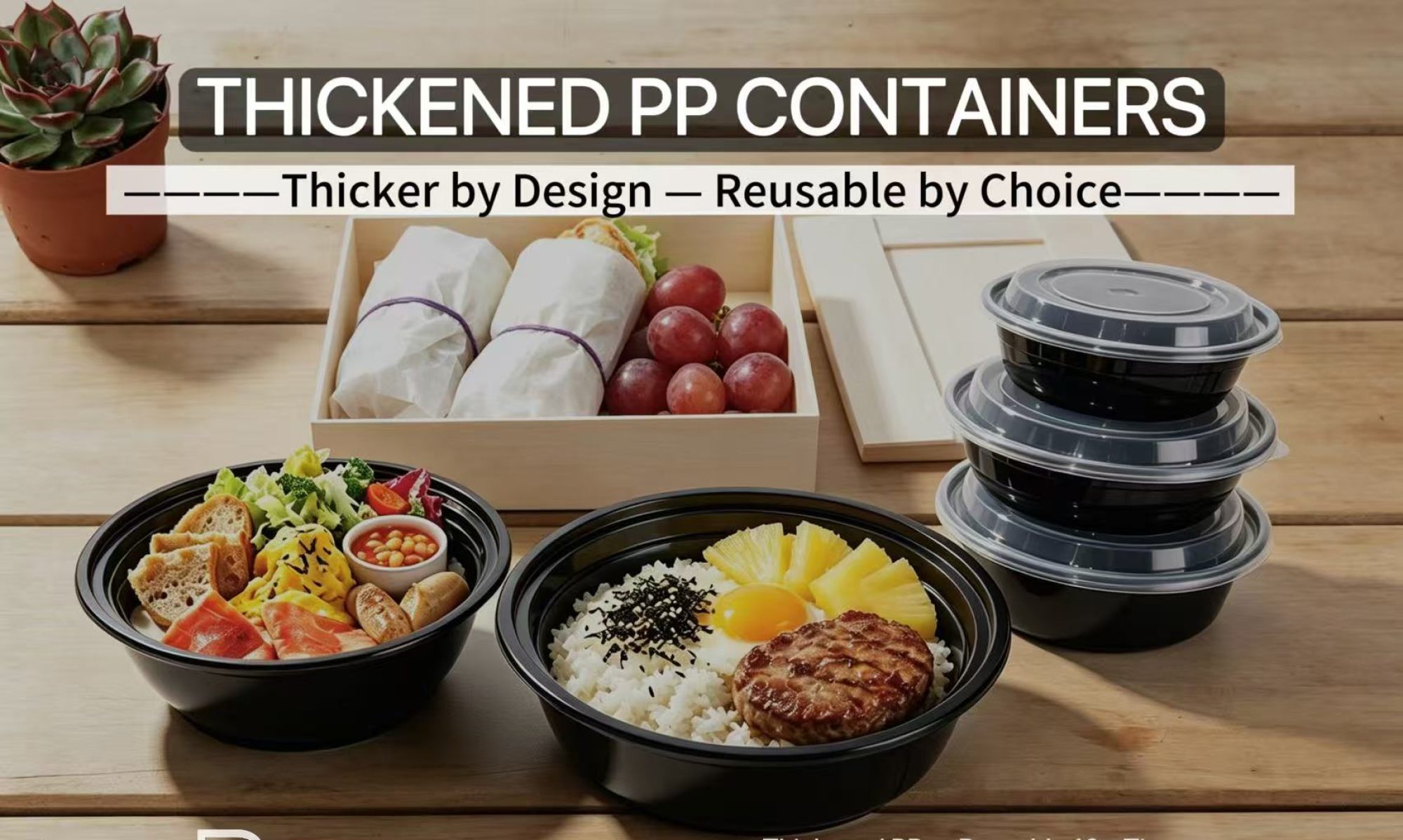
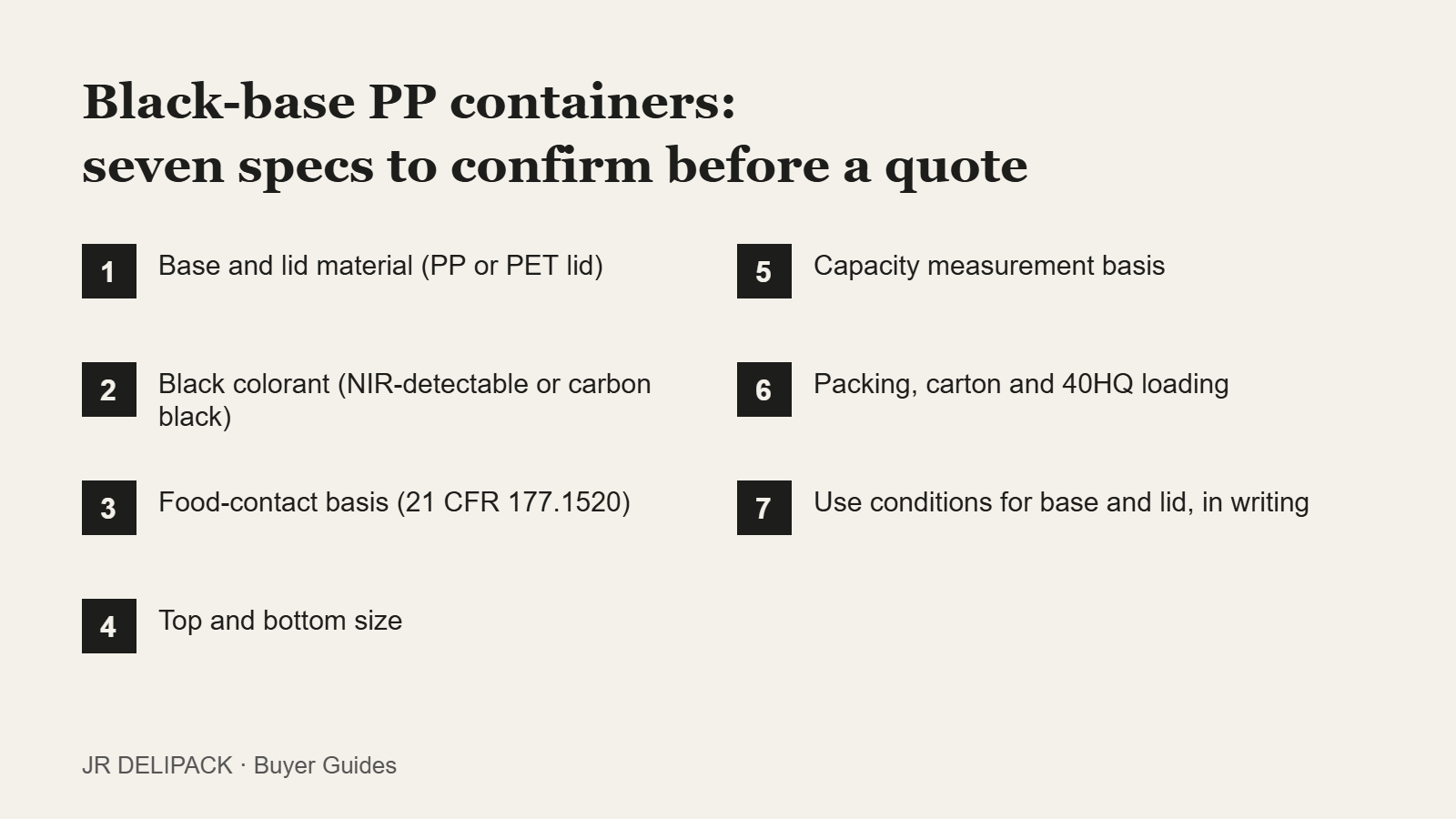
Before you quote black-base PP takeout containers, confirm seven specifications, and treat the black colorant as one of them. Off-premises orders made up 83% of limited-service and 30% of full-service restaurant traffic in 2024, up from 76% and 19% in 2019, according to the National Restaurant Association. The container is now part of the meal for most customers, so a vague spec costs more than it used to.
Why black bases are on more buyer lists in 2026
Restaurant demand for takeout packaging is not a short spike. The National Restaurant Association reports that 58% of limited-service and 41% of full-service operators say off-premises is a larger share of their sales than in 2019.
| Off-premises share of customer traffic | 2019 | 2024 |
|---|---|---|
| Limited-service restaurants | 76% | 83% |
| Full-service restaurants | 19% | 30% |
Black bases with clear lids are one answer to that demand. Trade-show coverage of the 2026 National Restaurant Association Show listed black-base containers as a growing format for sushi, bento, meal-prep and grab-and-go programs, because a dark base gives food more contrast (a supplier trade-show summary, not an independent market study). For an importer, that makes black bases a product decision, not a design detail.
Seven specifications to confirm before you request a quote
| Specification | What to ask the supplier | Why it matters |
|---|---|---|
| Base and lid material | Is the base PP? Is the clear lid PP or PET? | Base and lid can behave differently in use and may need separate documents. |
| Black colorant | Is the black made with conventional carbon black or an NIR-detectable black? | This decides whether common recycling sorters can identify the base (see below). |
| Food-contact basis | Which U.S. regulation the resin is declared under; for polypropylene this is usually 21 CFR 177.1520 (olefin polymers) | Ask for the supplier’s written declaration for base and lid separately. |
| Top and bottom size | Top length × width × height, plus bottom size | Bottom size decides fit on trays, in bags and on shelves. |
| Capacity basis | How capacity was measured: brim-full, fill line, water or rice | Two catalogs can list different ml for the same mould. Compare like with like. |
| Packing and carton | Bases and lids packed together or separately; carton size, CBM and cartons per 40HQ | Freight cost per piece comes from these numbers. |
| Use conditions | Microwave, hot-fill, dishwasher and freezer conditions for base and lid, with temperature and time | A general “microwave safe” line is not a usable spec. Ask for model-specific conditions in writing. |
The black colorant question: recyclability
Most U.S. plastic packaging is not recycled to begin with. The U.S. EPA estimated 35.7 million tons of plastics in municipal solid waste in 2018, with an 8.7% recycling rate; plastic containers and packaging alone were over 14.5 million tons.
Black packaging faces an extra barrier. Material recovery facilities sort plastics with near-infrared (NIR) sensors, and conventional carbon black absorbs that light, so the sensor cannot identify the polymer underneath. Plastics Engineering (SPE), August 2026 reports that RecyClass treats carbon-black packaging as non-recyclable under its current guidance and that the APR Design Guide discourages it in rigid packaging. NIR-detectable black pigments exist, but they can cost more and may affect color consistency.
- If your customers make recyclability statements, ask whether an NIR-detectable black is available and request trial samples.
- If they do not, conventional black may be acceptable, but do not let “recyclable” appear on the pack or listing without checking local rules.
- Clear PP lids avoid the colorant issue; a black base with a clear lid can still be specified to reduce the undetectable share.
Landed cost: the duty line to check
The U.S. tariff heading for plastic tableware and kitchenware is 3924.10. In the USITC Harmonized Tariff Schedule, the general rates read 6.5% for plates, cups and bowls (3924.10.20), 5.3% for trays (3924.10.30) and 3.4% for other articles (3924.10.40).
Classification depends on the exact product and is your customs broker’s call. Additional duties on goods from China may apply on top of the general rate, so confirm the full rate before you compare supplier prices.
Data notes
Restaurant traffic figures are national U.S. survey and panel data, not container volumes. EPA figures are the 2018 national estimates, the latest in that series, and are not product-specific. Tariff rates are the general column read on 1 November 2026 and are not a duty ruling. None of these figures is a JR DELIPACK quotation.
Example: how the RT68 listing answers these questions
RT68 is a 28 oz black-base, clear-lid rectangular container in the JR DELIPACK rectangular range, part of the PP containers we manufacture in Dongguan for importers and distributors. Its published listing already answers four of the seven items:
| Specification | RT68 as published |
|---|---|
| Top and bottom size | Top 22 × 15 × 3.8 cm; bottom 17.5 × 10.5 cm |
| Packing | 50 bases per bag × 3, plus 50 lids per bag × 3; 150 sets per carton |
| Carton | 46.5 × 22.8 × 35 cm; 0.037 m³ |
| 40HQ loading | 1,850 cartons |
Ask us in writing for the remaining items: lid material, the black colorant used, the food-contact declaration, the measurement basis behind the 28 oz rating, and use conditions for base and lid.
For the rest of the quote, see what a PP food container quotation should include besides the unit price and how carton volume and units change freight per piece.
Next step: send us the models and quantities you are comparing, and we will reply with the base, lid, colorant and packing details for each, and arrange samples for your own checks.
Sources
- Report: Takeout, drive-thru, delivery are more popular than ever, National Restaurant Association, 17 April 2025
- Plastics: Material-Specific Data, U.S. EPA (2018 data)
- Carbon Black Pigments Create New Recycling Compliance Challenges, Plastics Engineering (SPE), 25 August 2026
- 21 CFR 177.1520 Olefin polymers, eCFR
- HTS 3924.10 search results, U.S. International Trade Commission, read 1 November 2026
- NRA Show 2026 Packaging Trends, OneStop Supply Co. (supplier trade-show summary)
KEEP READING
What should you read next?
BUYER FAQ
Questions buyers ask before sourcing PP food packaging
Can JR DELIPACK PP containers be used for hot food and microwave reheating?
Our PP food packaging is designed for hot-food service. The selected product specification should be confirmed for microwave reheating, dishwasher cleaning and freezing before an order is placed.
Which food-contact documents can be confirmed for an order?
JR DELIPACK can provide SGS and FDA-related documentation within the confirmed scope for the selected SKU and destination market. Please tell us the product, destination and document requirement first.
What is the minimum order quantity and how is a quotation prepared?
MOQ is confirmed by SKU, packing and order requirements. Final pricing is quoted according to the model, quantity, destination, packing requirement and agreed trade terms.
Are samples free?
Samples are free. Buyers first advance the freight or handling cost; when a formal order is placed, the confirmed advanced amount is deducted from the final payment.
What is the estimated production lead time?
Production normally takes 30 days or more from order confirmation to FOB Shenzhen Shekou. Ocean transit time is not included and the final schedule is confirmed per order.