Before ordering PP takeaway containers for the EU, match each ordered configuration to its responsible operator, applicable requirements and supporting documents: in a hypothetical review of four configurations against five document categories, there are 4 × 5 = 20 checks to resolve. A complete folder is not proof of compliance; every applicable record must cover the actual container, lid, decoration and intended use.
The Packaging and Packaging Waste Regulation has generally applied since 12 August 2026. It entered into force on 11 February 2025, a separate milestone. The Commission describes its scope as packaging placed on the EU market, regardless of material or origin; individual provisions can have different application dates. European Commission: packaging waste and application date [1]
This is a procurement guide, not legal advice, a laboratory report or a declaration that any JR DELIPACK product complies. Obtain a qualified, product-specific assessment for your supply chain and destination.
What should the purchase specification identify first?
Start with the item you intend to buy, not a request for a generic certificate. Give the base and separate lid their own references. Record colour, capacity, dimensions, compartments, material declarations, decoration and the current drawing revision. Keep the ordered combination explicit even when the two components belong to the same catalogue family. A convenient commercial set name should not hide a substitution.
Describe the intended food and handling sequence. For example, distinguish an item filled and served immediately from one used for chilled storage followed by reheating. Record the actual conditions you expect the supplier to evaluate rather than inserting a temperature range from another model. Where the use remains undecided, label it as an open purchasing question. The review cannot reliably assess a changing brief.
Specify the commercial unit as well. State whether the order quantity means bases, lids or complete sets, and identify any sleeve, label or accessory included. This helps the team relate a supporting record to the shipment being quoted. It also prevents a buyer from approving documentation for the base while accidentally ordering an unreviewed lid in a separate carton line.
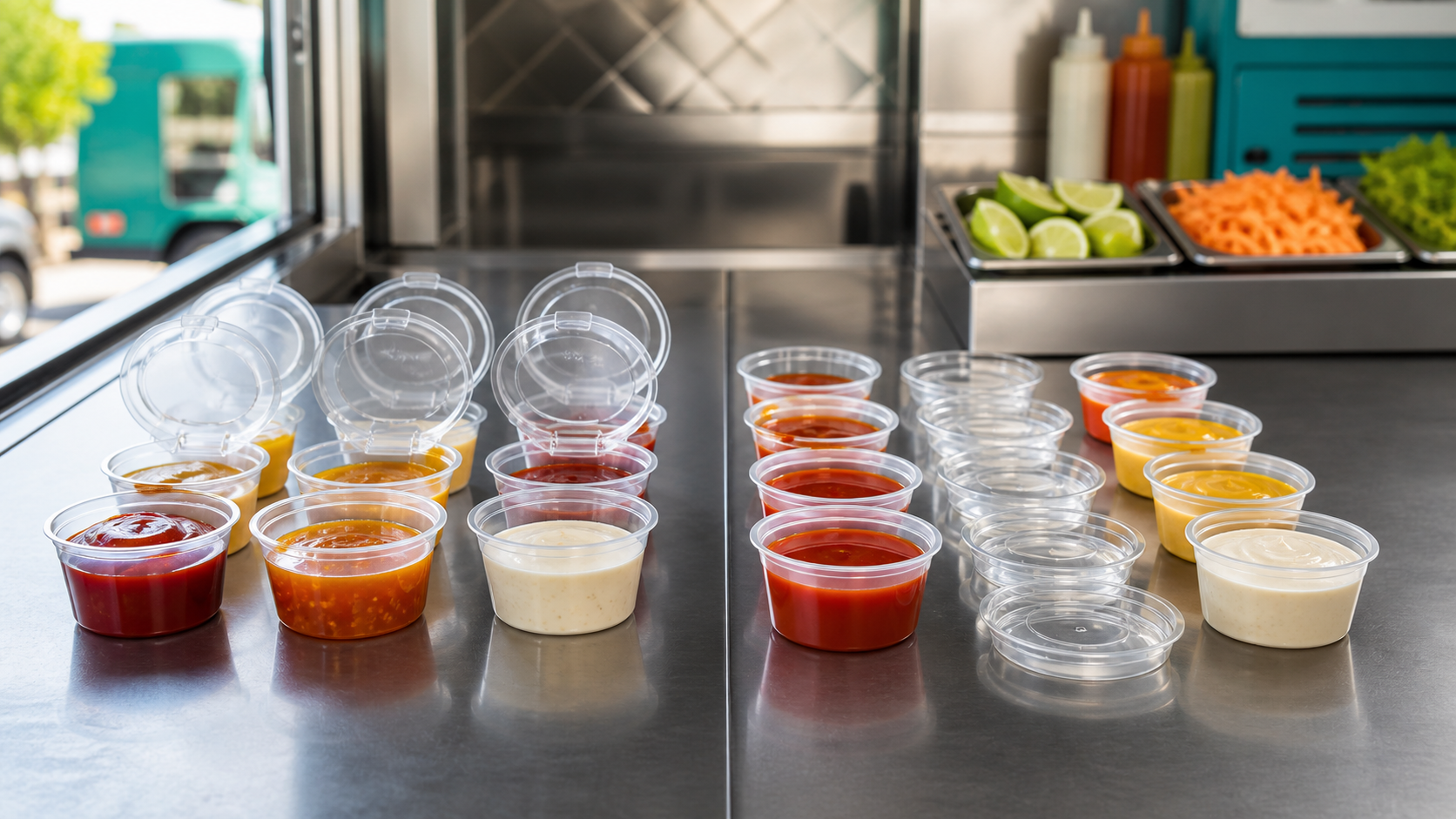
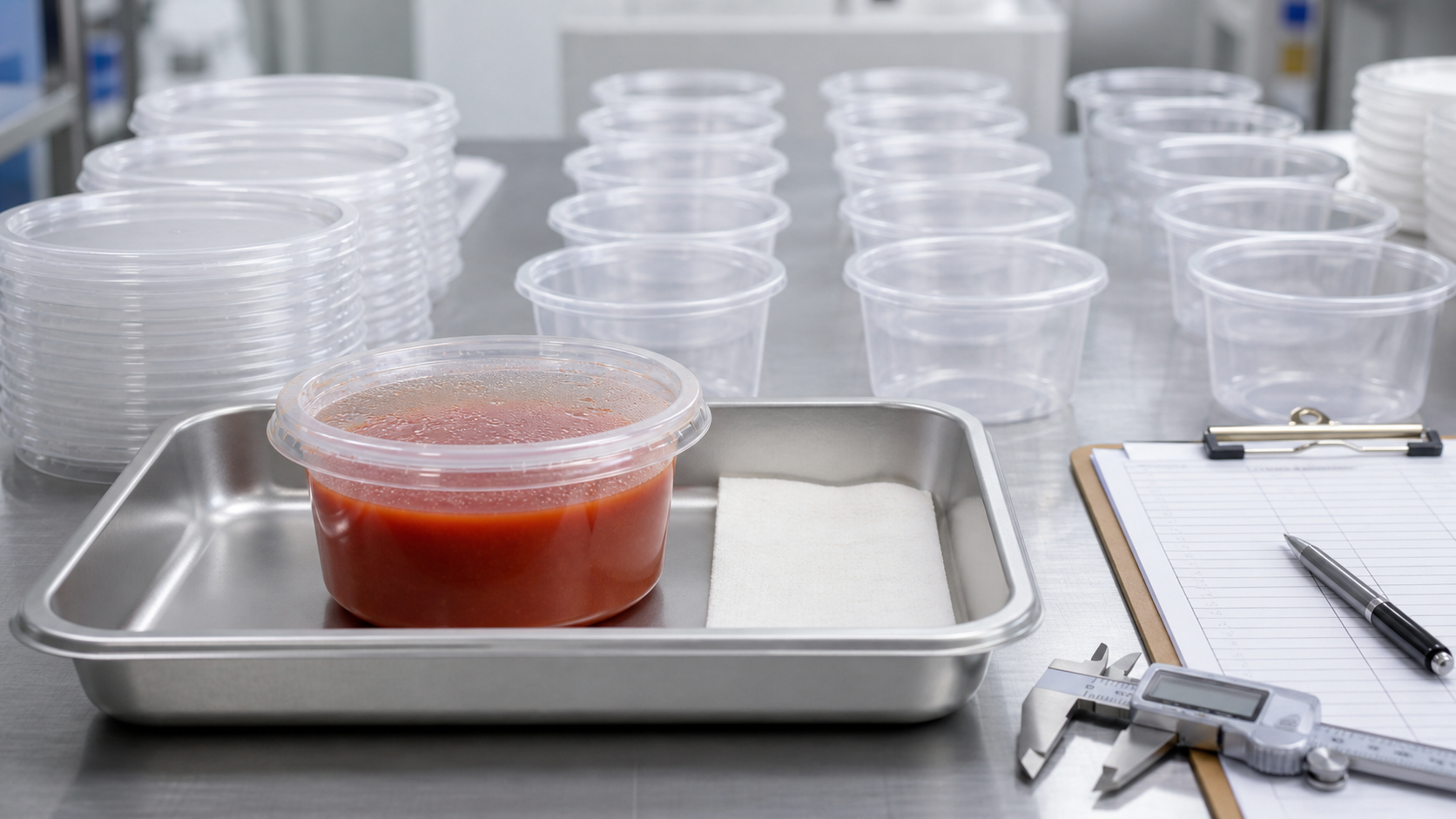
Keep a sample or reference image with the specification when available, but use it to identify the proposed configuration, not to prove regulatory performance. A photograph cannot establish formulation, migration behaviour or conformity. Ask for the relevant record where the distinction matters; do not infer it from colour, rigidity or a familiar recycling symbol.
Which businesses should own the document questions?
Identify the commercial supplier, the legal manufacturer under the applicable rules and the EU importer where relevant. These roles are not necessarily the same business. Commission guidance discusses how branding and the supply arrangement affect the manufacturer definition. Commission guidance, section 2 [2]
As a practical workflow, assign a named role to each unresolved question. The purchasing contact may collect the specification, a quality reviewer may check model scope, and the responsible compliance professional may decide legal applicability. Do not send every question to a sales contact and interpret a quick acknowledgement as a technical approval. Ask who is authorised to answer and how that answer will be recorded.
For a private-label project, show the proposed brand and artwork early. Ask the buyer’s adviser to confirm responsibility before the supply arrangement is finalised. Avoid writing “the factory handles all compliance” into an order simply because the factory can supply a test report. Equally, do not assume that the purchasing department can transfer another operator’s obligations through an informal email.
Keep confidential source records in the appropriate controlled review channel. Your public catalogue needs accurate, scoped statements; it does not need copies of upstream business licences, private manufacturing addresses or unredacted reports. Agree which evidence can be shared, with whom and for what review purpose. Public marketing and responsible technical disclosure are different activities.
What belongs in the PPWR review file?
Articles 15 and 18 address manufacturer and importer responsibilities. Articles 38–39 and Annexes VII–VIII set out the conformity-assessment and declaration framework. Review the applicable requirements rather than requesting a universal third-party “PPWR certificate.” Regulation (EU) 2025/40, relevant articles and annexes [3]
The following table is a suggested purchasing index, not a mandatory statutory template. Its categories organise the questions; they do not prescribe a fixed number of laboratory reports or imply that every buyer must receive every confidential file.
| Review category | Match to the order | Question to resolve |
|---|---|---|
| Configuration | Base, lid, decoration and revision | Is this the exact combination being purchased? |
| PPWR declaration and technical-file reference | Identified packaging and responsible operator | Which applicable requirements and records support it? |
| Restricted substances | Finished construction and relevant components | Does the evidence address the applicable restriction? |
| Food-contact documents | Material, food, contact time and temperature | Do the declared conditions cover the intended use? |
| Change control | Approved revision and named contact | What triggers a fresh review before substitution? |
Read the scope, not just the heading. A file named after the product may still describe a different colour, formulation or manufacturing configuration. Compare identifiers throughout the documents, including attachments and laboratory sample descriptions. Where names differ for a legitimate reason, request an explicit mapping. Save that explanation with the file so the next reviewer does not have to reconstruct the connection.
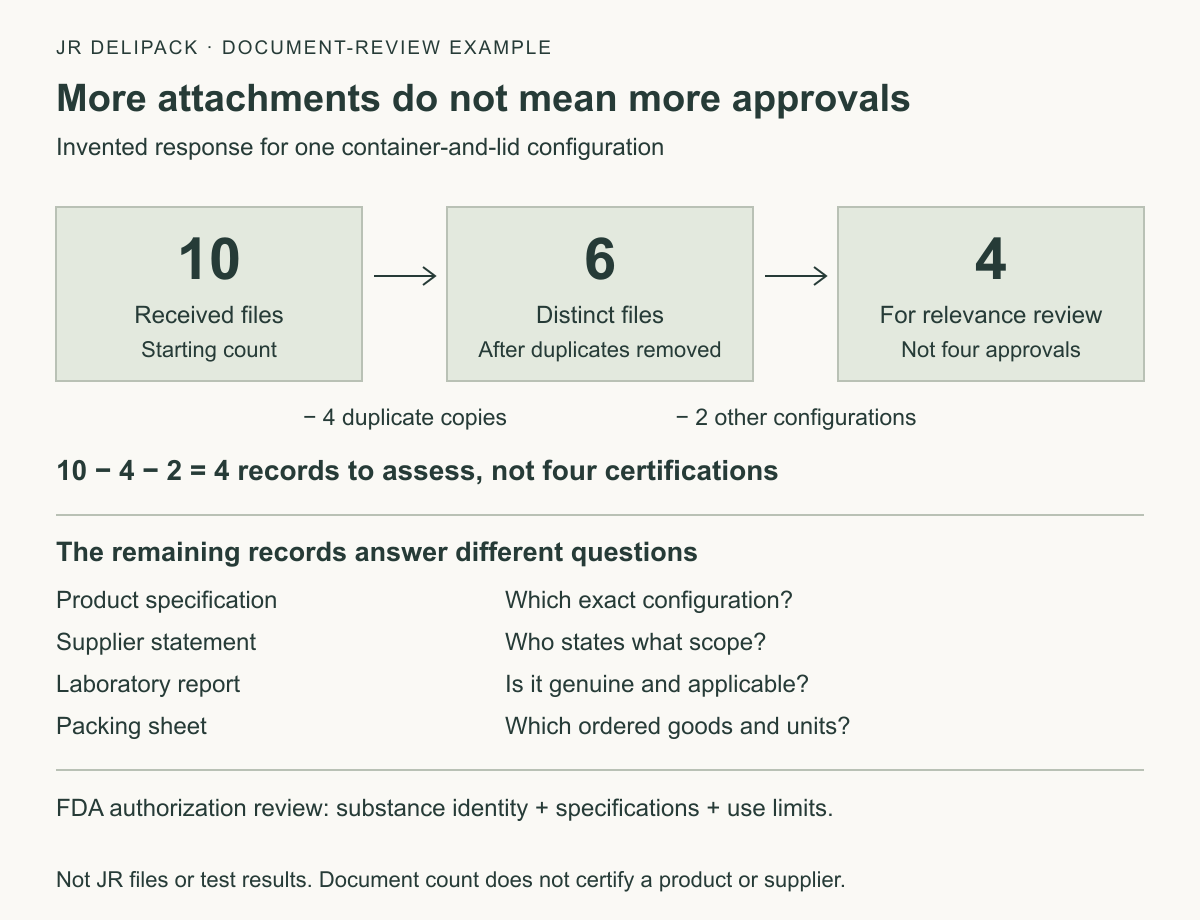
Separate three administrative states: received but not reviewed, reviewed with open questions, and accepted for the defined scope by the responsible reviewer. These are suggested internal labels, not legal classifications. A document can exist and still leave an important question unanswered. Counting uploaded files without recording their scope can make an incomplete order appear ready.
How should buyers read the PFAS evidence?
Article 5(5) specifies distinct limits: 25 ppb for an individual PFAS in targeted analysis; 250 ppb for the sum of targeted PFAS, with precursor treatment where applicable; and 50 ppm including polymeric PFAS. The first two exclude polymeric PFAS from quantification. The provision also contains a total-fluorine evidence requirement; read the complete wording and conditions. PPWR, Article 5(5)–(6) [3]
Do not compare a laboratory result with a limit until the measurement scope and unit have been checked. Ask the qualified reviewer what the reported method measures, what it does not measure, and whether the sample represents the ordered construction. A result expressed in one unit should not be copied into a different field without a documented conversion and a check that the underlying measurand is the same.
Keep the laboratory sample reference, test date, method, reporting limit and stated limitations together. If a report covers a raw resin, ask how its relevance to the decorated finished article has been established. If several components are combined in the sample, ask whether the result answers the question being assessed. These are review questions, not instructions to use a universal test method or frequency.
Avoid turning “not detected under this method” into an unrestricted “PFAS-free” marketing statement. Send any proposed wording to the responsible reviewer with the evidence it is intended to describe. The artwork team should receive approved wording and its scope, not a laboratory attachment from which it is expected to invent a sales claim.
For stock-transition questions, distinguish manufacturing from placing on the market. The Commission’s guidance says food-contact packaging placed on the market after 12 August 2026 must meet the PFAS limits; an earlier production date is not by itself a stock exemption. Commission guidance, section 5 [2]
Does the PPWR file replace food-contact documentation?
No. The Commission identifies Regulation (EC) No 1935/2004 as the general food-contact framework and Regulation (EU) No 10/2011 as the specific plastics measure. Its guidance describes a food-contact declaration of compliance supported by documentation, with assessment related to the intended food and conditions of use. This is distinct from the PPWR declaration of conformity. European Commission: food-contact legislation and plastics documentation [4]
Use clearly different folder labels for the two declarations. Link both to the same controlled product reference, but do not replace one with the other because their abbreviations look similar. Ask the reviewer to record which question each document answers. This small administrative step helps a purchasing assistant avoid attaching the wrong document to a customer’s request.
Write the food-contact brief in ordinary operational terms before converting it into testing terminology. Describe the meal, fill condition, holding time, storage and any proposed reheating. Ask whether the lid stays on during that use. If the buyer changes the application, return to the evidence rather than treating the previous answer as a material-wide promise. No general PP temperature limit is assigned by this guide.
A US-oriented test report may be useful background, but do not assume it answers the applicable EU question. Record its actual standard and scope, then ask for the correct basis for the destination. The same discipline applies to repeated-use, dishwasher and microwave claims: retain only the wording supported for the selected item and conditions.
Which deadlines belong on a separate planning list?
The Commission interprets the general recyclability obligation as applying from 12 August 2026, while harmonised design-for-recycling criteria have a later timetable. Its guidance also distinguishes the timing of the related conformity assessment. Do not describe all recyclability requirements as either fully new on one day or irrelevant until 2030. Commission guidance, section 6 [2]
Article 12(1)’s material-composition label applies from 12 August 2028 or 24 months after the relevant implementing acts enter into force, whichever is later. This is not a present requirement to print an invented harmonised label. PPWR, Article 12(1) [3]
For each proposed future requirement, record the legal provision, trigger, affected configuration and next review date. Put unresolved future artwork on a planning list instead of marking the current order compliant with a symbol that has not been reviewed. A long-term supply programme needs both a current-order decision and a route for later design changes; neither should be hidden inside the other.
Keep a record of which official version the reviewer used. When a supplier or adviser sends an updated interpretation, compare its effect on the specific order rather than replacing the entire file without explanation. Preserve the previous decision and explain the changed point. This gives the buyer a usable history of what was approved at each stage.
How can a buyer calculate document readiness without inventing a compliance score?
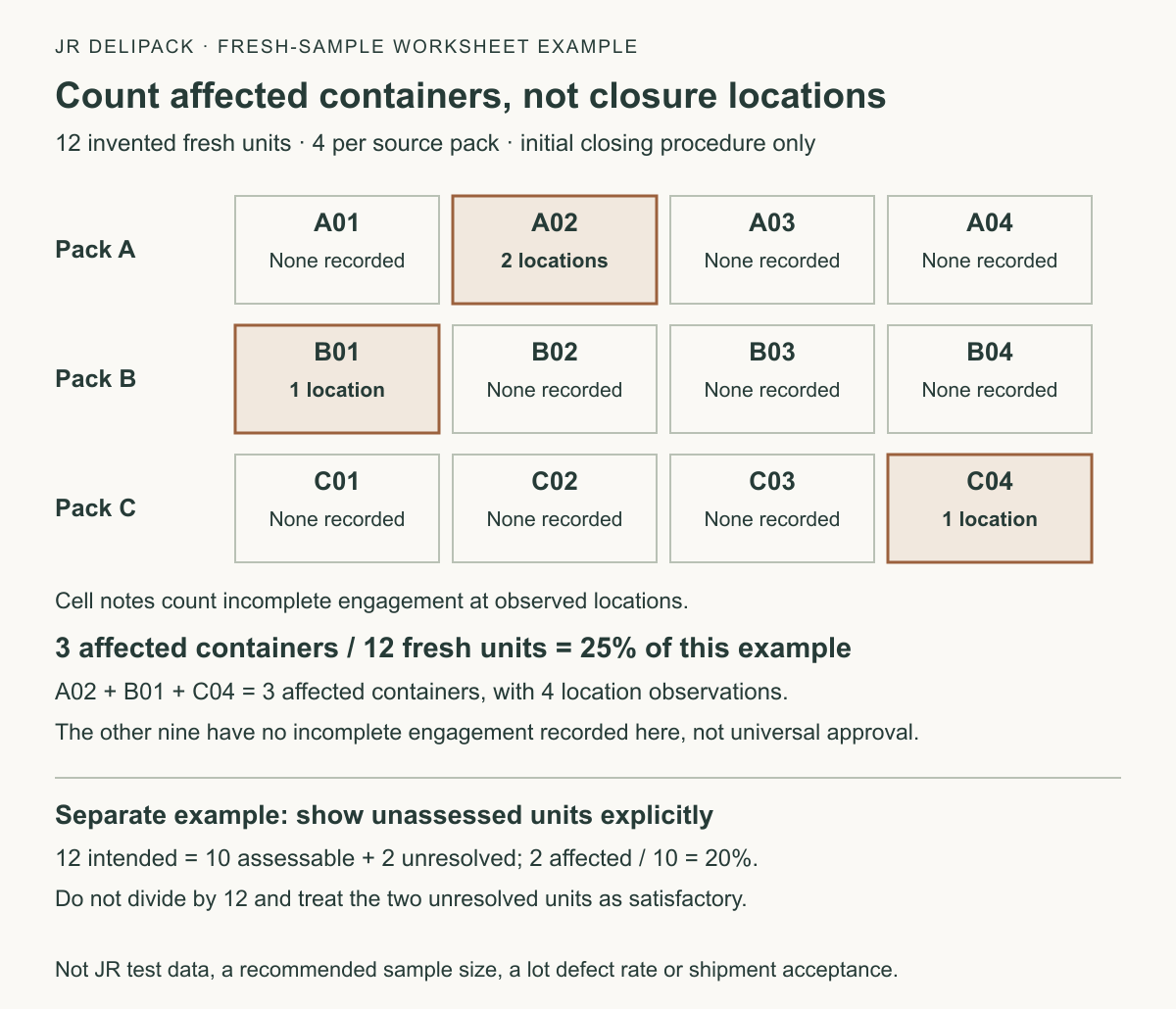
Return to the explicitly hypothetical opening example. Assume four distinct container-and-lid configurations and five review categories for each. Four multiplied by five gives twenty review positions. If eighteen positions have been resolved for their intended scope and two remain open, the administrative completion rate is eighteen divided by twenty, or 90%. These inputs are illustrative, not JR DELIPACK order data or a legal scoring method.
Now assume both open positions concern configuration D: one is a mismatch between the lid reference and the declaration, and the other is an unreviewed decoration change. The overall percentage hides the fact that D is not ready for the buyer’s decision. Record the specific unresolved questions and the action owner. Do not use the average to release every configuration or to call ninety percent of the shipment compliant.
Suppose the assumed order contains 8,000 sets of A, 6,000 of B, 4,000 of C and 2,000 of D. The total is 20,000 sets. D accounts for 2,000 divided by 20,000, or 10% of the planned quantity. This is a volume-exposure calculation for the unresolved review, not an estimate of defective goods. The three other configurations account for 18,000 sets; their document status still needs independent confirmation.
The commercial team can use that distinction to ask a precise question: should D wait while its evidence is corrected, should the specification change, or should the delivery plan be reconsidered? Any split shipment needs commercial agreement and the responsible compliance decision. The arithmetic does not authorise shipment, establish a savings claim or prove that the remaining goods are acceptable.
Keep the calculation inputs with the file. If quantities change, recalculate the exposure instead of reusing the old percentage. If a missing record affects more than one configuration, flag each affected line. This turns a general “documents pending” message into a traceable action list without pretending that a spreadsheet can replace professional judgment.
What should the final supplier request and handover contain?
Send the supplier the selected base-and-lid references, current drawings, intended food-contact conditions, destination, decoration and commercial quantities. Attach the review questions as separate numbered items. Ask for the document reference, covered configuration, limitations and person who can resolve each gap. A specific request is easier to answer than “please send all European certificates.”
Before the order handover, reconcile the quotation, specification, sample approval and document index. Record differences rather than silently correcting one file. If the carton description uses a shorter name, include the mapping to the controlled reference. Require proposed substitutions to return to review, including changes that seem cosmetic to the sales team but may affect the construction or claimed scope.
Give the receiving team a short identification sheet derived from that approved revision. It should show which references to compare on arrival, where to record an unexpected label or component, and whom to contact before accepting a substitution. Receiving staff are checking whether the delivery matches the reviewed order; they are not performing a laboratory assessment. Save discrepancies separately from the original approval so an arrival photograph cannot accidentally replace the technical evidence.
Keep a dated record of accepted wording for the product listing and artwork. Where a claim is still unsupported, omit it from the approved copy and record the open review privately. Do not put internal document-status labels, staff notes or pending verification fields into the customer-facing article or catalogue.
JR DELIPACK supplies PP, PLA and paper-based foodservice packaging with supply and manufacturing support. Start with the food-container product families, review the boundaries described on the factory and quality evidence page, and send the selected model, quantity, destination and document questions. Supporting records and their permitted disclosure are confirmed for the selected product and intended use, not promised for every item in advance.
Frequently asked questions
Does “PP” on a product description prove EU compliance?
No. It identifies a stated material, not a complete assessment of the finished configuration. Ask the reviewer to connect the actual base, lid and decoration to the applicable requirements and records. Do not transfer a conclusion from another model solely because both descriptions use the same material abbreviation.
Should we order a generic third-party PPWR certificate?
Make the request specific to your order and ask the responsible reviewer to identify the needed records. In the suggested document index above, keep the record reference, covered configuration and unresolved questions together. A folder title should not decide whether an order is ready.
Can one food-contact document cover every lid sold with a base?
Do not assume so. Check the document’s scope and the selected combination. Where a supplier proposes equivalence, request the basis and have it reviewed. The operational question is whether your intended food and conditions are covered, not whether the products look similar in a catalogue.
Does 90% document completion mean the order is ready?
No. In the hypothetical example it only describes eighteen resolved review positions out of twenty. The unresolved positions may affect a critical configuration. Keep the administrative indicator separate from the decision on each order line and from the responsible person’s release authority.
Should an already approved file be discarded when the supplier changes one component?
Keep the previous version as a record of the earlier decision. Identify the changed component, open the affected questions and obtain a new decision for the revised configuration. Do not copy an old approval date onto the replacement or erase the evidence of what changed.
Does this guide establish that JR DELIPACK’s products meet the PPWR?
No. It gives buyers a document-review workflow and a clearly hypothetical calculation. Product-specific conclusions require appropriate evidence and review for the selected item, intended use, responsible businesses and destination. The article does not provide a blanket certification or a regulatory guarantee.
References
- European Commission, Packaging waste. Current overview and general application date; publication date not provided. Back to citation.
- European Commission, Guidance document for Regulation (EU) 2025/40, Official Journal C/2026/3084, June 10, 2026. Sections 2, 5 and 6. Back to citation.
- European Union, Regulation (EU) 2025/40, January 22, 2025 publication. Articles 5, 12, 15, 18 and 38–39; Annexes VII–VIII. Back to citation.
- European Commission, Food-contact materials legislation. Framework, plastics measure and documentation; publication date not provided. Back to citation.
Sources reviewed October 7, 2026. Recheck current legislation and official implementation guidance for the specific order.